Is a Lab Grown Diamond Worth It? Cost and Resale in 2026
Short answer: as jewellery, worth it — 61% of US engagement rings bought in 2025 carried a lab-grown centre stone. As an asset, not: wholesale fell from $1,800 a carat in 2018 to $87, and no public resale record exists.
Those sentences are not in tension: one purchase is a piece you wear, the other a position in a commodity priced by reactor capacity.
This page is about the second, because nobody quotes it at the counter. For materials rather than assets, see moissanite vs lab-grown diamond. The disclosure: we sell moissanite, not lab-grown diamond, and every figure of ours below is a finished moissanite piece.
What a lab-grown stone costs in 2026
| Stone | Lab-grown wholesale, per carat Q3 2026 | Lab-grown retail, per stone 13 Oct 2026 | Mined retail, per stone Sept 2026 |
|---|---|---|---|
| 1 ct | $87 | $508 | $3,898 average |
| 2 ct | $73–$142 (per ct) | $1,041 | not quoted in this source |
| 3 ct | $73–$142 (per ct) | $1,626 | not quoted in this source |
Stone only, before setting. Wholesale is Edahn Golan's trade list for IGI-certified rounds; $73–$142 is the per-carat band for 1–3 ct, and 1 ct D colour VVS is the one size with its own figure at $87. Retail is StoneAlgo's asking average; mined is CNBC's 1 ct average. Different sources: positions, not one quote sheet.
The distance between the first two columns is the story. A 1 ct stone that costs a trade buyer $87 is offered at $508 — a retail figure that had itself fallen 19.4% in three months to 13 October 2026. The spread pays for cutting, certification, inventory and margin, which is why “lab-grown is cheap now” and “my lab-grown ring was not cheap” are both true.
Why the price fell, and why a good quarter is not a floor
A mined diamond is a geological accident. A lab-grown one is a manufacturing schedule: a substrate in a reactor, carbon delivered from a plasma or a metal flux under pressure, and a rough stone in weeks. Nothing there is scarce except the reactor, and a reactor is capital, not geology.
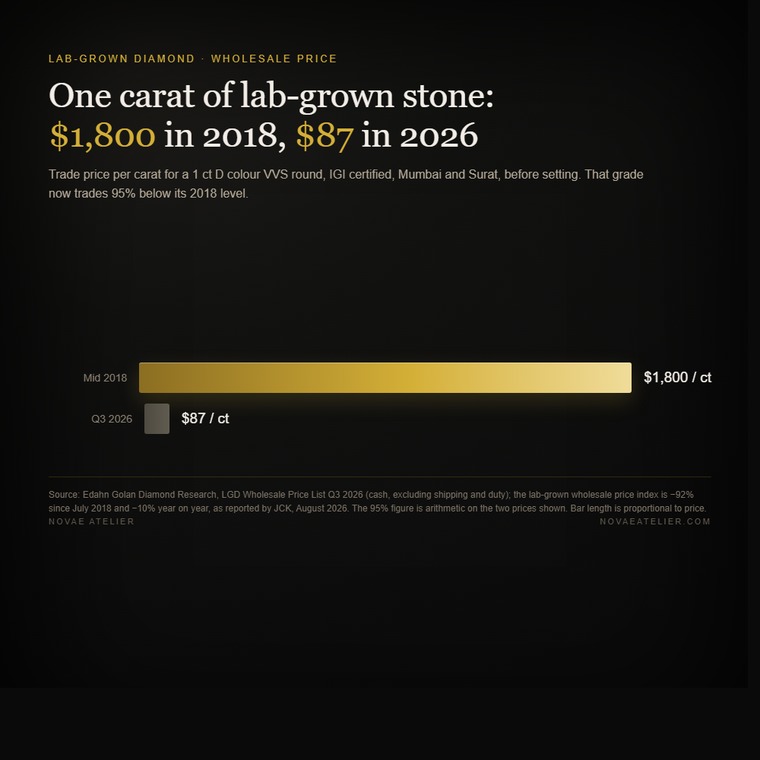
What changed after 2018 was volume. Capacity expanded, growers competed, and wholesale lists published the competition. Edahn Golan's LGD Wholesale Price List puts IGI-certified 1–3 ct rounds at $73–$142 per carat in Q3 2026; the 1 ct D colour VVS grade is $87, against $1,800 in mid-2018. The index is −92% since July 2018 and −10% year on year.
The quarterly detail is the useful part. JCK, 10 August 2026: 2025 −26%, Q1 2026 −14% year on year, Q2 −13%. Edahn Golan's Q3 2026 list has Q3 up 2% — 1 ct +1.3%, 2 ct +2.3%, 3 ct +7.5%, while 1.5 ct fell 3%. A market can bounce for a quarter and still be down 92% over eight years. If a seller calls the +2% a floor, ask for the eight-year line.
Wholesale is not retail, and retail is an asking price
Retail moves in steps: a shop buys months ahead, prices against what it paid, and cuts when the replacement cost hurts. StoneAlgo had 1 ct at $508, 2 ct at $1,041 and 3 ct at $1,626 on 13 October 2026, with the 1 ct average down 19.4% in three months. Read those as asking prices: nobody publishes what a lab-grown stone sold for at retail.
Mined moves the same way, later. CNBC's 26 September 2026 report, using Rapaport data, put the average 1 ct mined stone at $3,898, down 51% from $8,007 in 2021, and priced a near-colourless VVS excellent-cut lab-grown stone from $450 against $2,800–$3,200 mined. That gap is the commercial case for lab-grown, not a case about resale.
What resale actually pays
Rings.com's Lab-Grown Diamond Price Index states in October 2026 the line that should open every version of this article: there is no public transaction record for lab-grown resales. Not a thin record — none. Every percentage below is an offer, not a market price.
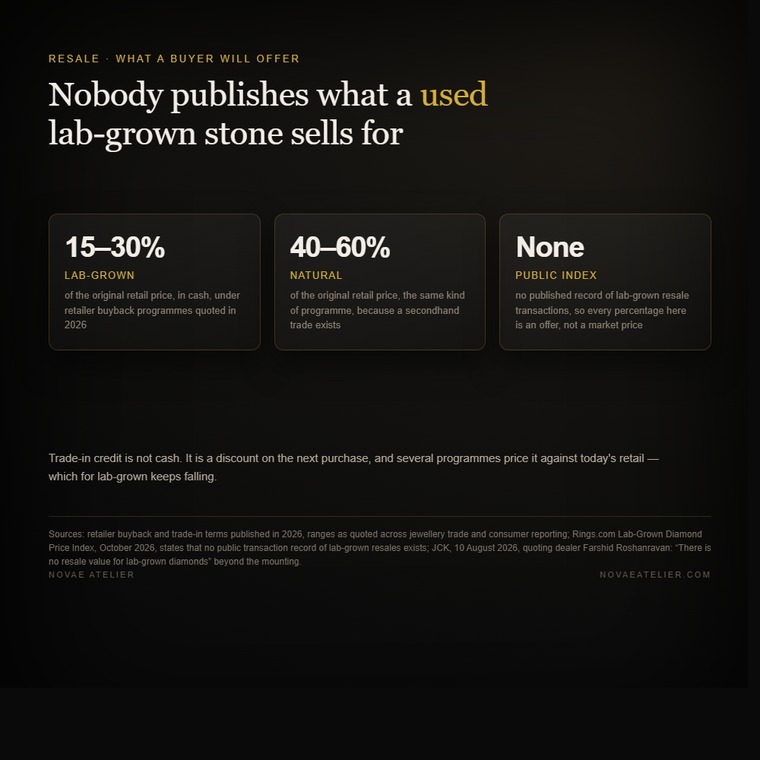
Retailer buyback terms quoted in 2026 cluster at 15–30% of original retail in cash for lab-grown, against 40–60% for mined. Trade-in credit looks better and is a different instrument: a discount on your next purchase, several programmes calculated against today's retail price — which, for lab-grown, is the number that keeps falling.
The trade says it more bluntly. JCK, 10 August 2026, quoting dealer Farshid Roshanravan: “All that I could explain was that the resale value only exists for the mounting... There is no resale value for lab-grown diamonds.” The mounting is metal and labour; the stone is the part a dealer will not price.
Who is buying them
The Knot Worldwide's Real Weddings Study 2026, released 18 February 2026, surveyed 10,474 US couples married in 2025. 61% of their engagement rings had a lab-grown centre stone — 12% in 2019, 52% in 2024, a 239% rise since 2020. Average centre stone 1.9 ct, both origins; average ring spend $4,600, down from $5,200 the year before; 40% said a lab-grown centre mattered to them.
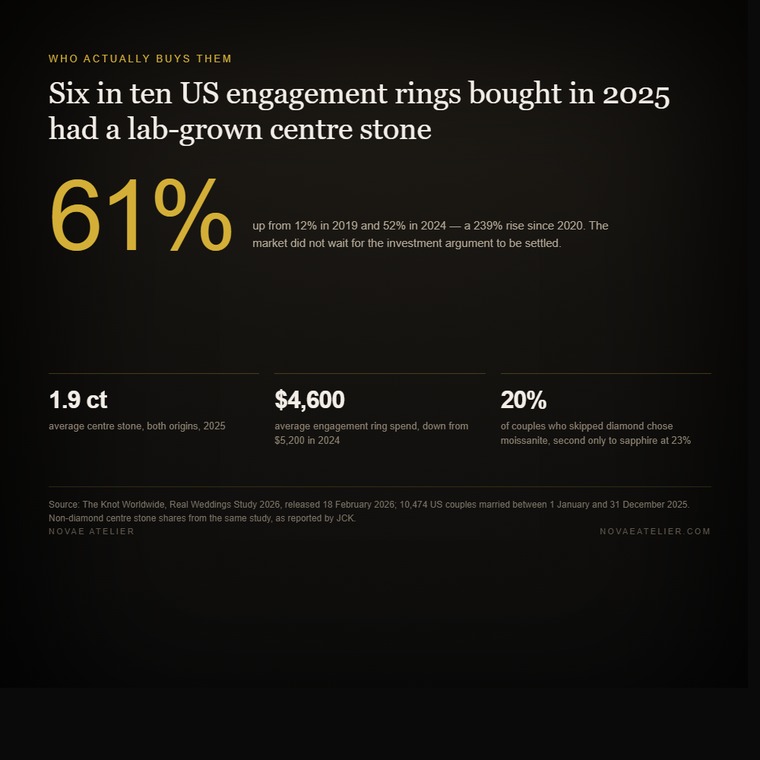
Couples who chose lab-grown spent $4,300 on average; those who chose mined spent $7,000, per IDEX citing the same study. Among couples who skipped diamond entirely, 20% chose moissanite, behind sapphire at 23% — a material that is openly not diamond and claims no asset value.
When it is worth it, and when it is not
Worth it:
- You are buying something to wear. A ring you put on every morning returns its value in mornings.
- You want size on a fixed budget. A 3 ct lab-grown stone averages $1,626 at retail.
- You would rather spend on the setting or the wedding. Couples who chose lab-grown still spent $4,300 on the ring.
- You are not planning to sell it. Gift, anniversary, self-purchase.
Not worth it:
- You are buying it to hold value. The cash offer is 15–30%, and the published market is nothing.
- You may sell within a few years. You would sell into a price down 92% in eight years, with no index to quote.
- You are paying a premium for paperwork. A certificate identifies a stone; it does not underwrite a price — the argument in what a certificate proves.
The third road: the same size for a different sum
Here we stop being neutral. NOVAE ATELIER sells moissanite — silicon carbide, not carbon, and not a lab-grown diamond. Under 16 CFR 23.12 the word diamond needs a qualifier for anything that is not diamond; for moissanite none fits. The material itself is in what is moissanite, the three-way is moissanite vs CZ vs lab diamond, and a self-check is three checks you can run at home.
What that buys at our prices — finished pieces in 925 sterling silver, setting included:
| Piece | Variant price |
|---|---|
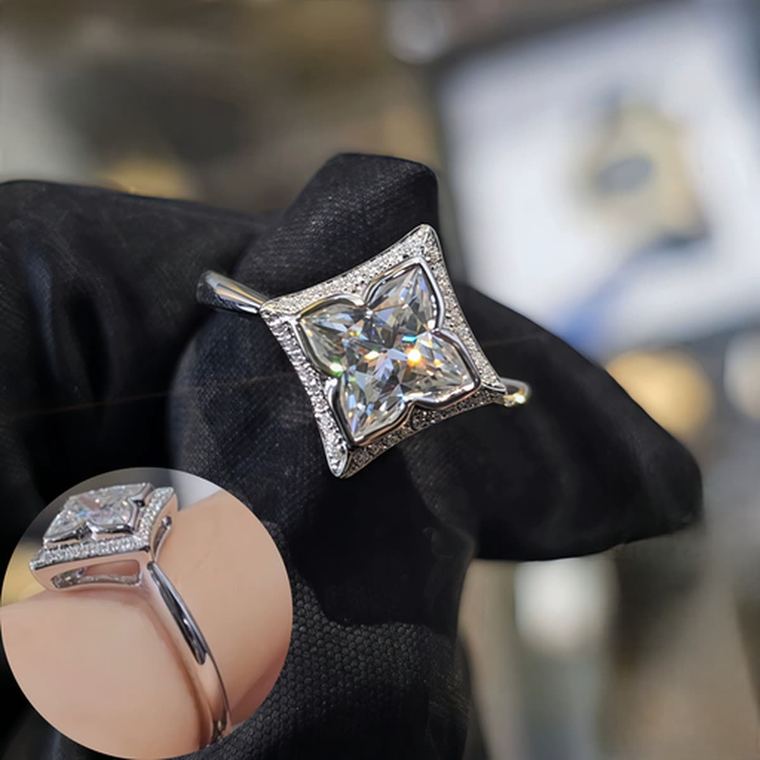
| Moissanite Solitaire Ring, 2 ct (NOV-RG-1070) | 1.2 ct $129 · 2 ct $149 |
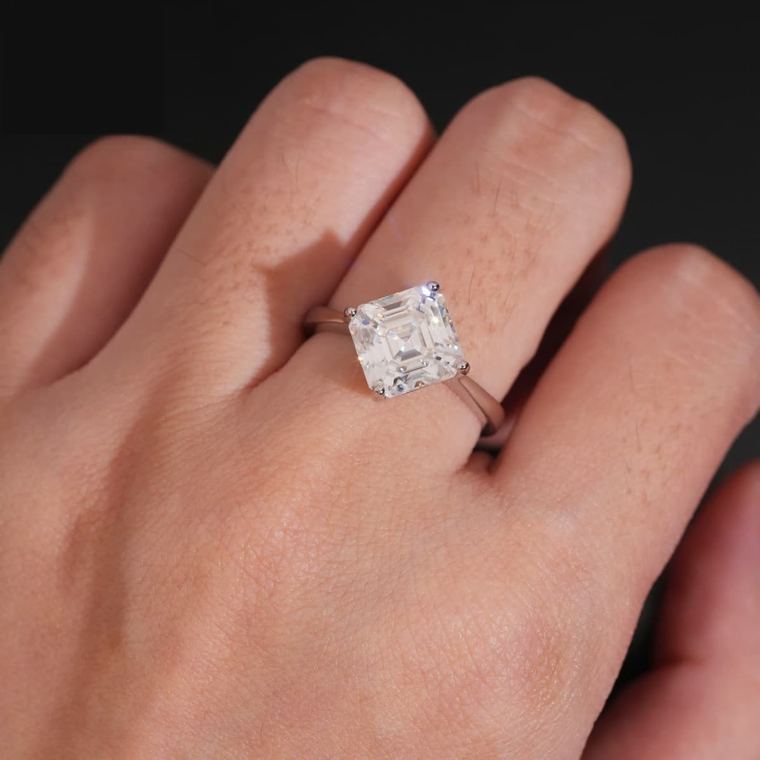
| Solitaire Asscher Ring (NOV-RG-1017) | $108 |
| 4-Prong Solitaire Studs (NOV-EA-4740) | 0.1–2.0 ct $29 a pair · 3 ct $39 · 5 ct $44 |
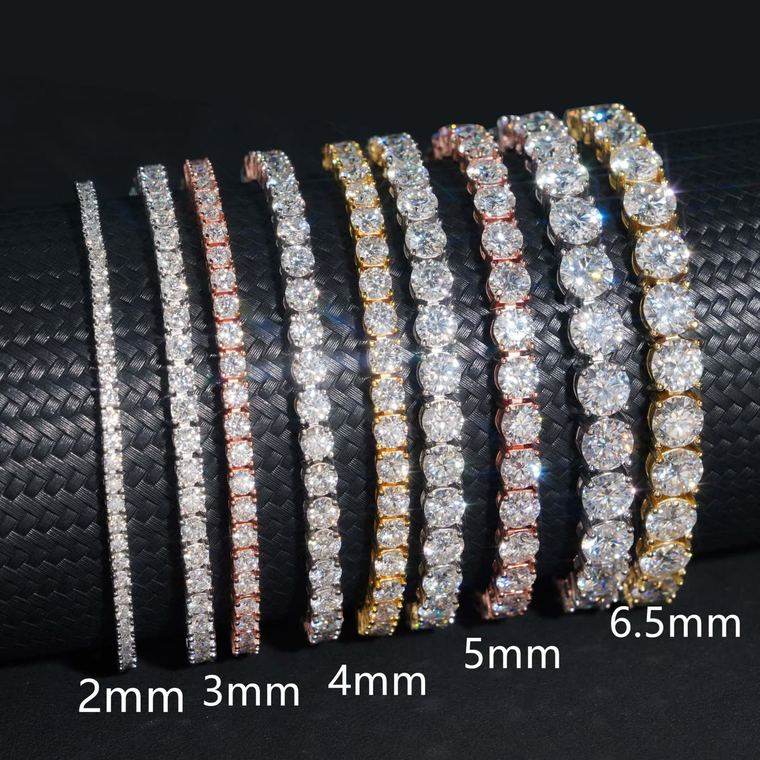
| 2mm Tennis Bracelet (NOV-BR-1006) | 6.5 or 7 in $99 · 7.5 in $109 · 8 in $119 |
| Teardrop Pendant Necklace (NOV-CH-9855) | 0.60 ct $29 · 2 ct $39 |
Our catalogue, variant prices in USD, 9 November 2026, per finished piece. Not comparable line-for-line with the table above: those are loose stones before setting. The comparison that holds is order of magnitude, not percentage.
A 2 ct moissanite solitaire in silver is $149 finished. A loose 2 ct lab-grown stone averages $1,041 before anyone sets it. Both figures are real, neither stone is an asset, and the difference is what you are choosing. Cost by size is in the ring cost guide and the tennis bracelet cost guide.
The bracelet is the same arithmetic: one row of individually set stones, where a cheaper centre stone changes the total least.
Six questions to ask before you pay
Copy these into the chat window. They take two minutes and they separate a comparable quote from an anecdote.
- Is this the stone or the finished ring? Get one all-in total.
- Which laboratory, and does the report number check out on its own site? Never the seller's page.
- Is the quote held, and for how long? An expiry date is information.
- Is the buyback cash or credit, and against which price? Three promises, one percentage.
- What happens to the mounting in a resale? That answer is the deal.
- Who is the buyer? A named index, auction house or dealer.
Weighing a Lab-Grown Quote Against Ours?
Send the quote — carat, colour, clarity, certificate number and the all-in price. We will tell you what it is per carat, what the setting adds, and what a comparable size costs in moissanite.
Ask on WhatsAppFrequently asked questions
Is a lab grown diamond worth it?
As jewellery, yes: 61% of US engagement rings bought in 2025 had a lab-grown centre stone. As an asset, no: 1 ct D colour VVS fell from $1,800 a carat in mid-2018 to $87 in Q3 2026, and cash buybacks run 15% to 30% of retail.
Do lab grown diamonds hold their value?
No, and there is no market that would let them. The Rings.com index states in October 2026 that no public transaction record of lab-grown resales exists. Buyback offers run 15% to 30% of retail in cash, against 40% to 60% for mined; trade-in credit is a discount, not money.
Why are lab grown diamonds so cheap now?
Because the stone is a manufacturing output, not a geological accident. Capacity expanded, growers competed, and wholesale lists published it. IGI-certified 1 to 3 ct rounds sit at $73 to $142 per carat in Q3 2026; 1 ct D colour VVS is $87, against $1,800 in mid-2018, and the index is down 92% since July 2018.
Is moissanite a lab grown diamond?
No. Moissanite is silicon carbide; a lab-grown diamond is carbon, grown in a reactor, and still diamond. US rules require a qualifier before the word diamond for anything that is not diamond, and for moissanite no qualifier fits. We sell moissanite, not lab-grown diamond.
Are lab grown diamonds real diamonds?
Yes. Same carbon, same crystal structure, same hardness. That is why US rules require the qualifier, so the word is not used unqualified for a stone grown in a reactor. What differs for a buyer is price history and resale: mined has a secondhand trade, lab-grown has offers.
Sources, accessed 9 November 2026: Edahn Golan, LGD Wholesale Price List, Q3 2026 — edahngolan.com; JCK, 10 August 2026, for the 2025 close, Q1–Q2 2026 and the Roshanravan quote — jckonline.com; StoneAlgo index, 13 October 2026 — stonealgo.com; CNBC, 26 September 2026, citing Rapaport — cnbc.com; The Knot Worldwide, Real Weddings Study 2026, 18 February 2026, 10,474 couples — theknotww.com; IDEX Online, for $4,300 against $7,000 — idexonline.com; Rings.com, Lab-Grown Diamond Price Index, October 2026; retailer buyback and trade-in terms published in 2026; 16 CFR 23.12 — law.cornell.edu. Second-table prices: our catalogue, 9 November 2026, USD, per finished piece.