Moissanite vs Cubic Zirconia: How to Tell Them Apart
Short answer: under a 10x loupe, on a stone big enough to read, a moissanite's back facets show as two offset lines. CZ shows one. Out of the box, by eye, a new moissanite and a new CZ look the same — what you can read is weight, edge wear and fire.
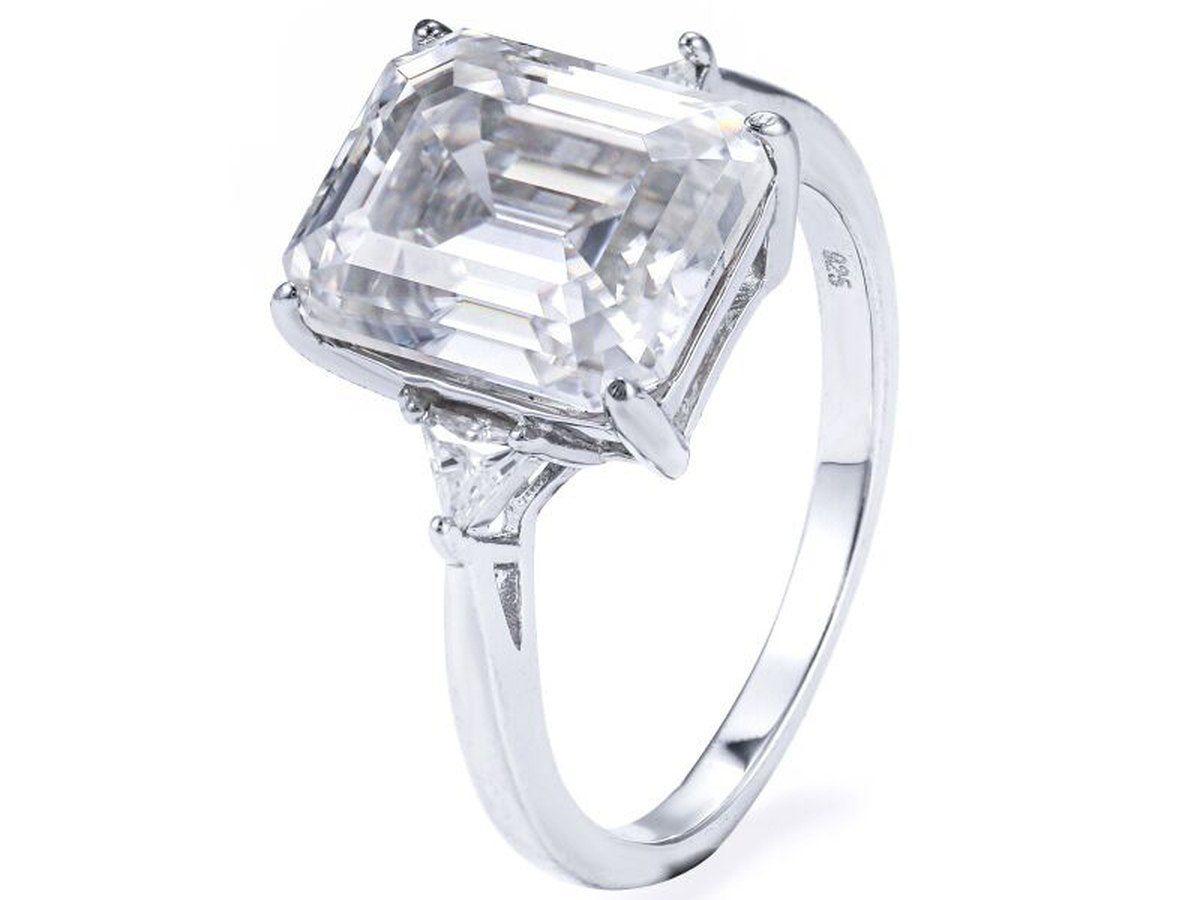
That is the opposite of how this comparison is usually sold. Most pages argue about which stone is worth buying; this one is about identifying what is already in your hand: four checks that work, three that do not, and an honest line about what none of them can tell you. Moissanite is silicon carbide, CZ is zirconium dioxide. The material itself is covered in what moissanite is.
The 30-second comparison
Seven properties, two materials. The last column is what most charts leave out: what each number lets you do at home.
| Property | Moissanite | CZ | The check it gives you |
|---|---|---|---|
| Composition | Silicon carbide (SiC) | Zirconium dioxide (ZrO2) | Nothing visible |
| Mohs hardness | 9.25 | 8.0–8.5 | Facet edges after months of wear |
| Refractive index | 2.648–2.691 | 2.15–2.18 | Brilliance — a look, not a test |
| Dispersion (fire) | 0.104 | 0.058–0.066 | Rainbow flashes, side by side |
| Specific gravity | 3.17–3.22 (GIA: 3.20–3.24, a second set of measurements in the same paper) | 5.56–6.00 | Weight in the hand |
| Birefringence | 0.043 — doubled back facets | None, single refraction | The 10x loupe, at the girdle |
| Thermal conductivity | Close to diamond | Low | A heat probe, which mislabels one of them |
Figures: GIA, Gems & Gemology, Winter 1997, and the International Gem Society comparison chart. Full sources at the foot of this page.
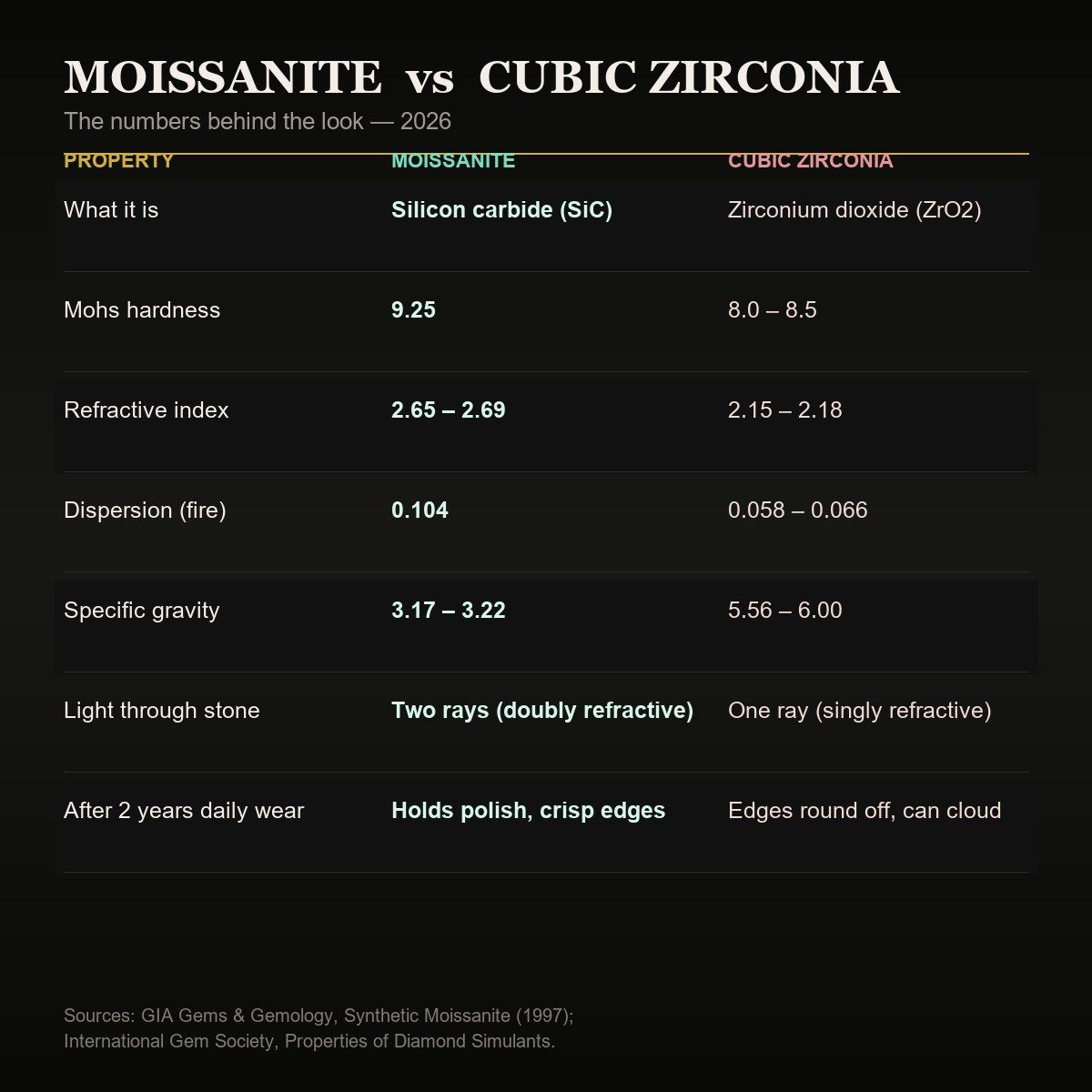
Read the birefringence row first. It is the only line there that gives a yes-or-no answer with a tool cheaper than a pair of earrings.
Why they look different in the first place
Light entering a stone is either returned to your eye or lost out the back. Refractive index measures how hard the material bends it: 2.648 to 2.691 for moissanite against 2.15 to 2.18. A higher index means more internal reflection, and more light coming back through the crown.
Dispersion measures how far it splits white light into colour: 0.104 against 0.058 to 0.066, close to twice as much. That split is the rainbow flash people call fire.
Together they explain the look buyers describe without knowing why. Moissanite reads brighter and throws colour further; CZ reads flat and white and barely changes as you tilt it. At arm's length in daylight, that is a mood, not a measurement.
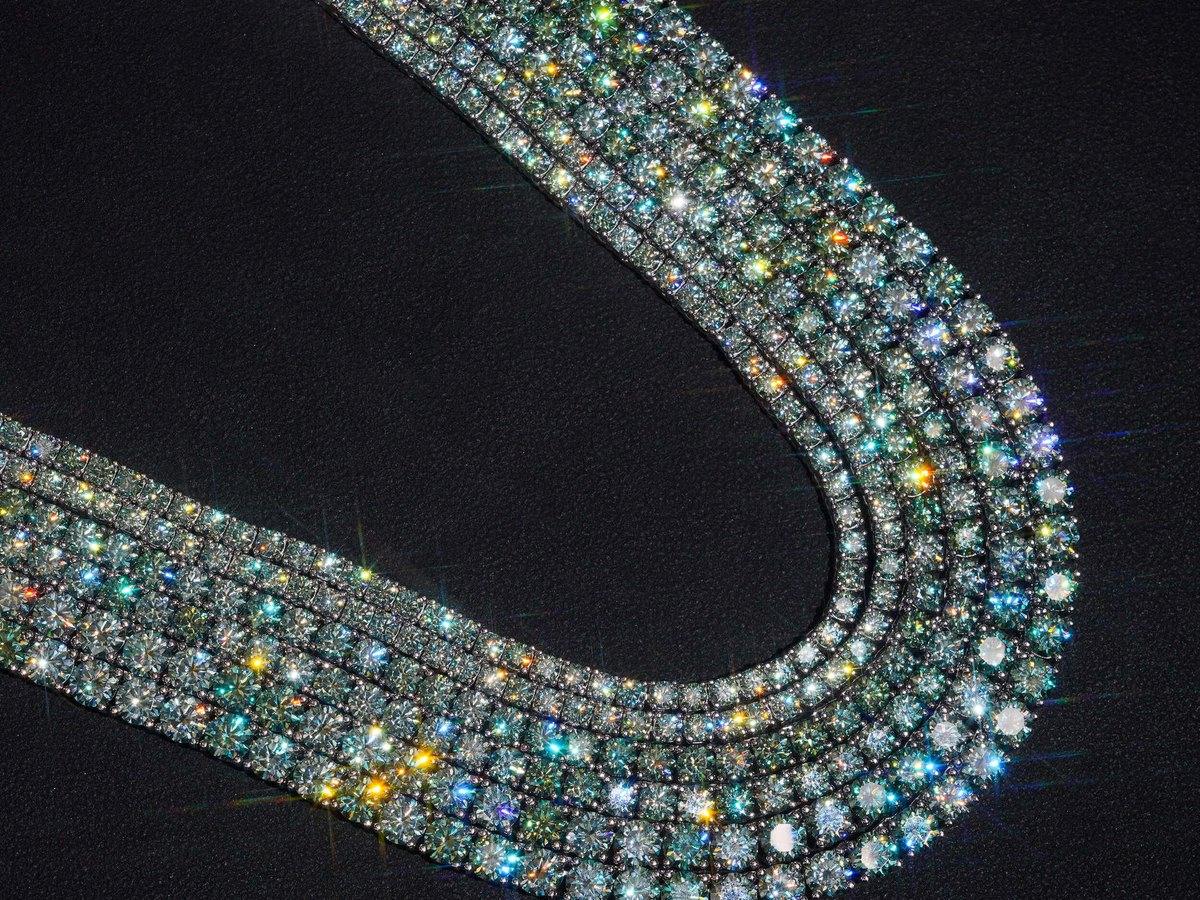
Which is where honesty costs us. On a pavé row — the 3, 4 and 5mm stones on a typical tennis chain — there is not enough facet on any one stone to read the difference from a metre away. Anyone who claims they can spot a CZ row across a room is guessing, or reading the setting rather than the stone.
Check 1 — Weight
Specific gravity is mass per volume, and the gap is not subtle: 5.56 to 6.00 for CZ against 3.17 to 3.22 for moissanite. At the same diameter a CZ weighs about 1.8 times as much.
That is the one test your hand can run alone. Two stones of the same diameter, one in each palm: the CZ is the one that feels filled with something, and jewellers use it as a first filter.
Two limits: a mounted stone is not a loose one, a closed-back setting hides the pavilion, and weight measures density rather than identity. Use it to build a suspicion, then confirm with the loupe.
Check 2 — The loupe
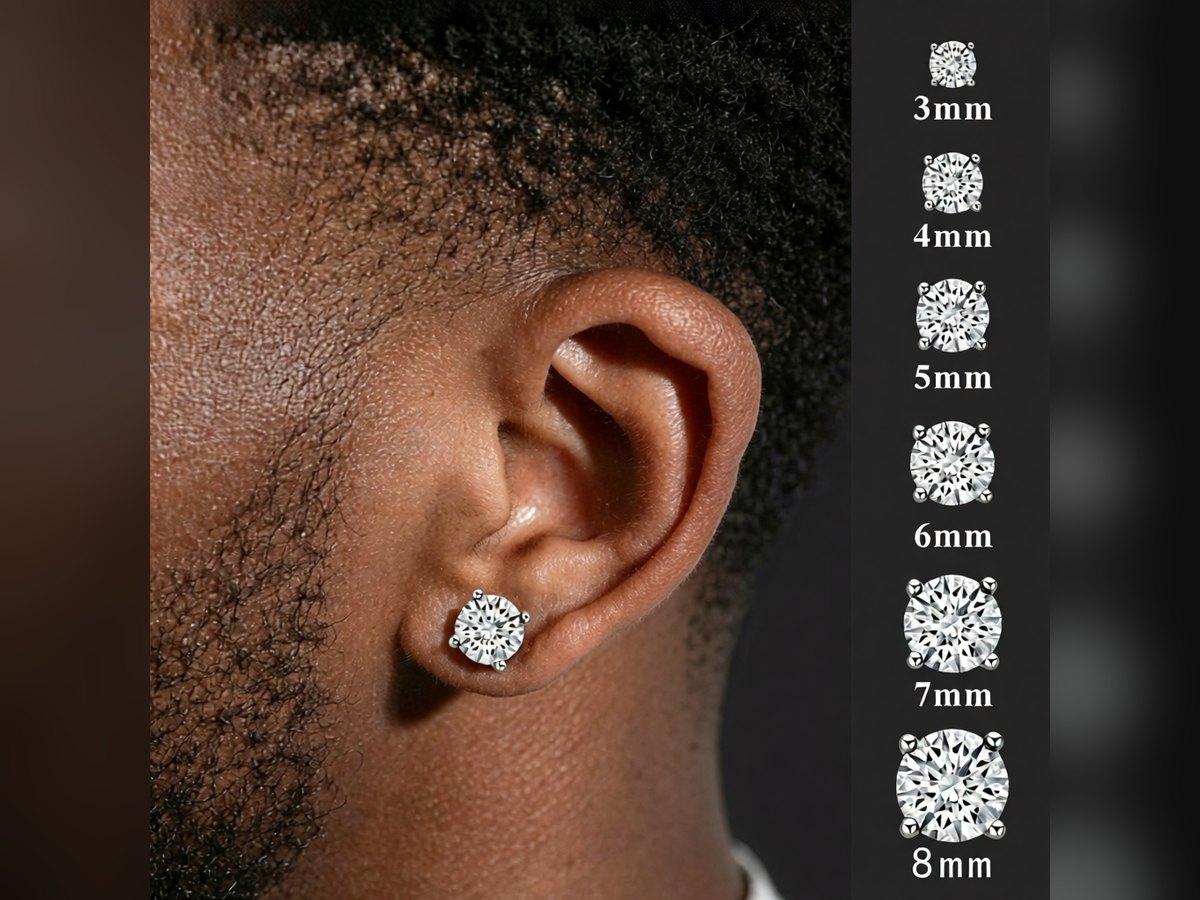
This one is decisive only on a single stone large enough to read — say 5mm and up. On a pavé row of 3, 4 and 5mm stones there is not enough facet on any one of them, which the pavé detail earlier on this page makes plain. Almost nobody does the check correctly even on a stone that suits it. A 10x loupe, the stone tilted, your eye on the girdle — the thin rim where the crown meets the pavilion. Not straight down through the table: face-up you see the stone as designed, tilted you see the material.
Moissanite is birefringent at 0.043. Light splits into two rays at different speeds, so the back facets reach your eye twice, slightly offset: two parallel lines where there should be one crisp edge. CZ is isotropic — one ray, one line, no ghost. The Gemology Project notes the doubling reads best obliquely through the crown, not square through the table.
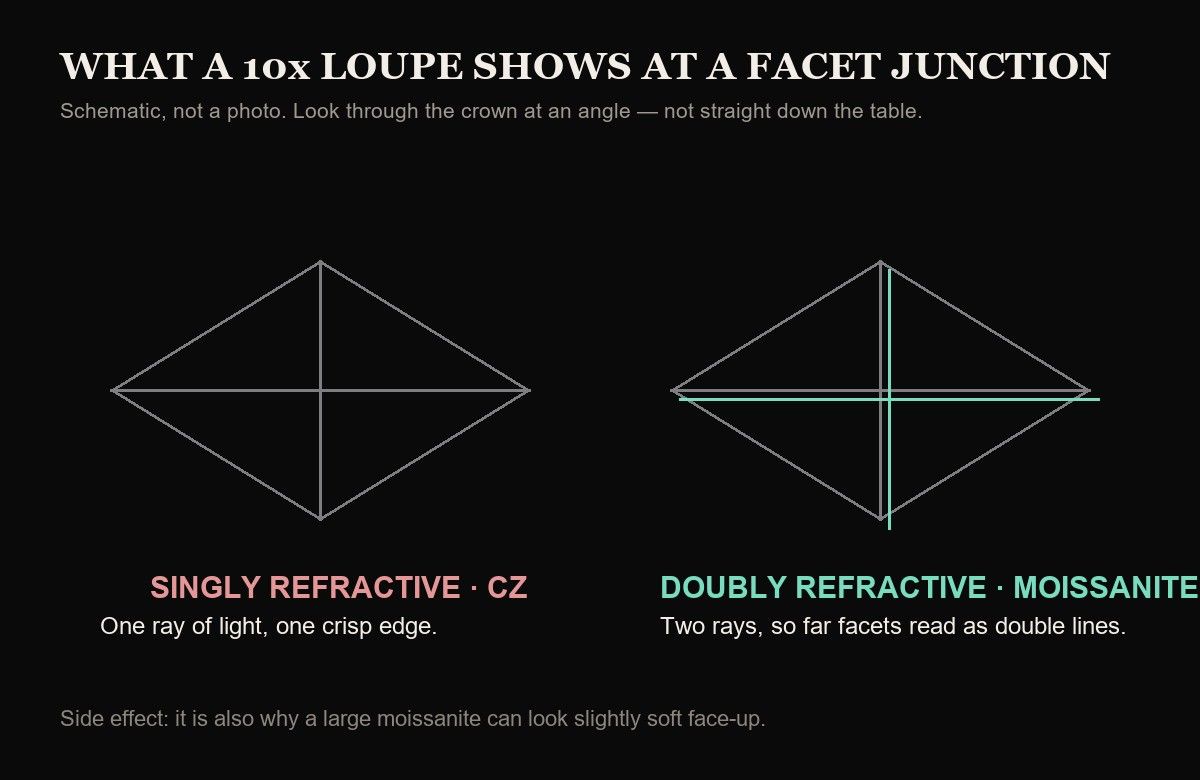
Scale and dirt defeat it. On a 1mm stone there is barely a facet to read, and skin oil scatters the light. Clean it, get within a centimetre, give your eye a few seconds: the doubling is obvious once seen. On a stone too small to show it, that absence proves nothing. Our three home checks cover what a kitchen table allows.
Check 3 — Wear over time
Hardness is not about breaking; it is about scratching. 9.25 against 8.0 to 8.5. On paper that is one step. On a ring worn every day, it is the difference between a polished facet and a rounded one.
A CZ does not fail dramatically. The facet junctions soften, the sharp line between two faces turns into a curve, the surface picks up a haze that will not wipe off, and the stone starts holding skin oil, so it looks duller every week. A moissanite holds its polish for years, and after long wear its edges are still edges.
Which makes second-hand more informative than the shop counter: a worn piece is a material test that has already run itself. Ask for a macro photograph of the facet edges.
Check 4 — Fire and colour
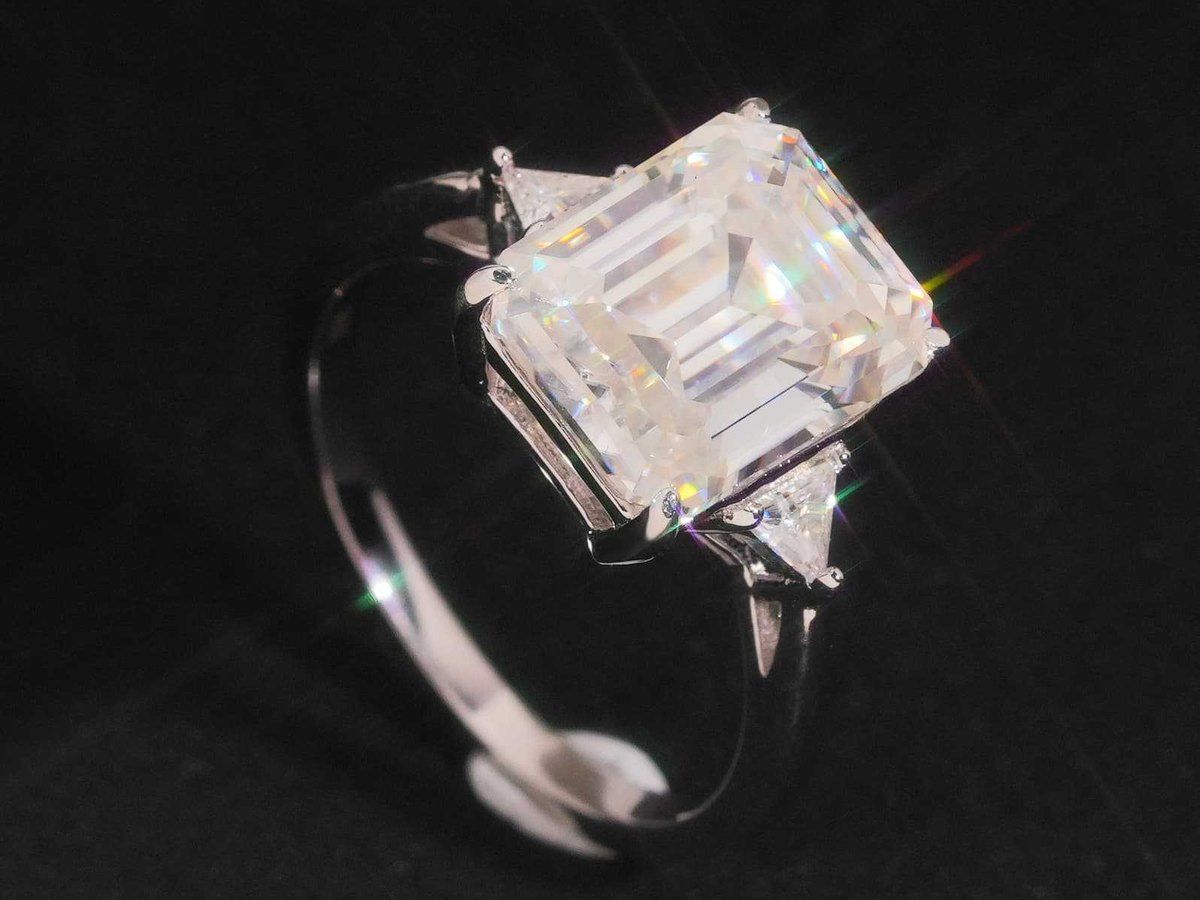
Dispersion is the number behind the look. Moissanite throws more rainbow, and further: longer, more saturated flashes that carry into indoor light where a CZ goes quiet. Many stones read slightly warm, some with a faint green or yellow cast. CZ is whiter and colder — a bright surface rather than a fire.
Two caveats. Colour cast varies between stones, so “slightly warm” is a tendency, not a charge you can convict a stone with. And fire is directional: a still photograph flattens it, which is why the clip below does more than any picture.
Three tests that do not work
The breath test. Fog clears fast on a good conductor, so this is a thermal test run on your breath, and a poor one: a small stone fogs for under a second, a warm room changes the result, a film of oil changes it again.
The water drop test. A drop should sit up on a high-index stone. In practice it reads the surface: cleanliness and one fingerprint decide the result before the material gets a vote.
A heat-only diamond tester. The one that produces confident wrong answers. Moissanite conducts heat close to how diamond does, so the probe lights up green; CZ conducts poorly, so the same probe reads it as not-diamond. The device separates the two stones while naming one of them incorrectly, and if your question was “is this moissanite?” a green light is not an answer. Testers that also measure electrical conductivity can identify moissanite as moissanite — more in why moissanite passes a diamond tester.
What this means at our prices
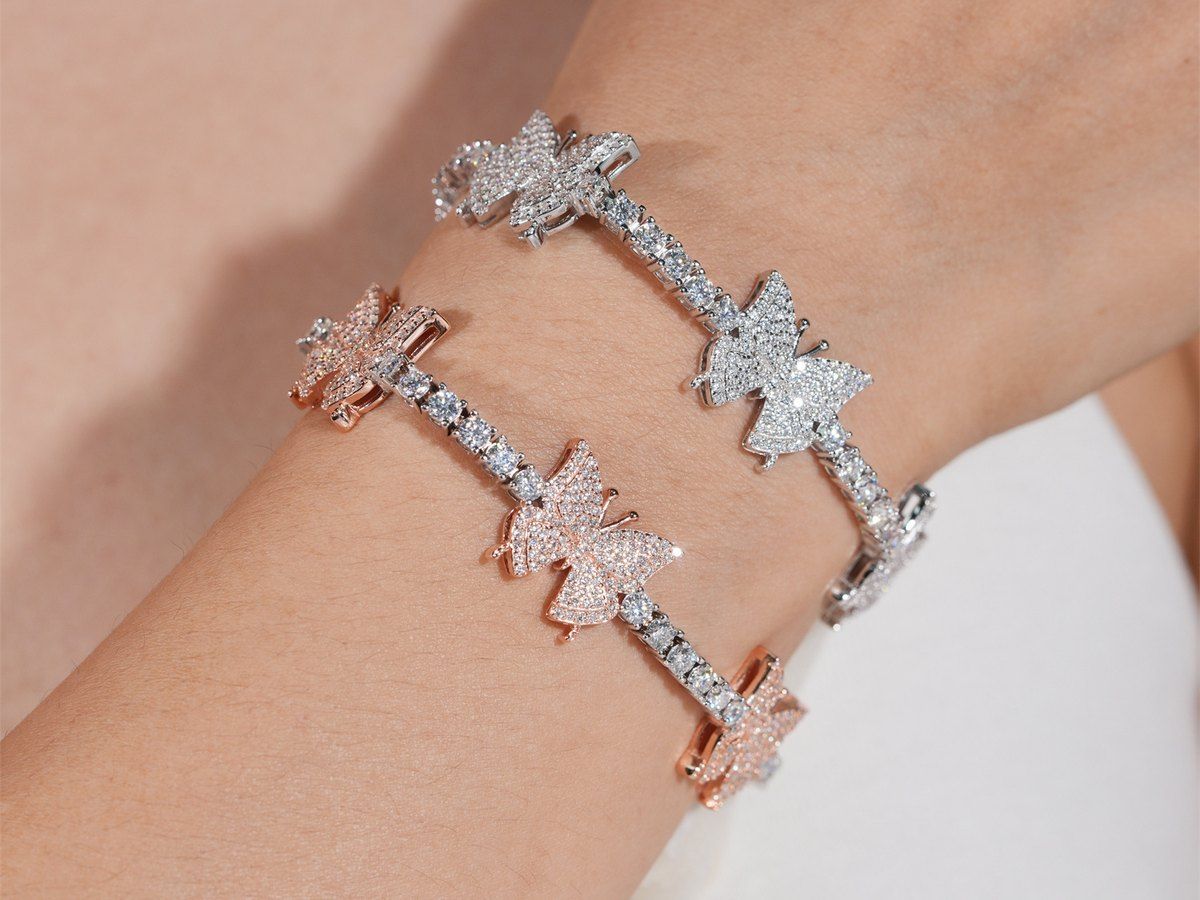
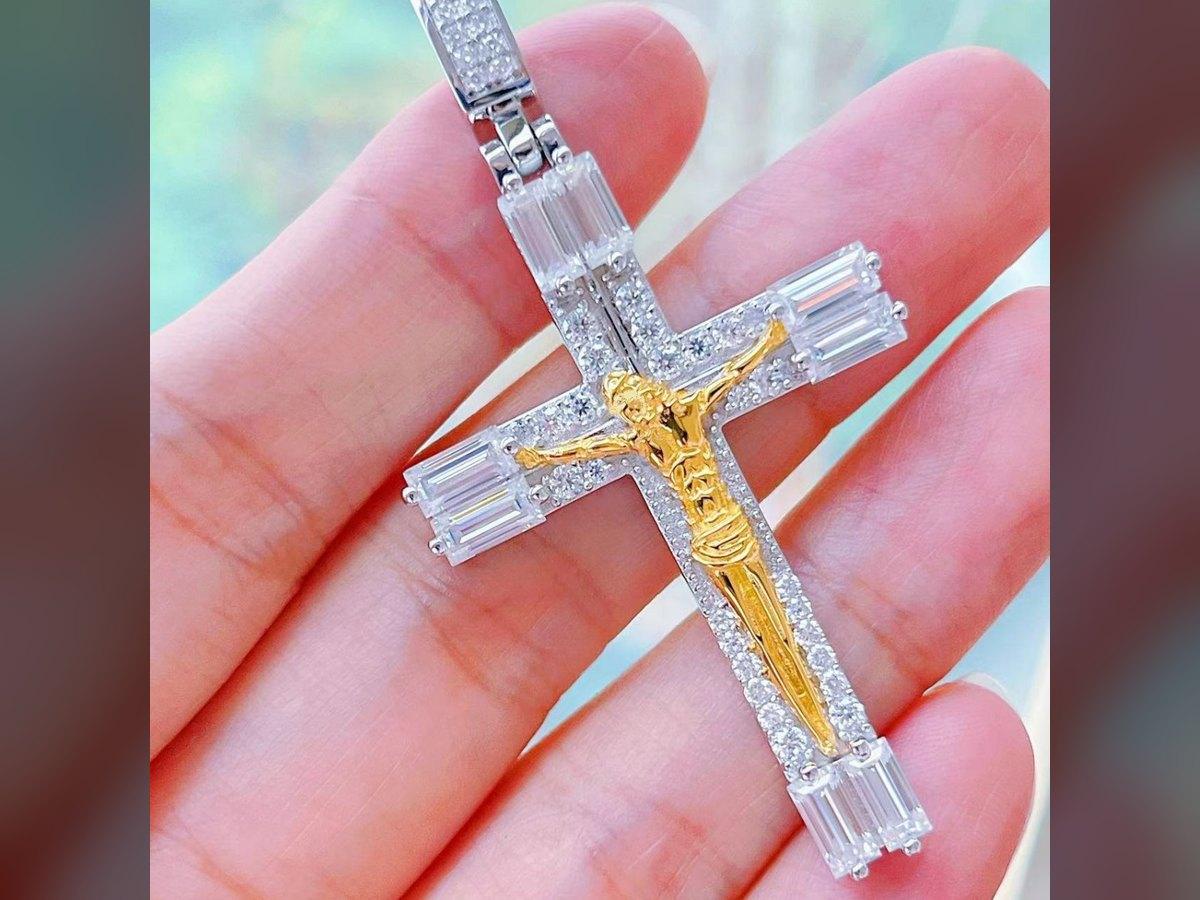
Our catalogue makes the argument concrete. Four-prong studs in 925 sterling silver are $29 in 0.1–2ct, $39 at 3ct and $44 at 5ct. A 3ct emerald-cut ring in silver is $149. A blue-green moissanite tennis chain is $119. A 3mm butterfly tennis bracelet runs $189 to $252 by length. A 47×32mm cross pendant is $219.
At those numbers the stone is not where the money is; silver and bench time are. Which is why the budget argument is weaker than it looks: the saving lands on the component that is already the smaller line on the bill, while costing you the one thing you cannot restore — the surface.
It is also why we describe our stones accurately and stop there. The paperwork we issue with a piece is a CoA — material and construction — not a grading report. The top of the market is a different question: moissanite against lab-grown and natural diamond.
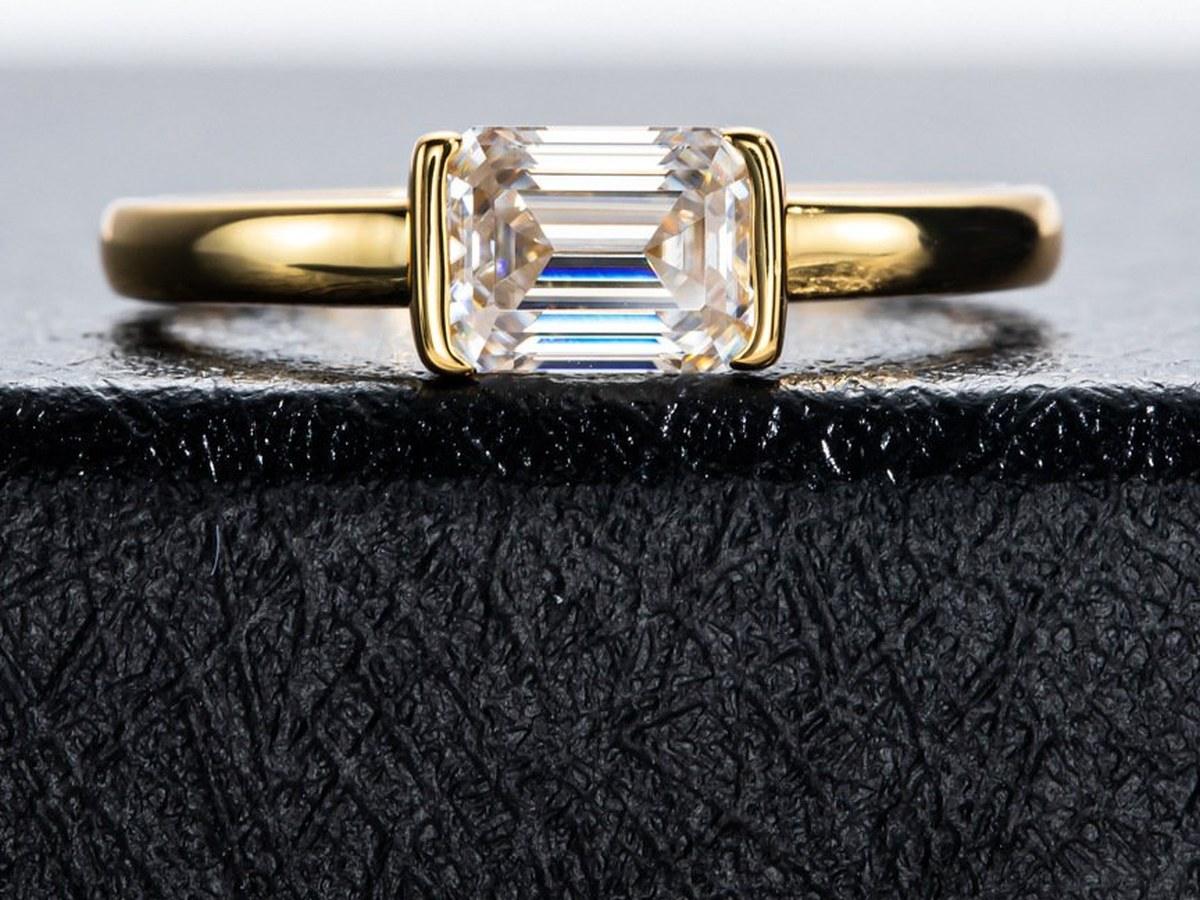
The two stones are not separated by beauty. They are separated by a number you can look up, a weight you can feel, and a surface that either survives or does not. Sizing is in the ring cost guide and the tennis bracelet cost guide; keeping silver bright is in does moissanite tarnish.
Frequently asked questions
Can you tell moissanite from cubic zirconia by eye?
Not on a new stone. Both are colourless, both are cut to much the same proportions, and the two properties that separate them — birefringence and density — are invisible at arm's length. A moissanite usually throws more rainbow fire and reads slightly warmer, but that is a tendency, not a test. On a stone large enough to read, the loupe settles it.
Is cubic zirconia heavier than moissanite?
Yes, by a wide margin. CZ has a specific gravity of 5.56 to 6.00; moissanite is 3.17 to 3.22, and the same GIA paper reports a second set of measurements at 3.20 to 3.24. At the same diameter a CZ weighs about 1.8 times as much, which is why a heavy stone is the first thing a jeweller notices.
Does a diamond tester tell moissanite from CZ?
Partly, and misleadingly. A heat-only probe reads moissanite as diamond because the two conduct heat similarly, and reads CZ as not-diamond. It separates the two stones while giving one of them the wrong name. A tester that also measures electrical conductivity can identify moissanite as moissanite.
Which one scratches more?
CZ. Moissanite is 9.25 on the Mohs scale and CZ is 8.0 to 8.5. A CZ worn daily rounds off at the facet junctions, hazes over and starts holding skin oil, while a moissanite keeps a polished surface for years. Both belong in a pouch, not loose in a drawer.
Why is moissanite more expensive than CZ?
Because making it costs more. Moissanite is grown as silicon carbide at high temperature, then cut and polished, and at 9.25 Mohs it is slow to work. CZ is cheap to produce in volume and softer to cut. The stone itself costs more to make, but on a finished piece most of the price is the silver, the setting and the bench time.
Not Sure What You Have?
Send us a clear macro photograph of the stone at an angle in daylight, with its measured diameter, and we will tell you what we can and cannot conclude from it — including when the honest answer is that we would need a loupe on the girdle.
Ask on WhatsAppSources: GIA, “Synthetic Moissanite: A New Diamond Substitute”, Gems & Gemology, Winter 1997 (composition, optical constants and specific gravity of silicon carbide) — gia.edu; International Gem Society, “Properties of Diamond Simulants” (CZ hardness, refractive index and specific gravity) — gemsociety.org; The Gemology Project, “Synthetic moissanite” (doubling reads best viewed obliquely rather than square through the table) — gemologyproject.com. Prices are our own catalogue variant prices, read 2 November 2026, in USD. Moissanite is silicon carbide, not diamond, and nothing here makes the two interchangeable. Any paperwork we supply is a CoA stating material and construction, not a grading report.
Shop the Pieces in This Guide
Made to order in our Guangzhou atelier — 925 sterling silver, hand-set moissanite.
Four of the five pieces are 925 sterling silver. The cross pendant is 925 silver with 18K gold plated details, and the butterfly bracelet comes either all-silver or in a silver-and-rose-gold two-tone; there the gold tone is a plated finish, not solid gold. The other pieces are silver only.
Where these pieces come from
Everything here is made and set on our own bench in Guangzhou — 925 sterling silver and moissanite, with gold-tone plated alloy watch cases where the listing says so. If you are buying for a store, a brand or a reseller, the wholesale pages carry the minimums, lead times and terms:
- Cuban link chains — wholesale
- Moissanite jewelry — wholesale
- Custom iced out watches — wholesale
- Private label & brand manufacturing
Retail pieces in the same workshop: 16mm Cuban link chain · 18mm iced Cuban chain · RAM iced out pendant · Iced out square-case watch