What Is Moissanite? The Complete 2026 Guide
Short answer: moissanite is silicon carbide (SiC), a lab-grown gemstone with its own chemistry, 9¼ on the Mohs scale and more rainbow fire than a diamond. It is not a diamond and it is not a fake. It is a third category, sold by the millimetre and priced as a finished piece.
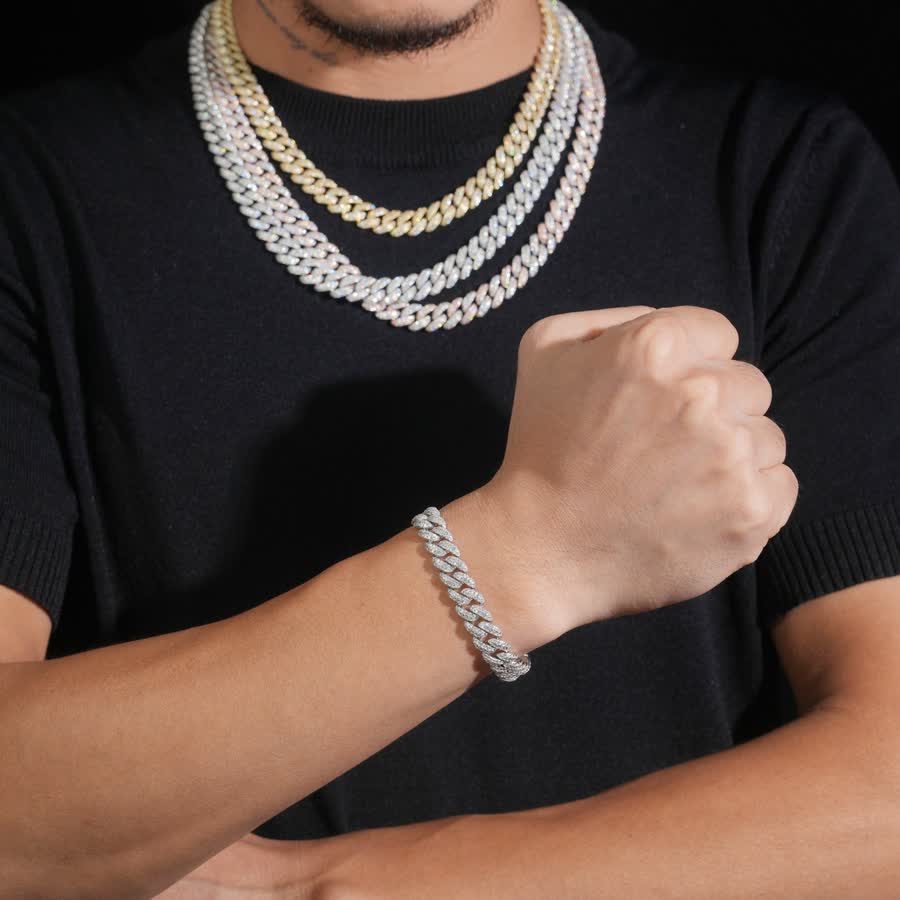
Everything below is what matters before you spend money: what the numbers mean at a counter, why the stone is sold in millimetres, where it belongs and where it does not, and what a finished piece costs.
Two disclosures first. We sell moissanite and we do not sell diamond of either origin, so every figure of ours on this page is a finished piece in 925 sterling silver. And the word diamond appears here only as a comparison or inside the phrase diamond alternative — US jewellery rules do not permit it as a name for this material, and a page that uses it has told you something about the rest of its spec sheet.
What moissanite actually is
Silicon carbide is a compound: one silicon atom bonded to one carbon atom, repeating in a crystal. That is the whole material. It is not carbon with something added, not a treated stone, and not a coating over a cheaper core. Carbon and silicon carbide are neighbours on a periodic table and behave nothing alike in a ring.
The name comes from the man who found it. In 1893 the French chemist Henri Moissan recovered silicon carbide grains from the iron meteorite at Canyon Diablo in Arizona — a meteorite, not a mine. Natural silicon carbide does exist on Earth, but in crystals too rare and too small to cut for jewellery. So the meaning of the word is a footnote in a meteorite study: the stone in a shop window is a manufactured material that carries his name.
That is why almost all moissanite in jewellery today is lab-created, including every stone we set. A laboratory grows the crystal at high temperature in a thermal process that takes weeks and ends with a crystal large enough to cut. We do not publish a temperature, a pressure or a process name, because we have not measured our supplier's run ourselves, and a number we cannot measure is a number we will not print. What we can describe is the output: a cut stone with the properties in the next section, repeatable batch after batch — and repeatability is the one real advantage a laboratory has over geology. It also explains why a fully set chain can be built at all. That format needs a steady supply of matching stones in a narrow size band, in the same colour, and a production run can supply it.
One consequence matters to a buyer. Because the material is manufactured, supply is a production decision rather than a mining one, and we ask our supplier for measured data with each batch. Ask a seller for the optical figures in writing and you will find out quickly who is working from a spec sheet and who is working from memory.
One vocabulary note, because it decides how you read a listing. Gemmology calls a laboratory-made version of a material that also occurs in nature synthetic, and that is what this is: silicon carbide exists in that meteorite, so a crystal grown in a furnace is synthetic silicon carbide. A simulant is something else entirely — a different material chosen to imitate an expensive one. Moissanite is the first and is often described as the second, which is the root of most arguments about it. A synthetic version of a material is still that material; a simulant is not.
The numbers, and what each one changes
These figures decide how a stone behaves, and they come from measurement rather than marketing. The moissanite column is from GIA's Gems & Gemology, Winter 1997, the paper by Nassau et al. that set out the material's optical profile. The diamond and cubic zirconia columns are standard reference values.
| Property | Moissanite | Diamond | Cubic zirconia |
|---|---|---|---|
| Chemistry | Silicon carbide (SiC) | Carbon (C) | Zirconium oxide (ZrO2) |
| Mohs hardness | 9¼ | 10 | 8–8.5 |
| Refractive index | 2.648 / 2.691 | 2.417 | 2.15–2.18 |
| Dispersion | 0.104 | 0.044 | 0.060 |
| Specific gravity | 3.22 | 3.52 | not quoted here |
Moissanite figures: GIA, Gems & Gemology, Winter 1997 (Nassau et al.). Diamond and CZ figures: standard gemological reference values. CZ is included for identification only; we do not sell it.
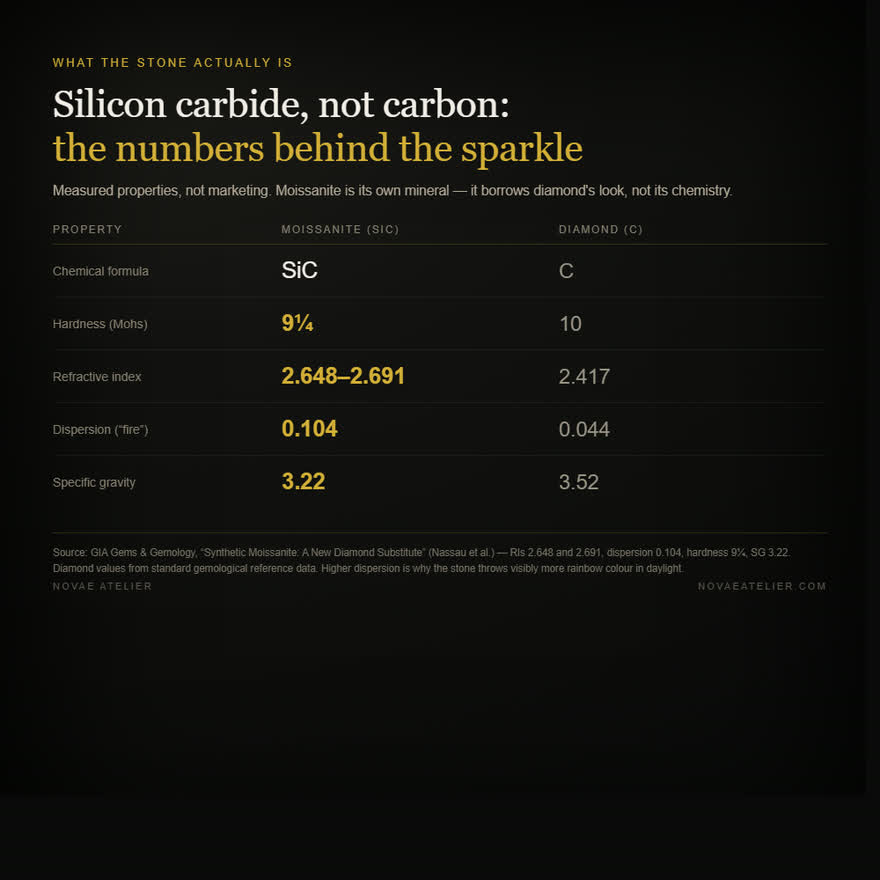
Start with hardness, because it is the line people ask about. 9¼ sits one step below diamond and above everything else worn in jewellery. In practice a moissanite does not scratch from ordinary life: keys in a pocket, coins in a tray, a stainless sink. What can mark it is another moissanite or a diamond, which is why the care section says to store pieces apart.
The refractive index pair is the detail that gives the material away. 2.648 and 2.691 are not two estimates of one value; they are two values, because light entering silicon carbide splits into two rays travelling at different speeds. Diamond's 2.417 is a single figure because diamond is not. Both moissanite figures sit above diamond's, which means a wider cone of light is bent back towards your eye instead of passing out of the back of the stone.
Specific gravity 3.22 against 3.52 looks like the dullest number here and is the one with a commercial consequence. The same diameter in moissanite weighs less than in diamond, which is why the trade sells it by the millimetre and why a scale tells you less than a pair of callipers. Hold that thought; it is the whole of the next-but-one section.
Why it throws more colour than a diamond
Dispersion is the number that produces the rainbow. It measures how far a material spreads white light into its component colours, and 0.104 against 0.044 is more than twice the spread. In flat office light you will not notice. Under a downlight, in a car at noon, or on a phone flash at dinner, the stone throws coloured flashes across the room in a way a colourless diamond does not.
The second optical fact is birefringence, and it is the free test. Because light splits into two rays inside the stone, a loupe at ten power shows a doubling of the back facets: every sharp edge at the bottom of the stone reads as two lines with a small gap, and the gap widens as you tilt the piece. On a diamond the same junction stays a single line at every angle. It is not a flaw, it is what the crystal does, and a normal product photo will not show it.
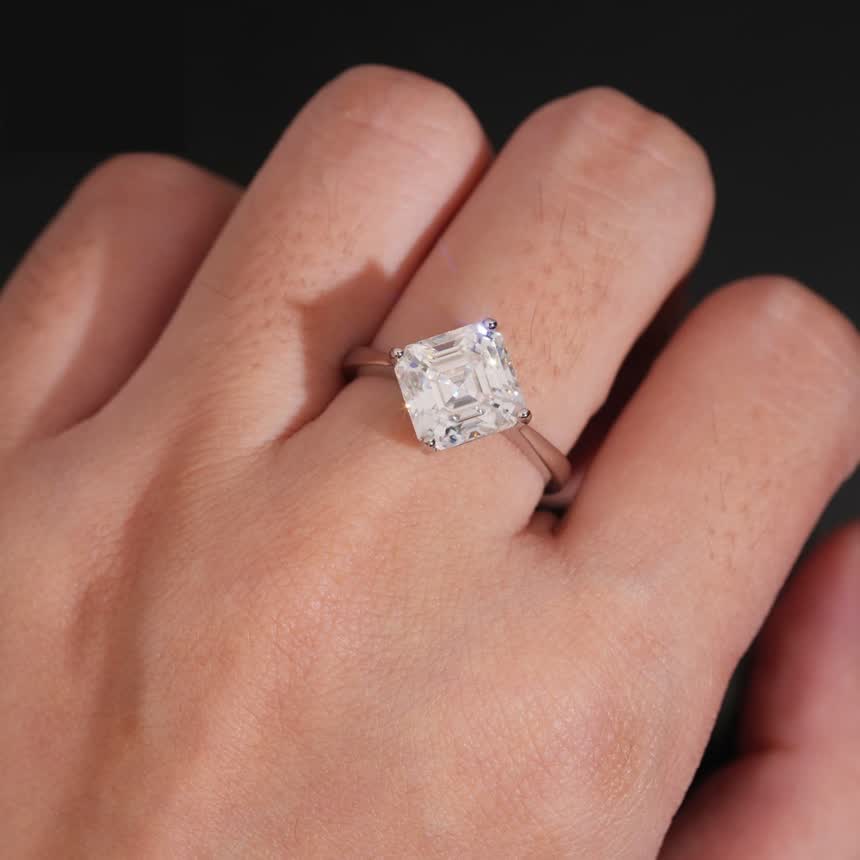
Does more fire look better? Brand view, labelled as one: on a fully set chain at 8mm, yes — the point of that piece is the light coming off it. On a single small stud it is a preference, not an upgrade. Some people want the neutral white sparkle of diamond and find the rainbow distracting; if you are one of them, this is the wrong stone and no price advantage repairs a taste mismatch. And the difference is not visible in every condition. Dispersion shows in direct, point-source light; in flat daylight the two stones look closer than the numbers suggest.
Moissanite vs CZ vs lab-grown vs natural
Four materials get compared in the same breath, and only two of them are diamond. This is the table to screenshot before you shop, because most confusion in this category is a category error rather than a bad stone.
| Moissanite | Cubic zirconia | Lab-grown diamond | Natural diamond | |
|---|---|---|---|---|
| Material | Silicon carbide | Zirconium oxide | Carbon | Carbon |
| Hardness | 9¼ | 8–8.5 | 10 | 10 |
| Refractive index | 2.648 / 2.691 | 2.15–2.18 | 2.417 | 2.417 |
| Dispersion | 0.104 | 0.060 | 0.044 | 0.044 |
| Grown in a lab | Yes, almost always | Yes | Yes | No |
| Is it diamond | No | No | Yes, with a qualifier | Yes |
Same sources as above. We sell the first column. We do not sell cubic zirconia, lab-grown diamond or natural diamond.
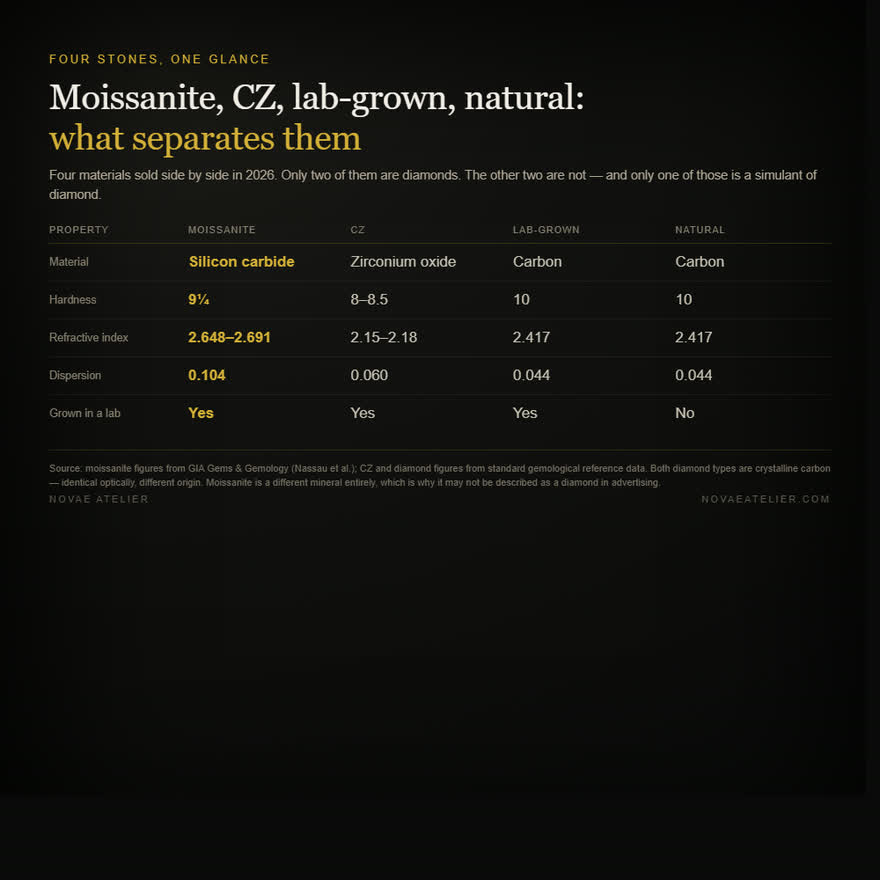
Lab-grown and natural diamond are the same material — carbon, hardness 10, refractive index 2.417, dispersion 0.044 — and differ only in where the crystal formed. They behave very differently on price history and resale, which is a separate argument we have made in whether a lab-grown diamond is worth it.
The two that are not diamond are not the same problem either. CZ is a simulant: an inexpensive material made to stand in for an expensive one, softer at 8–8.5 and less dispersive at 0.060, and it hazes as a softer surface picks up abrasion. Moissanite is not standing in for anything. It is silicon carbide, a material with its own measured properties that happens to be colourless and highly dispersive, so it looks like a diamond without claiming to be one. The trade phrase for that position is diamond alternative, and it is the accurate one.
The legal line matters more than the vocabulary. Under the FTC Jewelry Guides, 16 CFR 23, the word diamond may not be used for a material that is not diamond. That is why this page never uses it as a name for the stone. The three-way optical comparison is in moissanite vs CZ vs lab-grown, and the two colourless materials head to head are in moissanite vs lab-grown diamond.
How it is sold: millimetres, not carats
Diamond is sold by weight and the weight drives the price. Moissanite is sold by diameter, and the reason is the specific gravity figure: 3.22 against 3.52 means a moissanite of a given diameter weighs less than a diamond of the same diameter.
So a phrase like 1 carat moissanite is shorthand, not a measurement. It means a stone cut to the diameter of a 1 carat diamond — the same face-up size on the hand, at a lighter weight. Our chains and bracelets are listed by width in millimetres; the teardrop pendant is listed by its diamond-equivalent weight, 0.60 ct and 2 ct — the same shorthand, not a scale reading. We do not print a carat-to-millimetre table, because cutters vary in depth and girdle and a table we have not verified against our own stock would be a guess wearing a spec sheet.
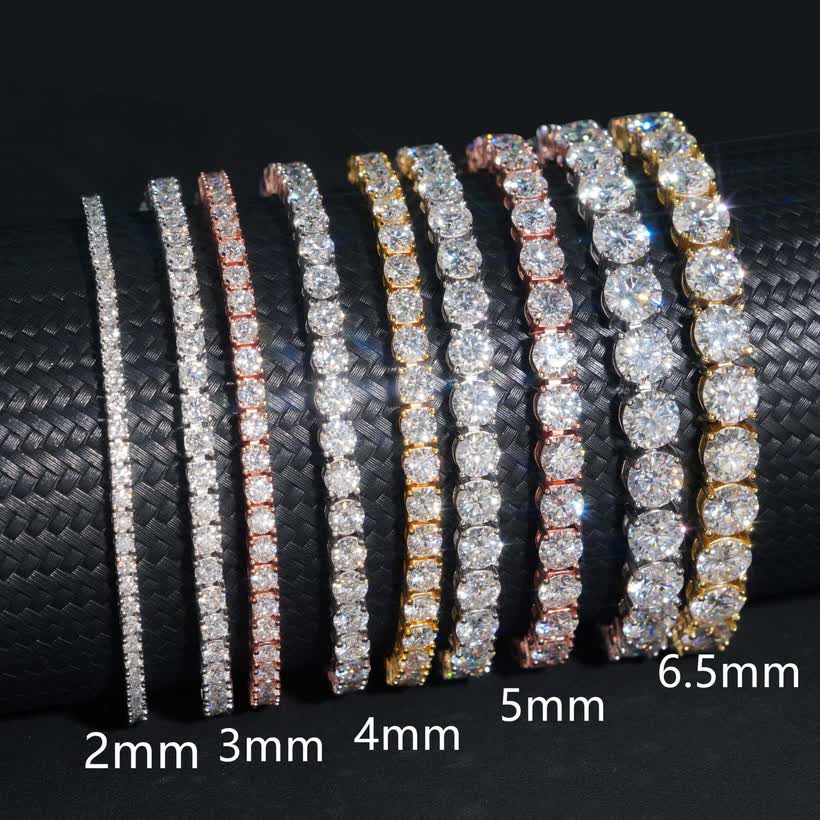
Width also changes stone count, which no size chart shows. A bracelet at 2mm has a single row of small stones; the same bracelet at 6.5mm has a much wider face, and the setter is placing stones across that width at every station along the length. Width and length move together, both are measured in millimetres and inches, and neither is a weight. That is why a total-carat figure is not comparable to a millimetre figure, even when two pieces look alike in a photograph. Sizing by format is in the tennis bracelet cost guide and the earring size guide.
Does it pass a diamond tester?
Often yes, on the wrong tester, and that is where most of the confusion comes from. Silicon carbide conducts heat well enough that a thermal probe reads it as diamond, and a standard heat pen is built to detect exactly that: heat moving away from the tip. Touch one to a moissanite and it lights up the way it does on a diamond.
The instrument that separates them measures a second property. Silicon carbide conducts electricity; diamond does not. A multifunction tester that checks electrical conductivity alongside the thermal reading will call a diamond diamond and a moissanite moissanite, which is why the serious version costs several times what the pen costs. Two things follow. “It passed the diamond tester” is not evidence of anything, because passing a heat pen is precisely what silicon carbide does. And you do not need the instrument: the doubling under a loupe needs no power supply and no calibration.
The reason the claim survives is that it is cheap to make and hard to disprove. A heat pen is a consumer device, the result is a light, and a buyer who has been told that a light means diamond has no way to know which property was measured. In our experience the sellers who lead with a tester result have the least to say about the material itself, so treat the claim as a prompt to ask a question rather than as the answer to one.
The technical detail of why each tester behaves as it does is in does moissanite pass a diamond tester, what the readouts mean is in the tester results explained, and the checks that need no equipment are in how to test moissanite at home.
Where it holds up, and where it doesn't
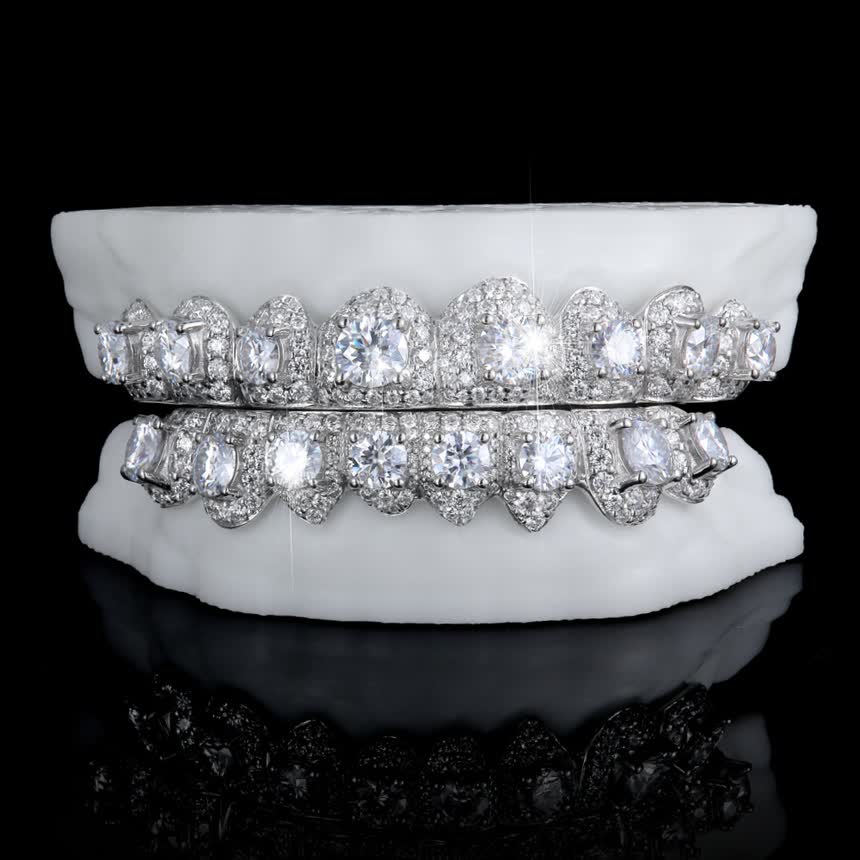
It holds up wherever the stone is a building material. An 8mm double-row Cuban chain is dozens of small stones set into a metal body, and what you are buying is coverage and light. Tennis bracelets work the same way. Studs and pendants are a single stone with no heirloom expectation attached, where the fire is the point rather than a compromise. Grillz are the clearest case: a full set of sixteen caps over two rows, worn for a look, pretending to be nothing else. Watch bezels too — the stones sit in a case, and none of them is the emotional centre of the object.
It does not hold up in two places, and we would rather say so than lose the sale quietly. The first is an engagement ring; the second is any piece meant to be inherited. In both, a diamond is doing a job that has nothing to do with optics — it carries a shared meaning, a secondhand market and a family expectation. A stone that is openly not diamond will not satisfy a person who wanted the word, and buying moissanite to save and then feeling that something is missing is a worse outcome than spending more on the thing you actually wanted.
The other limit is not the stone. 9¼ does not scratch in wear, so the material is not the weak point on a piece with dozens of stones. Settings are: a prong bends, a seat loosens, a stone goes missing in year three. That is a workmanship question, which is why the last question in the list below is about what happens when a stone comes out. Cost expectations by format are in the ring cost guide.
What a finished piece costs
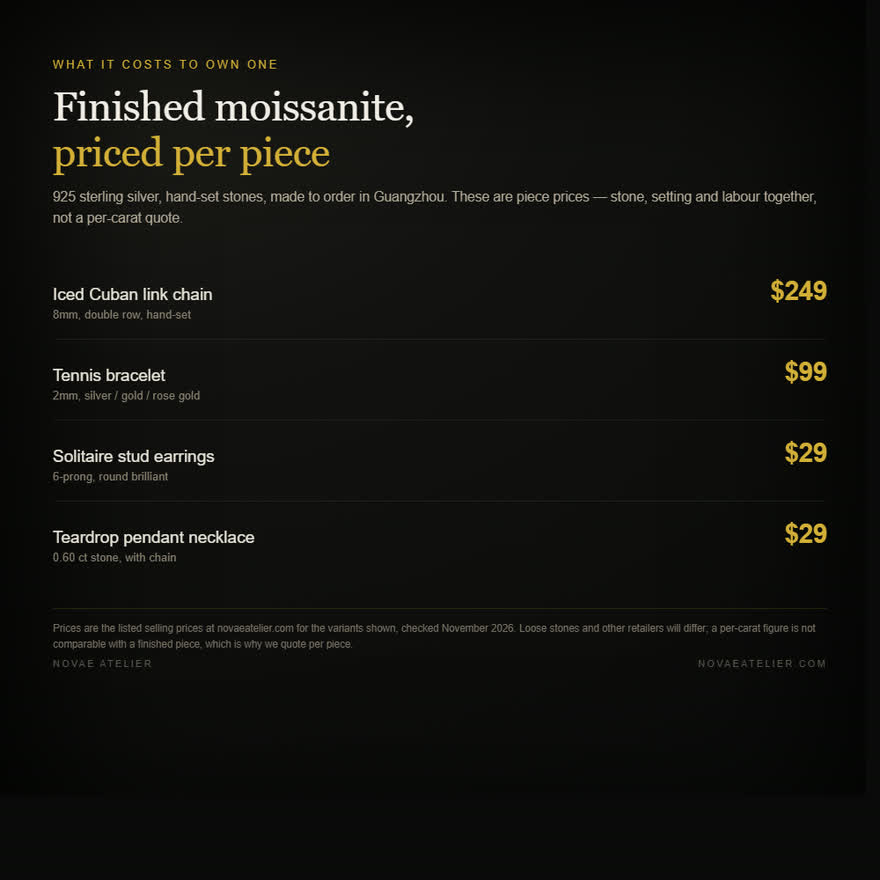
Here is our own catalogue, and the table header is the part to read carefully. These are finished prices: stone, 925 sterling silver, hand setting, polishing, clasp.
| Piece | Code | Price, finished |
|---|---|---|
| Moissanite 8mm Double Row Iced Cuban Link Chain | NOV-CH-9840 | $249 |
| Moissanite 2mm Tennis Bracelet, thin to 10mm | NOV-BR-1006 | 6.5 or 7 in $99 · 7.5 in $109 · 8 in $119 |
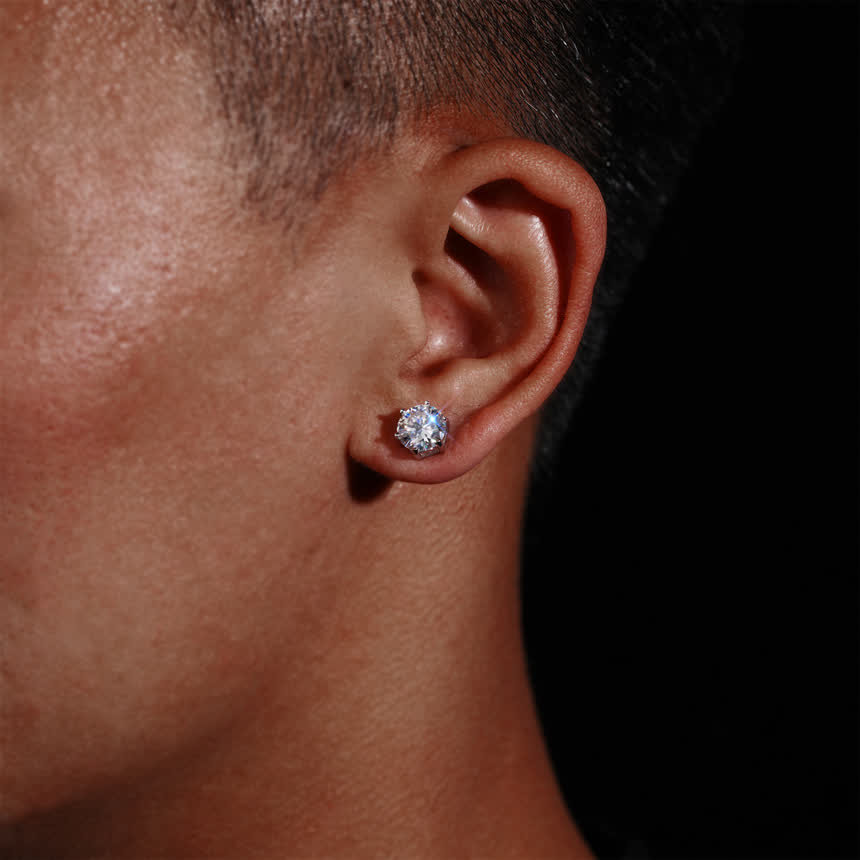
| Moissanite 6-Prong Round Solitaire Stud Earrings | NOV-EA-1011 | $29 |
| Moissanite Pendant Necklace, teardrop | NOV-CH-9855 | 0.60 ct $29 · 2 ct $39 |
Our catalogue, variant prices in USD, 11 November 2026, per finished piece in 925 sterling silver. Gold and rose gold tones are 18K gold plated over that silver.
We deliberately do not price the stone by weight, and we would treat a seller who does with caution. On a set piece a weight-based figure describes nothing you own: the stones in a 2mm bracelet are a couple of millimetres across and the number is an average across a parcel. It does not tell you what the labour, the silver, the setting or the finish cost, and on a fully set piece those are most of the invoice.
The spread in that table is instructive for the same reason. Studs at $29 and an 8mm double-row chain at $249 hold different quantities of the same stone, in different metal weights, with different hours of setting between them. What does not change is the material standard. Two lines need saying out loud, because a listing can mislead without telling a literal lie. 925 sterling silver is a specification with a number in it and the bare word silver is not. And our gold tones are 18K gold plated over silver — a colour, not a solid gold body. For the arithmetic per format, the Cuban chain cost guide runs it length by length.
Six questions to ask before you buy
Copy these into a chat window. They take two minutes to answer, and the answers separate a comparable quote from an anecdote.
- Is the stone silicon carbide, and is that the only material in the piece? You want the material named, not a brand of stone and not a marketing word. If the reply mixes the word diamond into a description of a non-diamond stone, ask which it is.
- Are the stones individually hand-set, and is the whole visible face covered? On a fully set piece the labour is per stone, so a “fully iced” claim that turns out to be half a face is a different product at the same headline.
- Is the metal 925 sterling silver, and is it stamped? Get the words in writing and look for the stamp on the clasp. The bare word silver is not a specification.
- What is the finish, exactly? Rhodium over silver, or 18K gold plated over silver. Ours is rhodium, or 18K gold plated in the gold tones.
- What does the paperwork actually say? On a centre stone over 1ct we issue a certificate stating material, weight, shape and colour. GIA does not grade moissanite — it issues an identification report, not a 4C grading report. Some laboratories have issued grading reports for specific producers' moissanite, but the material is not sold with a standard 4C grade. What it proves is set out in what a moissanite certificate proves.
- If a stone comes out in the first year, what happens, and what is the return window? Get both in writing. A seller who will not put either in writing has answered the question.
Six answers, and they are checkable against each other. A seller who names silicon carbide in the first answer and describes a diamond grading report in the fifth has contradicted themselves, and you have found the inconsistency before paying rather than after.
Care, and the one thing that actually fails
The stone needs almost nothing. Warm water, a drop of mild washing-up liquid and a soft brush for two minutes restores the light, because what dulls a fully set piece is a film of soap, skin oil and dust sitting where a cloth cannot reach. Rinse in warm water and dry on a soft cloth rather than a paper towel, which leaves fibres in the seats.
Keep it away from chlorine and bleach. Those do not attack silicon carbide; they attack the 925 silver and the plating around it, and a plated piece that lives in a swimming pool will lose its colour long before it loses a stone. Store pieces separately, because 9¼ cuts softer gemstones and marks other moissanite. Once a year, have the settings checked — on a piece with dozens of stones the failure mode is a bent prong. And if the metal goes dark, that is the silver rather than the stone, which is the argument in does moissanite tarnish; the routine for a chain in daily wear is in how to clean a 925 silver necklace.
Not Sure Which Format Suits the Stone?
Send us a photo of the piece you are considering, or tell us the look you are after. We will tell you whether moissanite is the right material for it — including when the answer is no.
Ask on WhatsAppFrequently asked questions
What is moissanite made of?
Silicon carbide, SiC: one silicon atom bonded to one carbon atom in a crystal. Gemological measurement puts it at Mohs hardness 9¼, refractive index 2.648 and 2.691, dispersion 0.104 and specific gravity 3.22, per GIA's Winter 1997 study in Gems & Gemology. It is not carbon with an impurity and it is not a coated simulant.
Is moissanite a real diamond?
No. Diamond is carbon, hardness 10, refractive index 2.417, dispersion 0.044. Moissanite is silicon carbide, hardness 9¼, refractive index 2.648 and 2.691, dispersion 0.104. It is also not a fake, because a fake imitates another material while moissanite is its own material with its own measured properties. The accurate phrase is diamond alternative, and US jewellery rules do not allow the word diamond to be used for it.
Is moissanite as hard as a diamond?
No, and it is the second-hardest stone used in jewellery. 9¼ against diamond's 10. In wear that means ordinary life does not scratch it — keys, coins, a stainless sink — and only another moissanite or a diamond can. Store pieces separately for that reason, since a moissanite will mark softer gemstones and other moissanite in the same box.
Why is moissanite sold in millimetres instead of carats?
Because specific gravity is 3.22 against diamond's 3.52, so a moissanite of a given diameter weighs less than a diamond of the same diameter. Selling by diameter describes the size you actually see on the hand. A phrase like 1 carat moissanite is shorthand for a stone cut to the diameter of a 1 carat diamond, at a lighter weight.
Does moissanite pass a diamond tester?
On a thermal tester, usually yes, because silicon carbide conducts heat well enough that a heat probe reads it as diamond. A multifunction tester that also measures electrical conductivity separates them, since silicon carbide conducts electricity and diamond does not. Passing a heat pen is therefore not evidence that a stone is diamond, and the doubling of back facets under a 10× loupe is the free check.
Sources, accessed 11 November 2026: GIA, Gems & Gemology, Winter 1997, Nassau et al., for the moissanite figures — refractive index 2.648 and 2.691, dispersion 0.104, Mohs hardness 9¼, specific gravity 3.22 — gia.edu; standard gemological reference values for diamond (Mohs 10, refractive index 2.417, dispersion 0.044, specific gravity 3.52) and for cubic zirconia (Mohs 8–8.5, refractive index 2.15–2.18, dispersion 0.060); the discovery of silicon carbide in the Canyon Diablo meteorite by Henri Moissan in 1893; FTC Jewelry Guides, 16 CFR 23, on the use of the word diamond — 16 CFR 23.12. Prices: our own catalogue, variant prices in USD, 11 November 2026, per finished piece. Images and video: our own studio, 2026.