How to Test Moissanite at Home: 3 Checks, Ranked
Short answer: five minutes, a 10x loupe and a $15 heat pen. Between them they rule out cubic zirconia, and the loupe rules out diamond. The fog, water and newspaper tests mostly cannot.
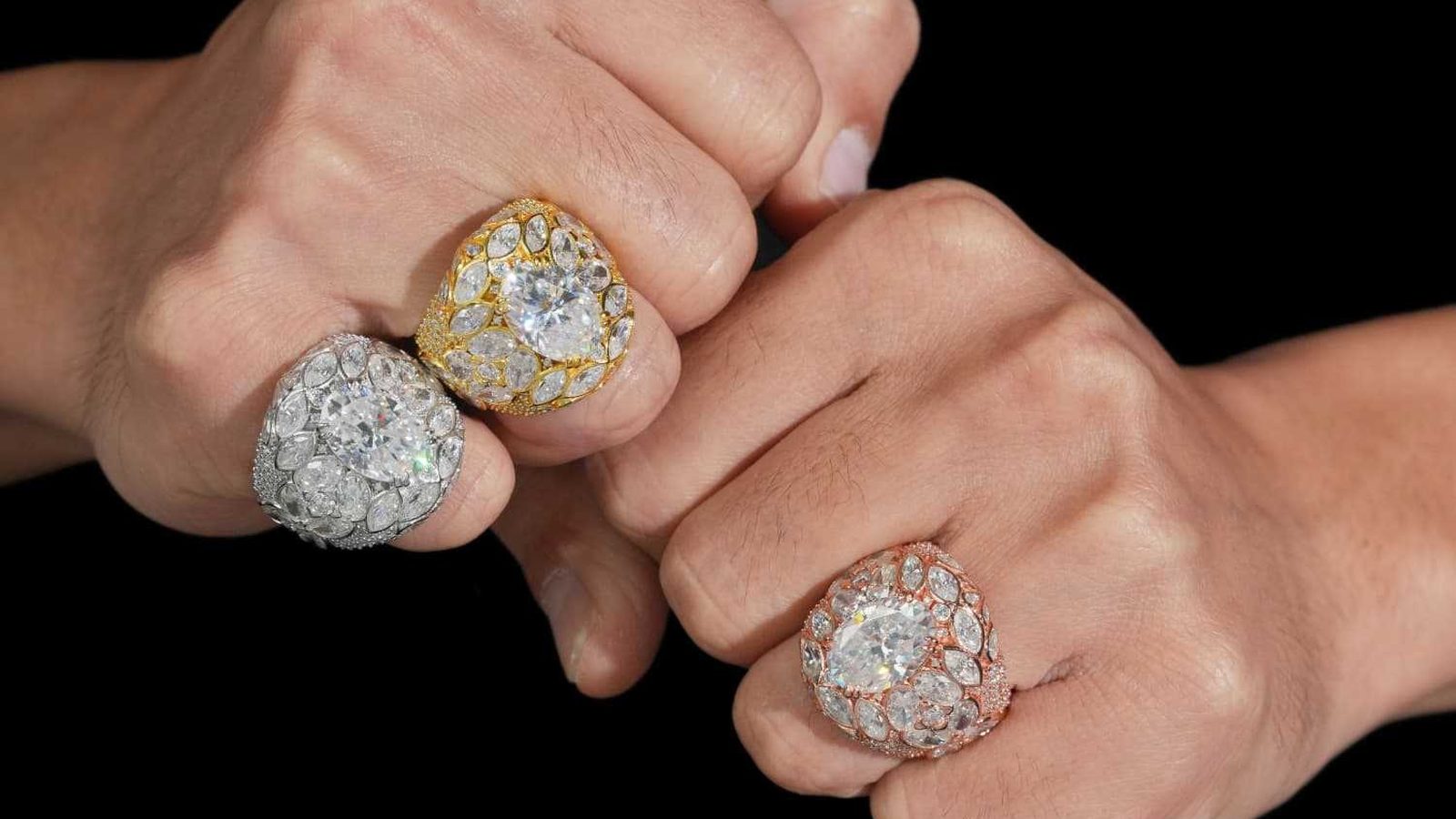
Before any of the famous tests: they were mostly written to answer a different question than yours. “Is this a diamond?” and “is this the stone I paid for?” overlap, but they are not the same question, and a stone can fail every diamond test in the book while being exactly what the seller said it was.
So this page is deliberately narrow. It covers three checks you can run on a kitchen table, what each one can and cannot prove, and the point where the honest answer is to stop and take the piece to someone with a refractometer. Nothing here replaces a laboratory report, and nothing here is a substitute for the material statement that should have come with the piece.
Three materials, and why one test keeps confusing them
Moissanite is silicon carbide (SiC), grown in a lab. Cubic zirconia is zirconium dioxide (ZrO2), also grown in a lab, and a good deal cheaper. A diamond is carbon. Three different materials, three different sets of numbers, and most of the confusion in this category comes from running a test that answers a neighbouring question.
The three numbers that matter for a home check are these: refractive index (how hard the material bends light), birefringence (whether light entering it splits into two rays), and heat conduction (how fast it carries warmth away from your fingertip or a pen tip). Moissanite is the odd one out on the middle number, and that single difference is what makes the loupe worth owning.
The three checks worth your time
1. The loupe: look for a doubled back edge
What you need: a 10x jeweler's loupe. Ten power is the working standard in the trade, and a magnifying glass off a desk is not the same instrument — you need the stone to fill the field and come into focus at a couple of centimetres.
How to do it: clean the stone first, because a film of hand cream hides every edge you are looking for. Hold the loupe close to your eye, bring the piece up until the flat top facet — the table — comes into focus, then look through the table at the facets on the far side of the stone. Tilt the piece slowly left and right. Put a light behind the stone rather than shining it straight into your eye.
The step most guides leave out: the table facet is usually cut perpendicular to the stone's optic axis, and along that direction the two rays overlap, which makes the doubling weakest exactly where most people look first. SSEF's moissanite identification paper is specific about this: a doubling of facet edges is seen “when looking obliquely through facets near the girdle.” So do two passes — one straight down through the table, then one with the stone tilted 20 to 30 degrees, running your eye around the crown facets near the girdle. A check done only straight down can make a moissanite look single, and that is how people reach the wrong conclusion with the right tool.
What you are looking for: a ghost. Each edge on the far side of the stone appears twice, the second copy offset by a hair and slightly fainter. That is facet doubling, and it is the visible signature of a material that splits light into two rays travelling at different speeds.
Why it works: moissanite is uniaxial and birefringent, at 0.043 in the International Gem Society's diamond-and-simulant comparison chart. Diamond and cubic zirconia are singly refractive — one ray in, one ray out, no second image. A diamond cannot produce that ghost, and neither can a CZ.
What it proves: if you can see clear doubling — through the table, or better, obliquely through the crown facets near the girdle — the stone is not a diamond and not cubic zirconia. That is the strongest statement any home test can make, and it is why this is check one. IGS is careful in the other direction: doubled facets mean the stone “might be moissanite, white zircon, white topaz, quartz, or white sapphire.” So doubling narrows the field to birefringent stones — and in white jewelry sold as moissanite, moissanite is the one you are going to meet.
What it does not prove: it does not positively identify moissanite, because four other colourless stones double the same way. It also needs an open back. On a fully iced piece the metal behind the pavé closes the view, so save this check for a single stone with a basket or gallery you can see through. IGS adds a caveat that matters in practice: the effect is obvious in zircon and “much more subtle” in other diamond substitutes, which is what a 0.043 birefringence buys you. Expect a faint offset edge, not a second stone. And if you see nothing at 10x after the tilted pass as well, on a clean, open-backed stone, that is information: it points away from moissanite, towards diamond or CZ, and check three is how you separate those two.
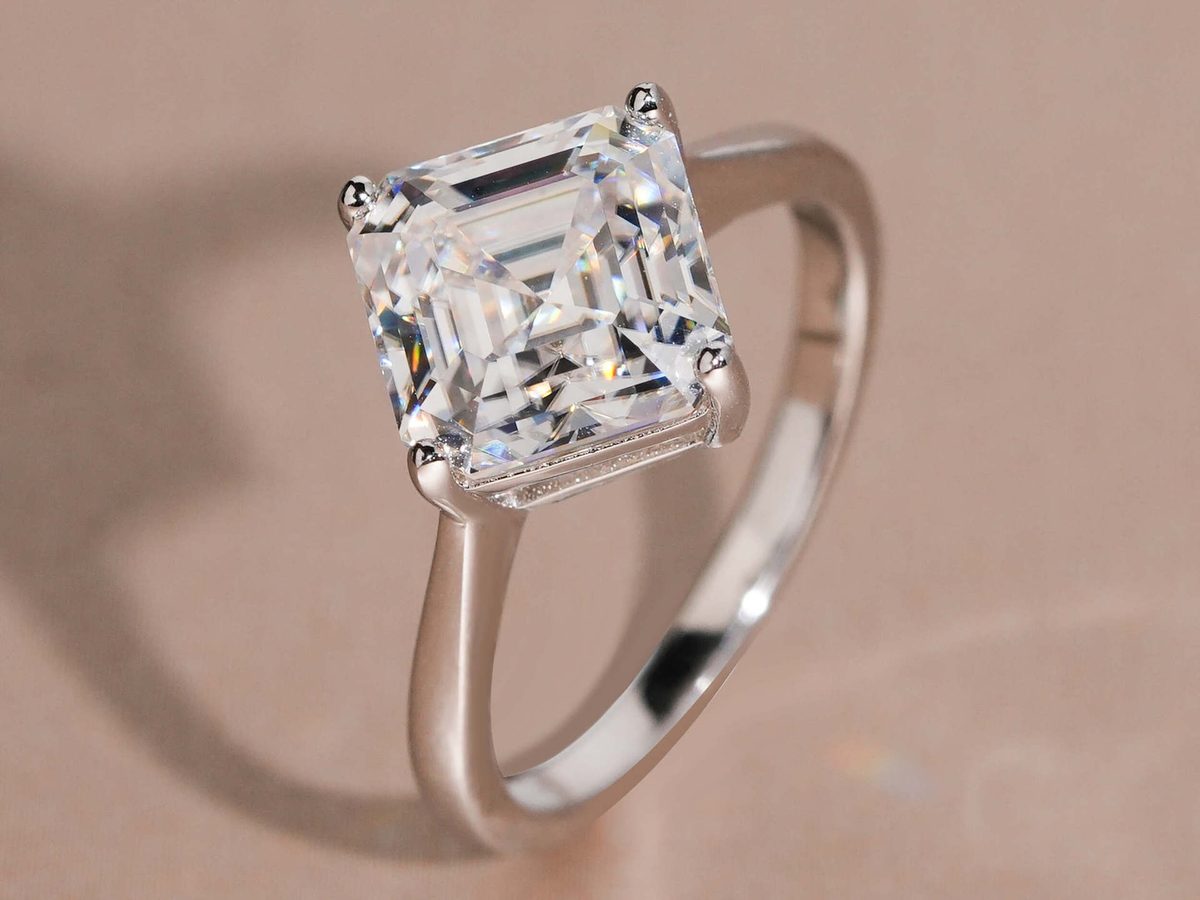
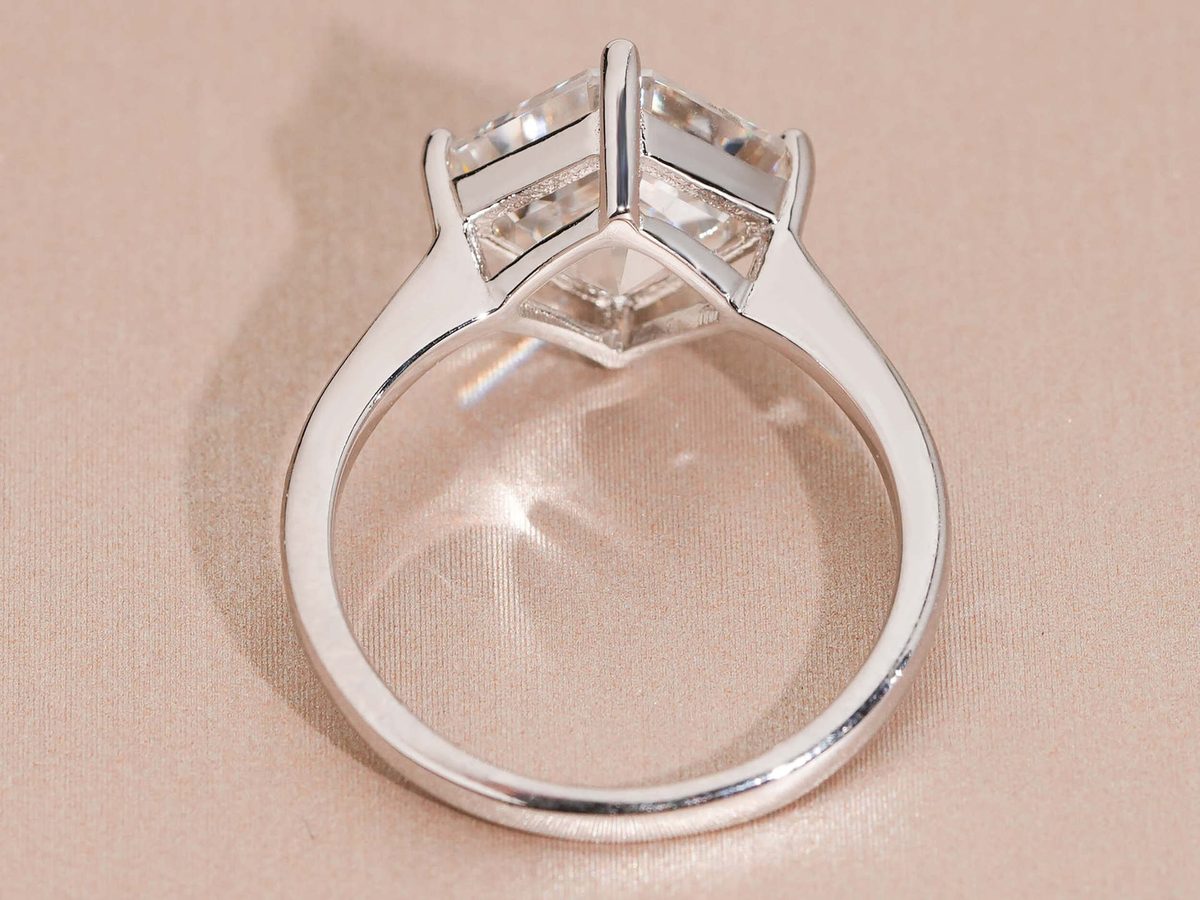
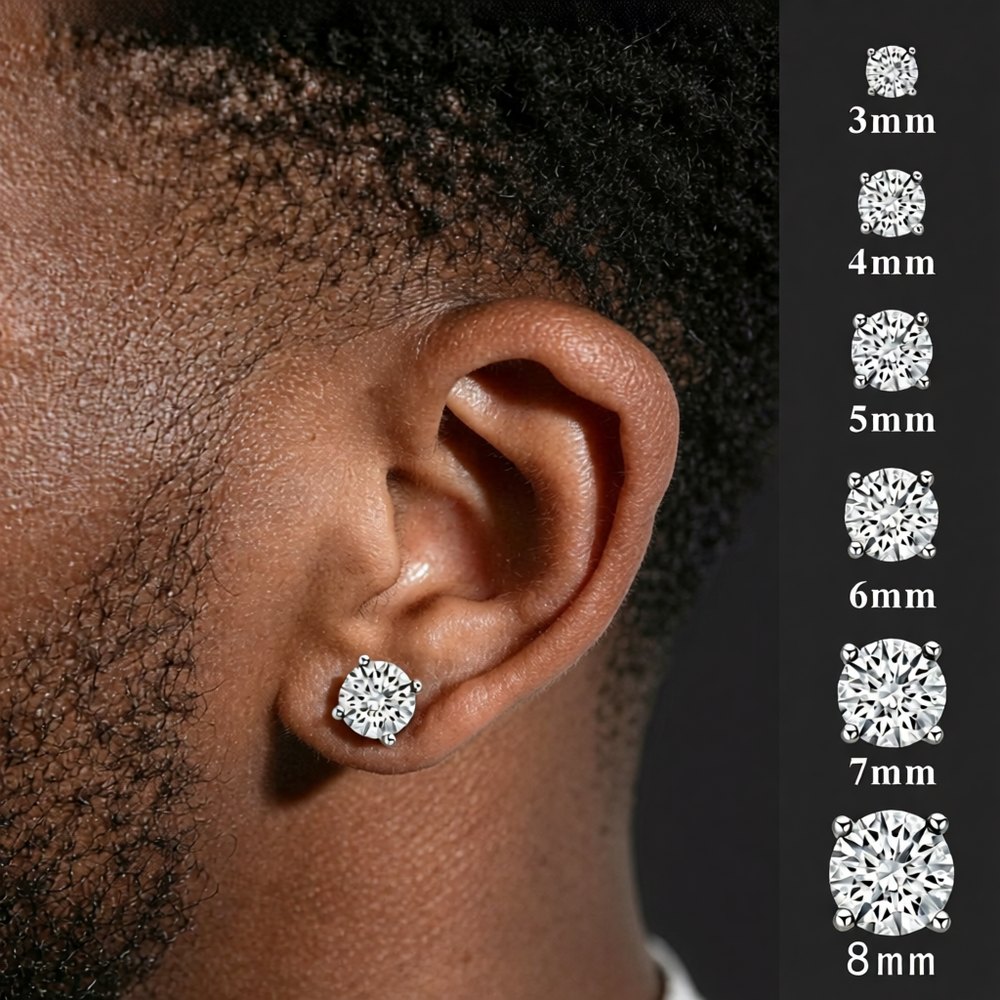
The second reason to practise on a piece like this is the setting. Four prongs hold one stone with the whole pavilion exposed to air, which is the only arrangement where a loupe has anything to look through.
2. The fog test: it screens out cubic zirconia, and that is all
What you need: a clean stone and a room that is not a sauna.
How to do it: breathe on the stone the way you would fog a mirror, then watch how quickly the haze goes.
What you will see: IGS states the result directly — “Diamond and moissanite shouldn't fog up for more than a couple seconds, but other imitations will!” Both materials pull heat out of the condensation fast enough that the surface clears almost at once. A CZ, which conducts heat poorly, holds the haze noticeably longer.
What it proves: one direction only. A stone that stays hazy for several seconds is very unlikely to be moissanite — and just as unlikely to be a diamond. That is a real result: it fails a CZ or a piece of glass, and it does it without spending a penny. It is the fastest way to reject a stone, not a way to accept one.
What it does not prove: anything at all about moissanite versus diamond, because this test is measuring heat and both of them pass it. IGS is equally straight about the method's precision: there is “no set amount of time that a diamond will fog up,” and ambient temperature and humidity both move the result. If you run it, breathe on a stone you already trust first and compare the two side by side — that comparison is the test, not the fog itself.
3. The heat pen: an instrument, and it is telling you the truth
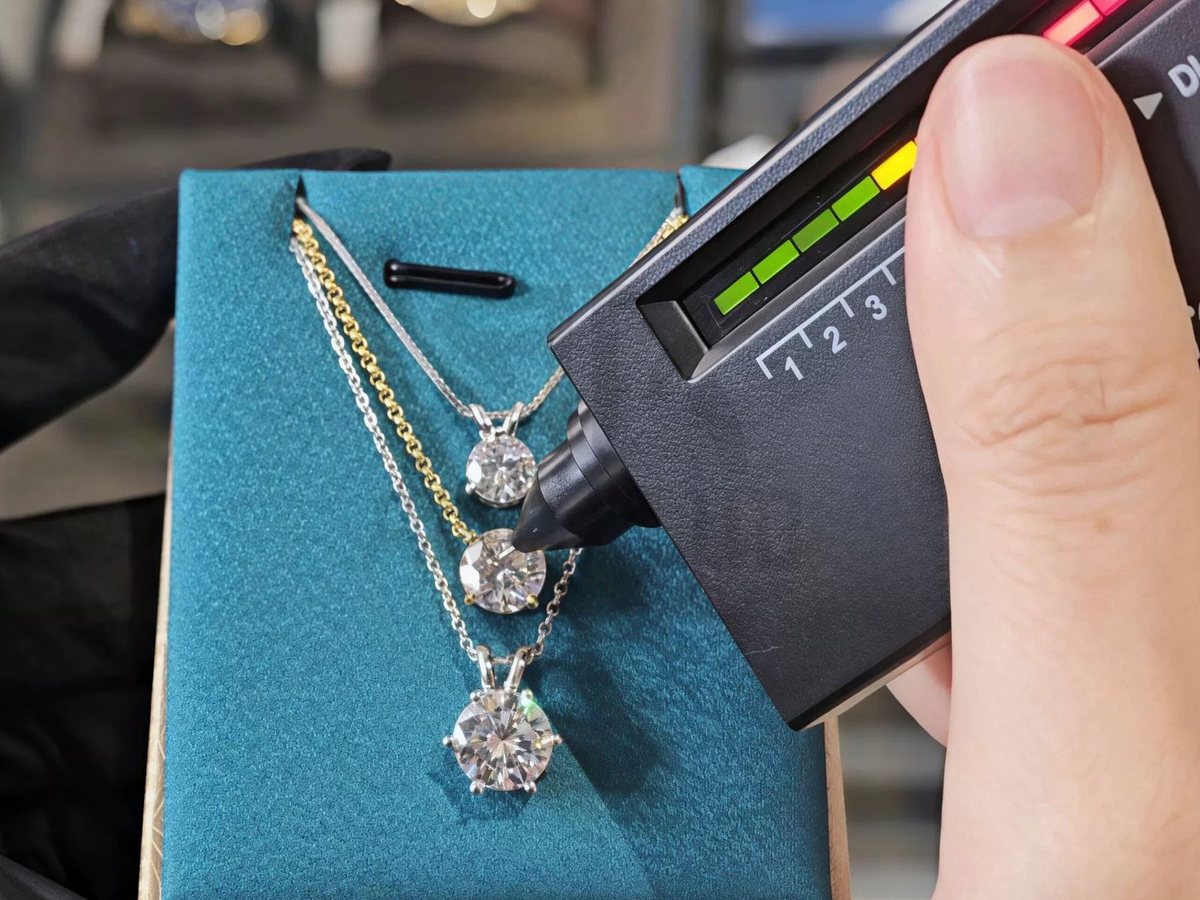
What you need: a thermal diamond tester. IGS puts a basic one at about $15 online; the multi-testers that also measure electrical conductivity cost more, and that second measurement is the one that matters below.
How to do it: clean and dry the stone, let the pen warm up the way its own instructions say, press the tip flat against the table facet, and hold still until the reading settles.
What you will see on moissanite: a “diamond” light. That is not a fault, not a lie, and not a reason to send the piece back. IGS says it plainly: “A diamond tester will only test positive for diamond and moissanite.” IGI explains why, calling these false positives on moissanite, “because diamond and moissanite are similar when it comes to interaction with heat.” From the laboratory side, the Swiss Gemmological Institute's moissanite identification paper reaches the same place: the material's thermal conductivity overlaps diamond's so closely that it “cannot be distinguished from diamond with a thermal conductivity probe.”
So the pen does one useful thing at a kitchen table: it separates a heat-conducting stone from a stone that is not one. Cubic zirconia fails it. Diamond and moissanite both pass. If you want the reading explained properly — why the light goes green on a stone that is not a diamond, what the different models measure, and what the trade thinks of them — that is its own page: هل يجتاز المويسانيت اختبار الألماس؟
What it proves: that the stone is not CZ, glass, or most other simulants.
What it does not prove: that the stone is not a diamond, and, more to the point for anyone who bought moissanite on purpose, it cannot tell you the two apart. A multi-tester that also measures electrical conductivity can, because moissanite conducts electricity and most diamonds do not. IGI attaches a warning worth knowing before you lean on that reading: some lab-grown diamonds made by the HPHT process carry metallic residues, and stones containing boron — including deliberately boron-doped ones — can read as moissanite on an electrical tester. The line IGI quotes from Yehuda is the one to keep on the fridge: “Informal detection is not a substitute for gemological laboratory analysis.”
What the numbers behind those checks actually are
This is the table worth keeping, because it makes the logic of the three checks obvious. Read down the birefringence row and you can see why the loupe is the only home test that separates moissanite from diamond. Read down the heat row and you can see why the pen cannot.
| Property | Moissanite (SiC) | Diamond (C) | Cubic zirconia (ZrO2) | What it lets you test at home |
|---|---|---|---|---|
| Refractive index | 2.648 – 2.691 | 2.417 | 2.15 – 2.18 | Nothing, on its own — reading RI needs a refractometer, which is a jeweler's tool |
| Birefringence | 0.043 (uniaxial) | None | None | The loupe check. Doubling rules out diamond and CZ in one look. |
| Specific gravity | 3.17 – 3.22 | 3.515 | 5.56 – 6.00 | Almost nothing — a set stone cannot be weighed, and both sink in water |
| Hardness (Mohs) | 9¼ | 10 | 8 – 8½ | Nothing you can measure without scratching something you own |
| Heat conduction | Very high | Very high | Low | The fog test and the heat pen. Both fail a CZ; neither separates moissanite from diamond. |
| Chemical identity | Silicon carbide | Carbon | Zirconium dioxide | Nothing at home — this is what a laboratory report states |
Optical and physical figures: International Gem Society, “Properties of Diamond Simulants” comparison chart (RI, birefringence, specific gravity, hardness by material). Heat conduction is described qualitatively rather than numerically on purpose: the useful fact is the ranking, and the ranking is what both the fog test and the pen depend on.
A five-minute check, in order
The order matters, because the cheapest checks come first and each one can save you the next. Work through it once, write down what each step said, and only then decide.
On the table before you start: a 10x loupe, a heat pen, a soft lint-free cloth, warm water with a drop of mild dish soap and a soft brush, and a piece of paper to record readings.
- Confirm what you are looking at. Note the stone's shape and roughly its size in millimetres, and look at the setting from the side. A single stone in an open basket can be checked properly; a closed-back or fully paved setting cannot. Size first, because a 3mm stone gives a loupe almost nothing to work with, while a 7mm or 8mm stone shows its facets clearly — our earring size guide has the millimetre-to-carat comparison if you want a reference.
- Clean it. Warm water, one drop of mild dish soap, a soft brush, then dry it properly. Skin oil and hand cream are the single most common reason a stone looks “wrong” and the single most common reason a loupe check fails.
- Loupe first. Look through the table at the back facets and tilt slowly. Doubling seen: the stone is not diamond and not CZ. No doubling seen on an open-backed stone: it points the other way, and you need step four.
- Fog it. Breathe on the stone and watch. Still hazy after several seconds: very unlikely to be moissanite. Clears at once: consistent with moissanite or diamond, which is all this step can tell you.
- Then the pen. Tip flat on the table, hold still, read the result. A “diamond” light means the stone conducts heat like diamond or moissanite; a low reading means CZ or another poor conductor. If your pen also does electrical conductivity, that second reading is what separates the two high-conductors.
- Write it down before you decide. Three readings, three sentences. If they agree, you have a useful working answer. If they disagree — or if any step was impossible because of the setting — you are at the edge of what a home check can do, and the next section is for you.
What a home test cannot tell you
This is the part most pages skip, and it is the part that decides whether you should be reassured or worried.
- It cannot positively identify moissanite. Not with a loupe, not with a pen, not with all three checks together. Doubling gets you to “birefringent colourless stone”, which in white jewelry is usually moissanite — but usually is not the same as certainly.
- It cannot tell a lab-grown diamond from a mined one. They are the same material with the same properties; every home test treats them identically. Only a laboratory with spectrometry can say which is which.
- It cannot grade the stone. Colour, clarity and cut quality are not part of any of these checks, and a stone can be exactly the material you paid for and still be a poorly cut one.
- It cannot be run on every setting. Closed-back, glued-in and heavily paved pieces hide the pavilion. If you cannot see through the stone, you cannot run check one, and the pen alone leaves you where the checking started.
Which leaves the red flags — the situations where the test result matters less than the behaviour around it:
- The price is far below the material's floor. A large stone at a small-stone price is the oldest signal in this trade, and no pen reading outweighs it.
- The seller will not say what the material is. “Moissanite” is a material name. A listing that only offers a marketing word, or that writes the stone as if it were a diamond, has told you something.
- Nobody will put the origin in writing. Moissanite is lab-grown, so asking which producer grew the rough is a normal question with a normal answer.
- No returns, and no permission to have it looked at. Any seller confident in the material will let you take it to a jeweler. A refusal is the answer.
- “It passes a diamond tester” offered as proof. It does pass — and so does a diamond, which is exactly why it proves nothing about moissanite. This is the single most common misleading claim in the category.
When to stop testing and ask a jeweler
Three situations, and none of them is about being unskilled:
When the money at stake is larger than the cost of an opinion. A bench can read the refractive index on a refractometer in seconds, and 2.417 against 2.648–2.691 is not a subtle difference. Under a microscope the doubling is unambiguous. That is a five-minute answer from someone who does it weekly.
When the setting blocks the view, or the stone looks wrong to you. A stone with an unexpected tint, visible inclusions or a dull pavé run is worth a professional look regardless of what any home test said, because those are questions about quality, not identity.
When you need a document rather than an opinion. Insurance, resale, an inheritance, a dispute: all of those want paper. A gemological laboratory report is the only thing that provides it, and note the hierarchy honestly — a jeweler's counter check is an expert opinion, a pen reading is a measurement of one property, and a home loupe check is a good guess made with a good tool. Where a piece is plated, the listing names the plating; where it isn't, it says so. What we cannot do is turn a home test into a report.
If the stone turns out to be a diamond rather than moissanite, the comparison that actually matters to a buyer is cost and origin, and that is covered in moissanite versus lab-grown diamond and, with CZ in the frame, in the three-way comparison. For the material itself, start with What Is Moissanite?
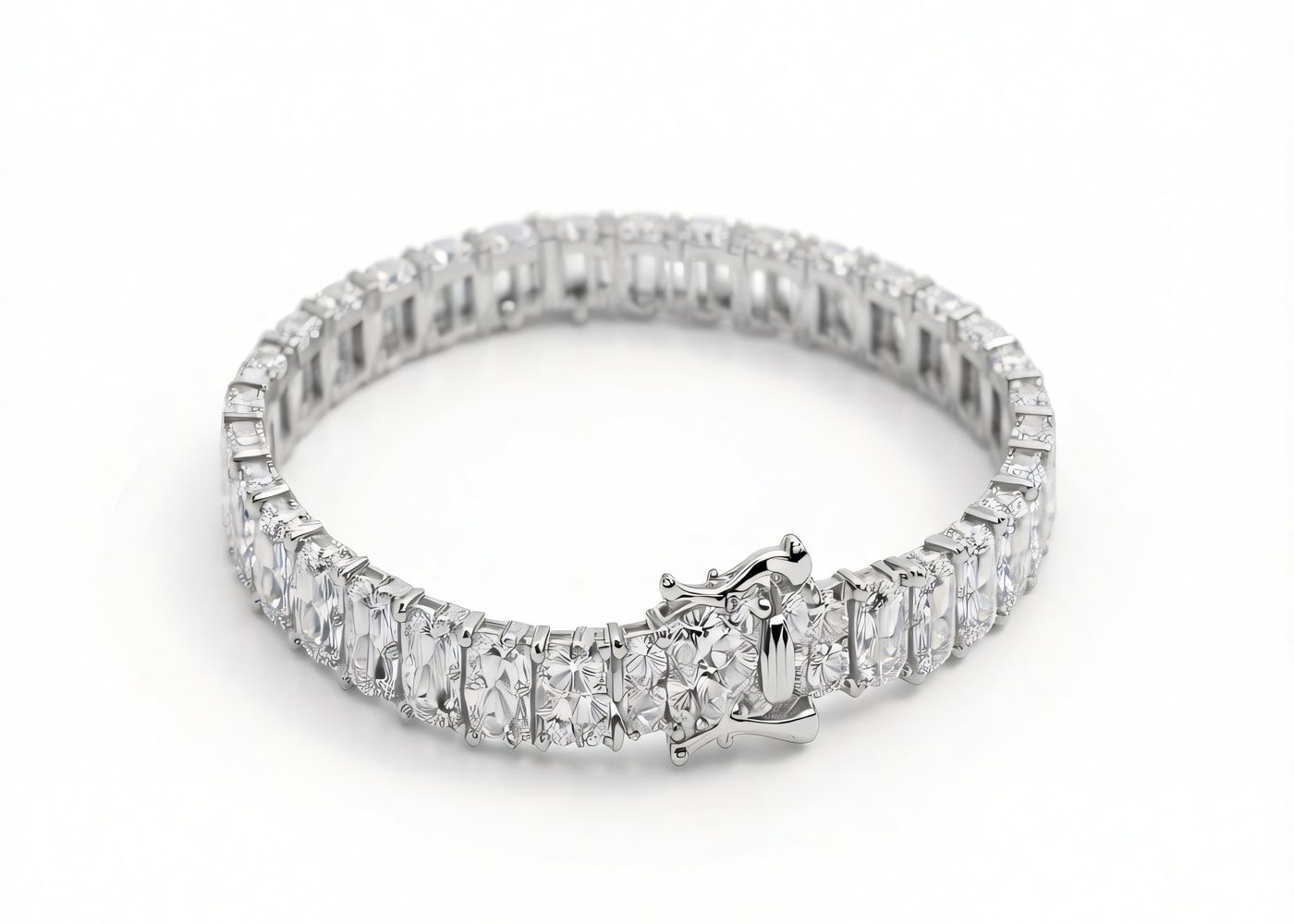
What these pieces cost, read from the catalogue today
Testing questions usually arrive with a price question attached, so here is the range per category, read from the NOVAE ATELIER catalogue on 30 October 2026: the start price, the top price, and how many listings sit in that range.
| Category | From | To | Listed pieces |
|---|---|---|---|
| Earrings | $29 | $339 | 95 |
| Rings | $29 | $585 | 77 |
| Pendants | $29 | $1,959 | 48 |
| Necklaces & chains | $29 | $11,483 | 33 |
| Bracelets | $63 | $903 | 20 |
| Grillz | $55 | $1,096 | 24 |
| Watches | $149 | $1,599 | 35 |
| Eyewear | $213 | $419 | 7 |
Source: NOVAE ATELIER catalogue, variant prices, 30 October 2026, in USD. The top of the chain range is not a typo: $11,483 is the 18mm fully iced Cuban chain, the widest piece in the catalogue.
The spread inside a single category is mostly three things: how big the stones are, how many of them there are, and how much of the work is done by hand. Stone size dominates, which is also why a cheaper piece is harder to check at home — smaller stones give a loupe less to read. The arithmetic for each category is broken out in the ring cost guide, the tennis bracelet guide and the pendant guide.
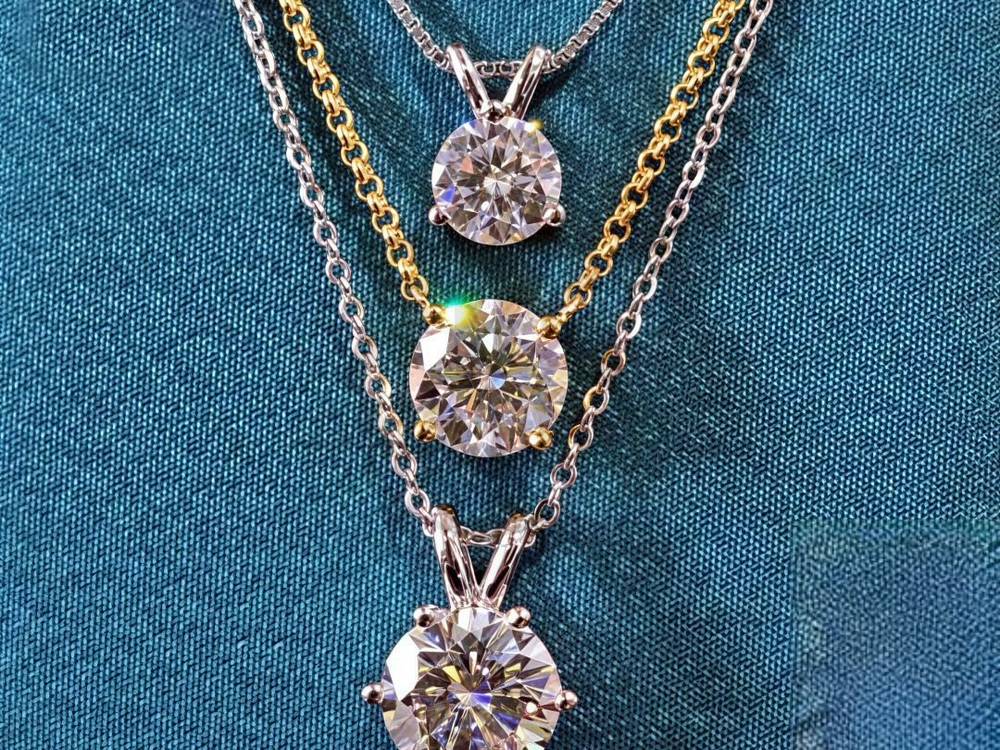
Three pieces to start with
If you would rather learn the check on a stone you can see clearly than on a paved piece, these are the three shapes in the current catalogue that make it easiest — each at the starting price of its listing:
Moissanite Solitaire Asscher Ring
A single square step-cut stone, set in 925 sterling silver in a four-prong setting on a plain polished band. Step-cut facets give long straight edges on the far side of the stone, which is exactly what a 10x loupe needs to show doubling clearly. $108. See the ring
Moissanite Pendant Necklace
One round stone, open back, nothing behind it — the easiest setting there is to check. Twenty combinations of prong style and stone size: three-, four- or six-prong heads, at 1ct, 2ct, 3ct or 5ct, which also makes it a straightforward way to see how much a stone's size changes what you can check. From $119 ($119–$209). See the pendant
Moissanite 2–10mm Iced Tennis Chain
A row of matched stones, 2mm to 10mm. Not the easiest piece to loupe, but the best one for the other habit worth building: running your eye along the row to check that size, colour and setting are even from one end to the other. $69. See the chain
Frequently asked questions
Can you really test moissanite at home?
Partly. A 10x loupe and a heat pen between them can rule out cubic zirconia, and the loupe can rule out diamond, because moissanite is birefringent and shows a doubled back edge while diamond and CZ do not. What no home test can do is positively identify moissanite, because white zircon, white topaz, quartz and white sapphire double in the same way. Only an independent gemological laboratory can give you a document rather than an opinion.
Does the fog test work on moissanite?
Only in one direction. The International Gem Society notes that diamond and moissanite both clear a breath fog within a couple of seconds, while other imitations hold it. So a stone that stays hazy for several seconds is very unlikely to be moissanite, but a stone that clears fast could be moissanite or diamond, and the fog cannot tell you which. There is also no fixed time to compare against, and room temperature and humidity change the result.
What does moissanite look like through a 10x loupe?
Each facet edge on the far side of the stone can appear twice, offset slightly, because silicon carbide splits light into two rays. The effect is subtle at a birefringence of 0.043 compared with zircon, so expect a faint ghost edge rather than a second stone, and it shows up best when you look obliquely through the crown facets near the girdle rather than straight down the table. You need an open back to see it: on densely set pavé the metal behind the stone blocks the view.
Why does a diamond tester say diamond on moissanite?
Because the pen measures how fast heat travels through the stone, and moissanite conducts heat much like diamond. The International Gem Society puts it plainly: a diamond tester will only test positive for diamond and moissanite. IGI calls these false positives on moissanite and notes that an electronic tester, which measures electrical conductivity, separates the two more reliably. Cubic zirconia is the material a heat pen does reject.
Do the water test and the newspaper test work?
Not as identification. Both need a loose stone, so neither can be run on a ring or a pendant. A stone dropped in water sinks whether it is moissanite, diamond or cubic zirconia, so the test only catches glass and quartz. The newspaper and dot test rules out diamond, but cubic zirconia has slight read-through as well, which leaves you unable to separate the two materials you were actually asking about.
When should I stop testing and take the piece to a jeweler?
When the amount at stake is more than the cost of an opinion, when the stone has a closed back you cannot see through, or when you need something in writing for insurance or resale. A jeweler can read the refractive index on a refractometer in seconds and see the doubling under a microscope, and a laboratory report is the only document that settles it. Any counter test, including ours, is an opinion.
How much does moissanite jewelry cost in 2026?
Read from the NOVAE ATELIER catalogue, variant prices, 30 October 2026: earrings from $29 to $339, rings $29 to $585, pendants $29 to $1,959, chains $29 to $11,483, bracelets $63 to $903, grillz $55 to $1,096, watches $149 to $1,599 and eyewear $213 to $419. The top of the chain range is an 18mm fully iced Cuban chain, which is the widest piece we make.
Not Sure What Your Stone Is?
Send us a well-lit close-up of the stone and the setting — a phone photo taken through a loupe is enough more often than you would think — and we will tell you which of the three checks is worth running on that piece, and whether it can be run at all. If you own a NOVAE piece and want the material and finish stated, ask us with the order or the listing and we will check what our records actually show — and tell you plainly if something was never recorded.
اسأل على واتسابSources: International Gem Society, “Properties of Diamond Simulants” (refractive index, birefringence, specific gravity and Mohs hardness for diamond, moissanite and cubic zirconia, read from the comparison chart) — gemsociety.org; International Gem Society, “How to Spot a Fake Diamond: What These 13 Tests Really Mean!” by Addison Rice, updated 16 May 2023 (facet doubling and what it can mean, the fog test and its limits, the water and dot tests, diamond testers and the “diamond and moissanite” result, tester cost) — gemsociety.org; International Gemological Institute, “Diamond Detection and Handheld Testers” (thermal false positives on moissanite, electronic testers, HPHT and boron conductivity, informal detection versus laboratory analysis, quoted directly) — igi.org; J. P. Chalain, SSEF Swiss Gemmological Institute, “Update on Moissanite Identification” (thermal conductivity overlapping diamond and a doubled facet edge visible only when looking obliquely near the girdle, both quoted directly) — PDF; Kurt Nassau, “Synthetic moissanite: A new man-made jewel,” Current Science Vol. 79 No. 11, 10 December 2000 (refractive indices 2.648 and 2.691, birefringence 0.043, dispersion, hardness 9¼, specific gravity 3.22 against diamond's 3.52) — PDF copy. Heat conduction is described qualitatively because the ranking, not a single figure, is what the tests use. Prices are read from the NOVAE ATELIER catalogue, variant prices, 30 October 2026, in USD. This page explains what home tests can and cannot show; it is not an identification, not a grading report, and not a warranty. A laboratory report is the only document that settles what a stone is.