Moissanite vs Lab Diamond vs Natural Diamond (2026)
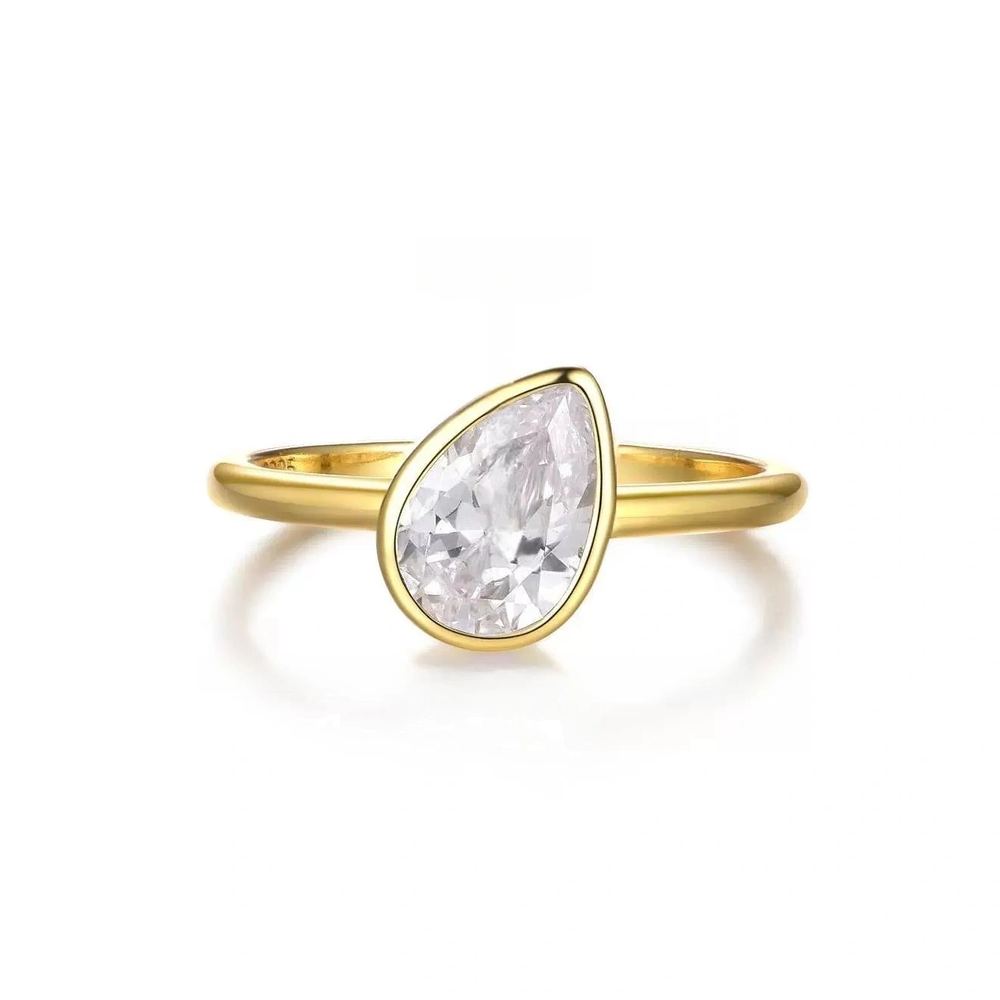
Moissanite is silicon carbide; lab and natural diamond are both carbon. One carat: $39 to $159 finished in our rings, about $570 to $640 loose lab diamond, about $3,510 loose natural. Different stones, and prices covering different objects.
The short version. A lab diamond and a natural diamond are the same material, and a loupe cannot tell which one you are holding; the price gap is a supply story. Moissanite is a different material that out-sparks both for a fraction of the money, and the three prices are not the same kind of number.
What each of the three actually is
Moissanite is silicon carbide, SiC, grown rather than mined. It is its own material, and this article calls it moissanite rather than a comparison word. What Is Moissanite? covers how it is made and what it does in light.
A lab diamond is carbon — the same carbon as a mined diamond — crystallised in a reactor instead of the mantle. Same chemistry, same 10 on the Mohs scale, same 2.42 refractive index, same 0.044 dispersion. It is not a simulant: it is a diamond with a different origin and a shorter supply chain.
So the gap between lab and natural cannot be a quality gap; it is a supply gap. And price alone says nothing about moissanite until you name what else changes.
Three stones, one table
Physical values are from GIA; prices come from the sources below.
| Moissanite | Lab diamond | Natural diamond | |
|---|---|---|---|
| What it is | Silicon carbide (SiC), grown | Carbon (C), grown in a reactor | Carbon (C), formed underground |
| Mohs hardness | 9.25 | 10 | 10 |
| Refractive index | 2.648 – 2.691 | 2.42 | 2.42 |
| Specific gravity | 3.22 | 3.52 | 3.52 |
| Dispersion (fire) | 0.104 | 0.044 | 0.044 |
| 1 carat price | $39 – $159 | ≈$570 – $640 | ≈$3,510 |
| What that price is | A finished ring, 925 sterling silver, setting included | A loose stone, no metal, no setting | A loose stone, no metal, no setting |
| Daily wear | Nothing marks it; the silver ages first | Nothing marks it; the setting takes the knocks | Nothing marks it; the setting takes the knocks |
| Secondhand market | Almost none | Exists, below what you paid | The deepest of the three |
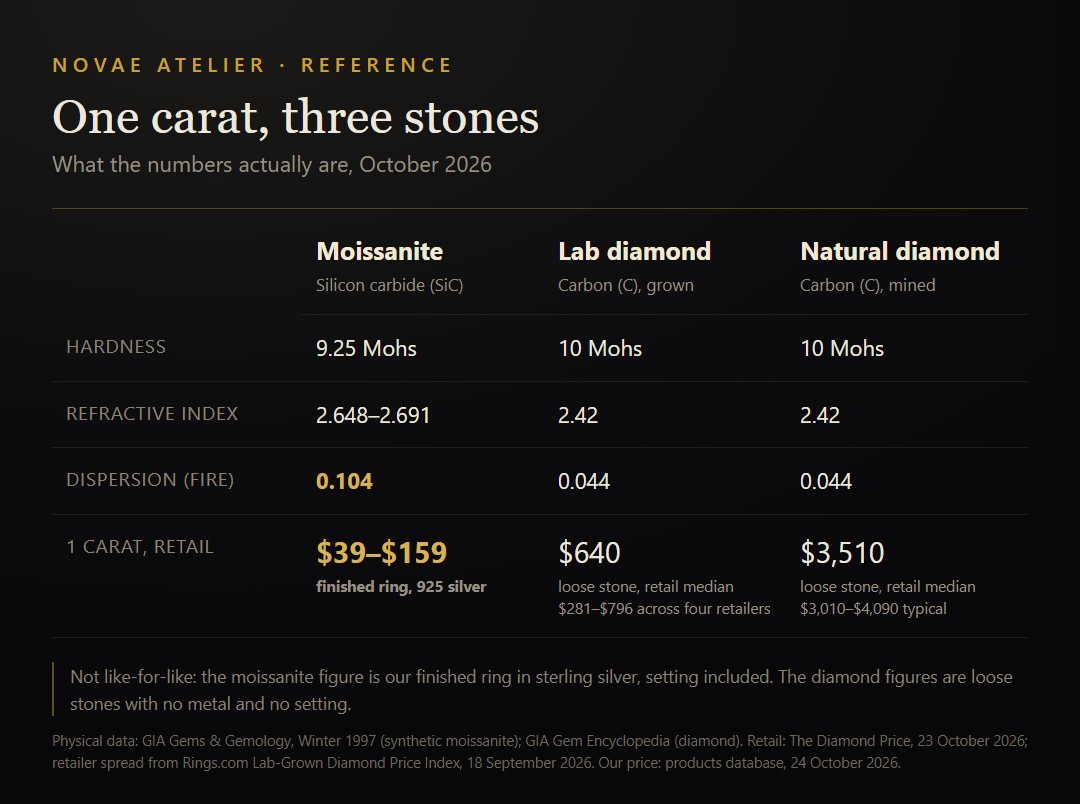
Not like for like. Ours is a finished ring: metal, setting work, stone already in it. The diamond figures are retail asking medians for loose stones — no band, no setting, asks rather than sales. A $39 ring against a $640 stone is not a sixteen-fold saving; it is two different objects.
Sources. GIA, Gems & Gemology, Winter 1997, Synthetic Moissanite (Nassau), and the GIA Gem Encyclopedia; published hardness for moissanite varies by source, some listing 9 to 9.5. Rings.com Lab-Grown Diamond Price Index, 1ct E VS1 IGI round, median $571, spread $281 to $796, read 18 September 2026. The Diamond Price, 1ct G to I, VS1 to SI1: lab median $640, natural $3,510 (most $3,010 to $4,090), read 23 October 2026. PriceScope, G VS1 about $4,851 and G VS2 about $4,517 a carat, read 1 October 2026. Our prices, read 24 October 2026, USD.
Why a 1 carat moissanite ring is $39 and not $570
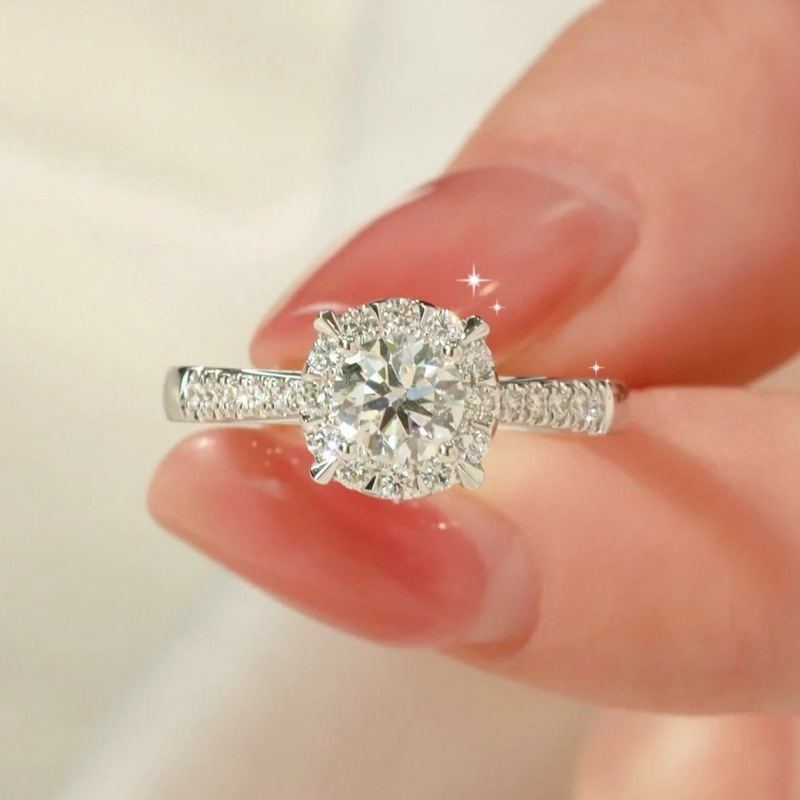
The floor of our line is NOV-RG-1043, a solitaire at $39 in the 1 carat option: 925 sterling silver, the stone set. The $571 lab diamond median buys a stone in a paper packet, and the ring to hold it is quoted separately — head, band, setting labour, none of it in the stone price. The two numbers are not competing quotes: one includes the work, one excludes it.
What $39 buys is a smaller face and a lighter shank than anything further up the line, not a lesser stone. That is the honest trade at the entry point — scale, not quality.
Same carat, four of our prices
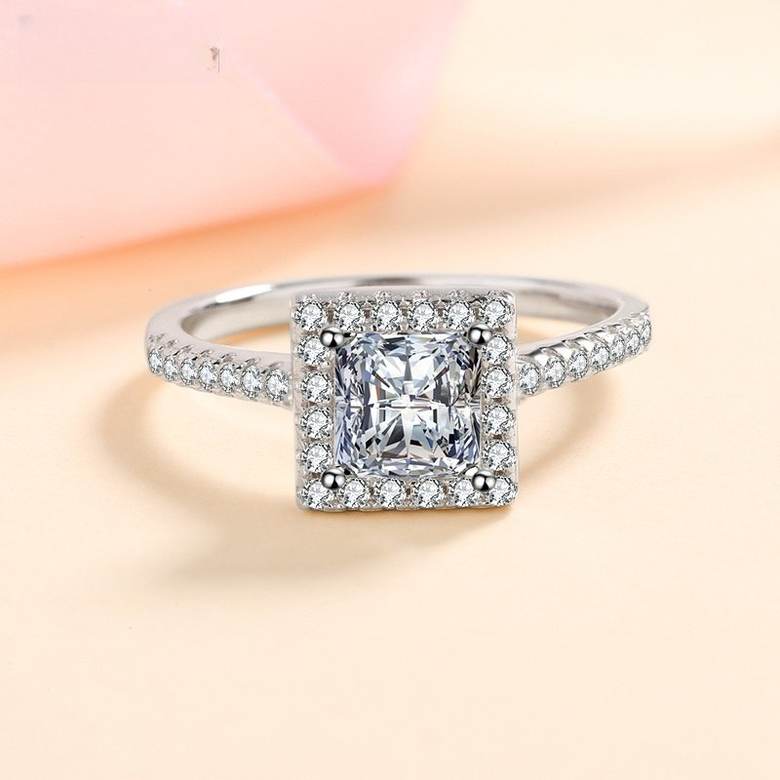
Across four of our rings, one carat appears at $39, $89, $109 and $159. Those are four of our prices, not the whole line — other 1 carat settings sit between them. The stone is identical at all four. What moves is the design: a halo instead of a bare head, stones on the shoulders, a step cut that needs a squarer, more exact setting.
NOV-RG-1066 makes the point bluntly: $89 at 1 carat and $89 at 2 carat. Here the design is the price and the carat is a label on an option.
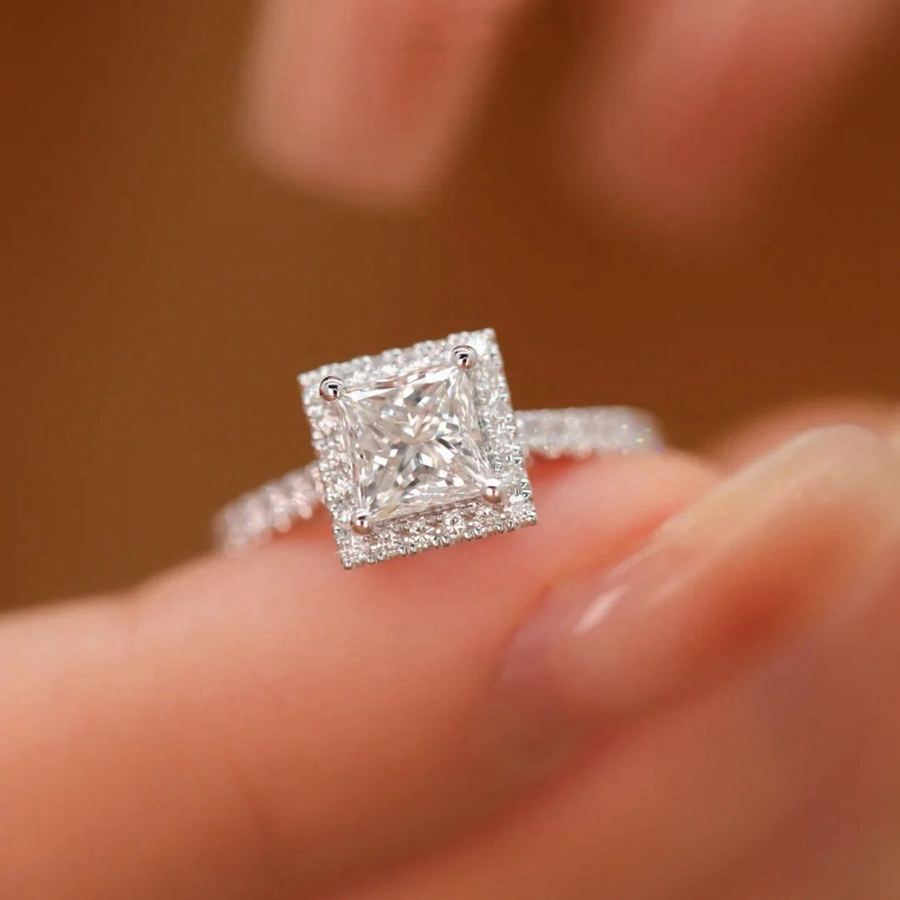
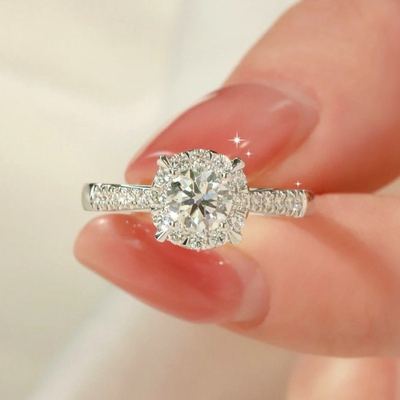
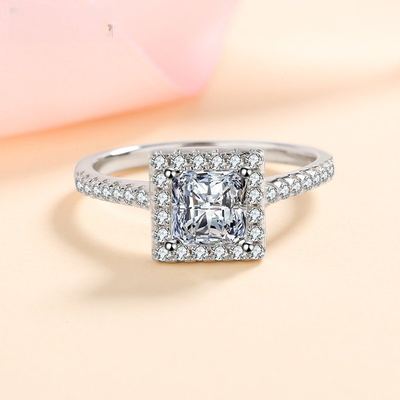
On the hand, a 1 carat princess cut in a halo reads wider than a 1 carat round in a four-prong head, because the halo adds stones around the centre rather than height above it. Same carat label, different read.
Prongs, bezels, and the side view
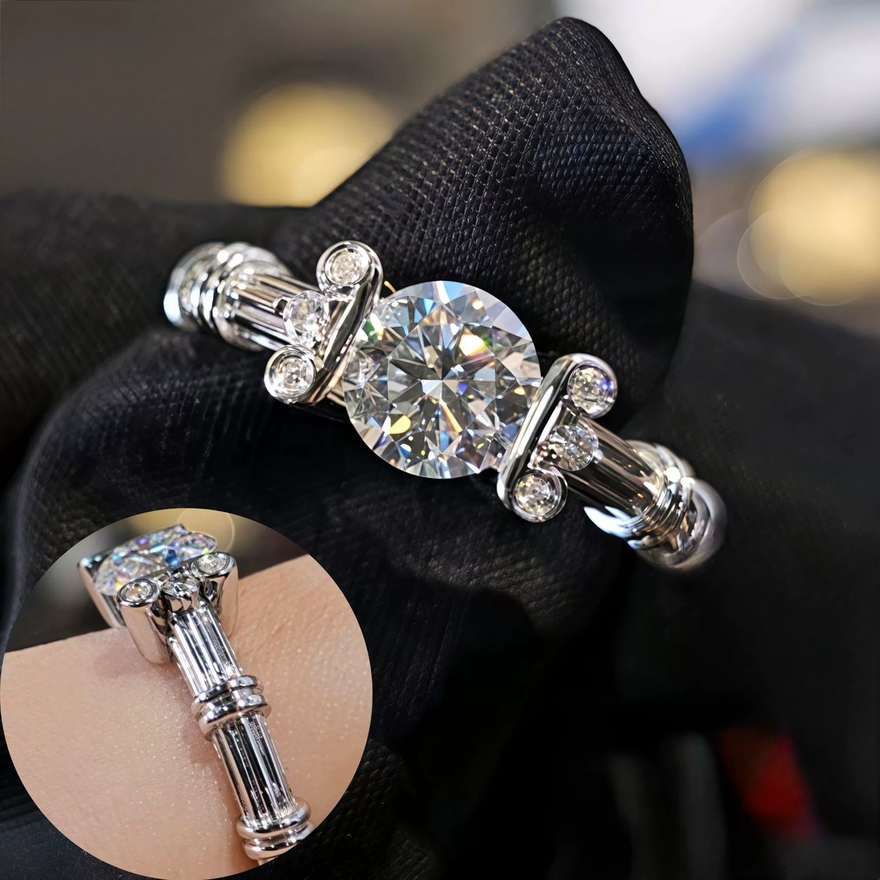
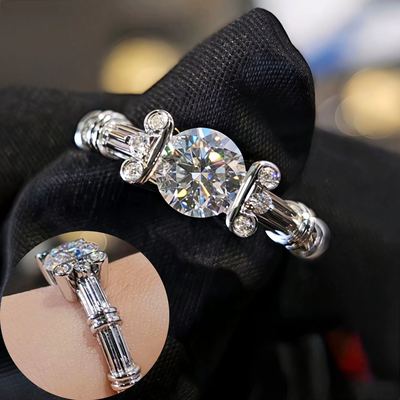
Four prongs show more of the stone from the side and let light under the pavilion; a bezel wraps metal around the girdle, and on a ring worn daily that edge is what meets doorframes. A bezel also takes more bench time than four prongs, and the emerald-cut bezel is the top of our 1 carat ring line at $159. Where that ring is yellow, the colour is a gold-tone plated finish over 925 sterling silver, and the plate wears first where it rubs.
Where CZ sits in this
CZ is usually the third price people collect, and it changes the question. It is a simulant rather than a material in its own right: made to imitate diamond, softer than either stone above, and it dulls with wear where silicon carbide and diamond do not. The full walk-through, including how each behaves under a tester, is in Moissanite vs CZ vs Lab Diamond.
Where the difference stops mattering
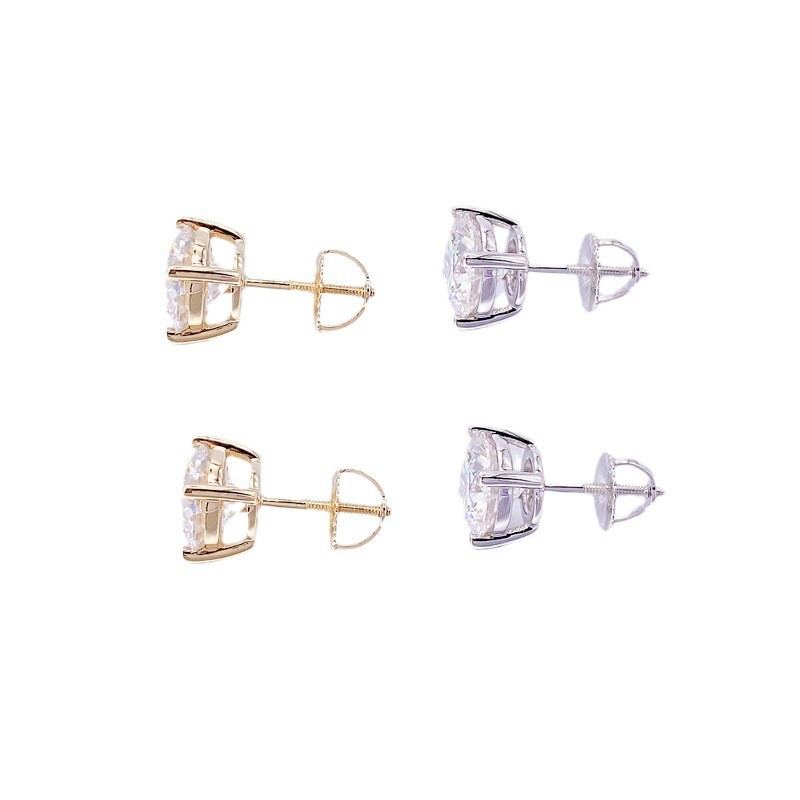
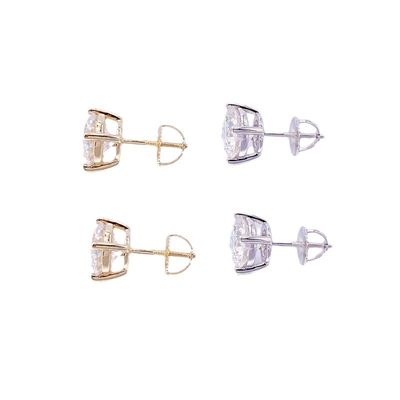
At 3mm the three stones are hard to separate face up in a lit room, and 3mm is the size most small set stones actually are. The gap opens with size, in the side view where the setting gives the stone away, and in low light, where moissanite's dispersion reads as colour while diamond stays white. Small sizes and prices are in the earring guide.
In motion
Twenty-three seconds of our pear-cut solitaire on the hand, several angles, no sound. What it shows is how the light behaves as the ring turns — a taste question no table answers.
What you give up with moissanite
Resale. Diamond has a secondhand market, lab or natural; moissanite has almost none. If you might want to turn the ring back into money, moissanite is the wrong purchase.
Documentation. A diamond worth grading usually comes with an IGI or GIA report, a third-party statement about colour, clarity and cut. Moissanite is not graded on those scales; where we state a colour or clarity standard, that is our buying standard.
The metal ages before the stone does. Silicon carbide does not tarnish or cloud; the 925 sterling silver around it darkens, and a gold-tone plated finish wears where it rubs. Does Moissanite Tarnish? is the only maintenance item.
Being told apart. Moissanite is doubly refractive, so a loupe shows doubled back facets in seconds, and a thermal tester reads it as diamond, which makes that test useless. Neither is a defect. See Does Moissanite Pass a Diamond Tester?
Which one to buy
The decision is smaller than the reading suggests: each stone answers a different question.
- You want the largest, brightest stone the budget allows. Moissanite. One carat runs $39 to $159 finished, 925 sterling silver, setting included, and the stone takes daily wear.
- The stone has to be a diamond. Lab diamond, about $570 to $640 a carat loose, plus the setting. It is a diamond, and it is graded like one.
- Resale is part of the purchase. Natural diamond, about $3,510 a carat loose and about $4,520 to $4,850 for G colour, VS clarity (PriceScope, 1 October 2026).
- The stones are small and there are many. Moissanite. Under 3mm the difference is invisible without a loupe, and the money is better spent on the setting.
The one thing not to do is buy moissanite and describe it as a diamond. For the wider price map, the ring cost guide lays out our ladder.
Frequently asked questions
Is moissanite the same as a lab diamond?
No. Moissanite is silicon carbide (SiC); a lab diamond is carbon (C), the same material as a mined diamond, grown in a reactor. Different chemistry, different hardness (9.25 against 10 on the Mohs scale), different optics: refractive index 2.648 to 2.691 and dispersion 0.104 for moissanite, against 2.42 and 0.044 for diamond.
Which is harder, moissanite or a diamond?
Diamond, at 10 on the Mohs scale against 9.25 for moissanite. Published values vary slightly by source, and some list a 9 to 9.5 range. The practical gap is small: only a diamond or another piece of moissanite scratches moissanite, so daily life will not mark either stone. The 925 sterling silver around the stone will show age first.
Can you tell moissanite from a diamond by eye?
Often not, especially under 3mm, where most small set stones sit. Face up in daylight the two read very similarly. Under a loupe a jeweller separates them in seconds: moissanite is doubly refractive, so the back facets appear doubled, and its dispersion of 0.104 against 0.044 gives it visibly more colour. A thermal tester reads moissanite as diamond, so that is not the test.
Why is a lab diamond cheaper than a natural diamond if both are diamond?
Because most of the cost is getting the stone. A natural one carat has to be found, and supply is fixed; a lab stone is grown to order, so supply follows demand. Both are carbon with the same hardness, refractive index and dispersion, and both are graded on the same scales. Retail medians put a loose one carat lab stone at about $570 to $640 (read on 18 September and 23 October 2026 respectively) and a loose one carat natural stone at about $3,510 (read 23 October 2026), in comparable colour and clarity bands.
For an engagement ring, is moissanite or a lab diamond the better buy?
If the finished ring has to come in under about $160, moissanite: our one carat rings run $39 to $159 in 925 sterling silver, setting included, and the stone is hard enough to wear every day. If it matters that the stone is a diamond, legally and to the people who will see it, buy a lab diamond and budget the setting on top. What is not honest is buying moissanite and describing it as a diamond.
Tell us the ring, the size and the date
Send the design you want, your US size and the date you need it, and we will quote the finished ring in 925 sterling silver with moissanite set by hand — stone, setting and sizing in one price. Already know the code? Quote it and we will pull up the piece.
Ask on WhatsAppSources: our own catalogue prices, read 24 October 2026, in USD, for finished rings in 925 sterling silver with the stone set, except where noted; carat figures are those printed in our product options, not laboratory weighings. Rings.com Lab-Grown Diamond Price Index, 1ct E VS1 IGI round, median list $571 with a $281 to $796 spread across four retailers, read 18 September 2026, cited as retail asking prices rather than completed sales. The Diamond Price, 1ct G to I colour, VS1 to SI1, lab median $640 and natural median $3,510 (most listings $3,010 to $4,090), read 23 October 2026, loose stones. PriceScope, 1.00 to 1.19ct natural round, G VS1 average asking about $4,851 a carat and G VS2 about $4,517, read 1 October 2026, loose stones. Gemological Institute of America, Gems & Gemology, Winter 1997, Synthetic Moissanite (Nassau), and the GIA Gem Encyclopedia entry for diamond, for chemical composition, Mohs hardness, refractive index, dispersion and specific gravity. Our prices are selling prices for finished rings; the diamond prices are retail asking medians for loose stones with no metal and no setting, and the two are not a like-for-like comparison. Every piece in our line is moissanite set in 925 sterling silver; where a colour is shown in yellow or rose, it is a gold-tone plated finish over that silver. A moissanite ring is not a diamond ring and is not described as one here.