Moissanite Tennis Bracelet Cost: $99 to $405, by Width
Short answer: our moissanite tennis bracelets cost $99 to $405. A 7 inch line is about 2.1 carats at 2mm and 12.5 at 4x6mm, which works out to about $48 and $28 a carat.
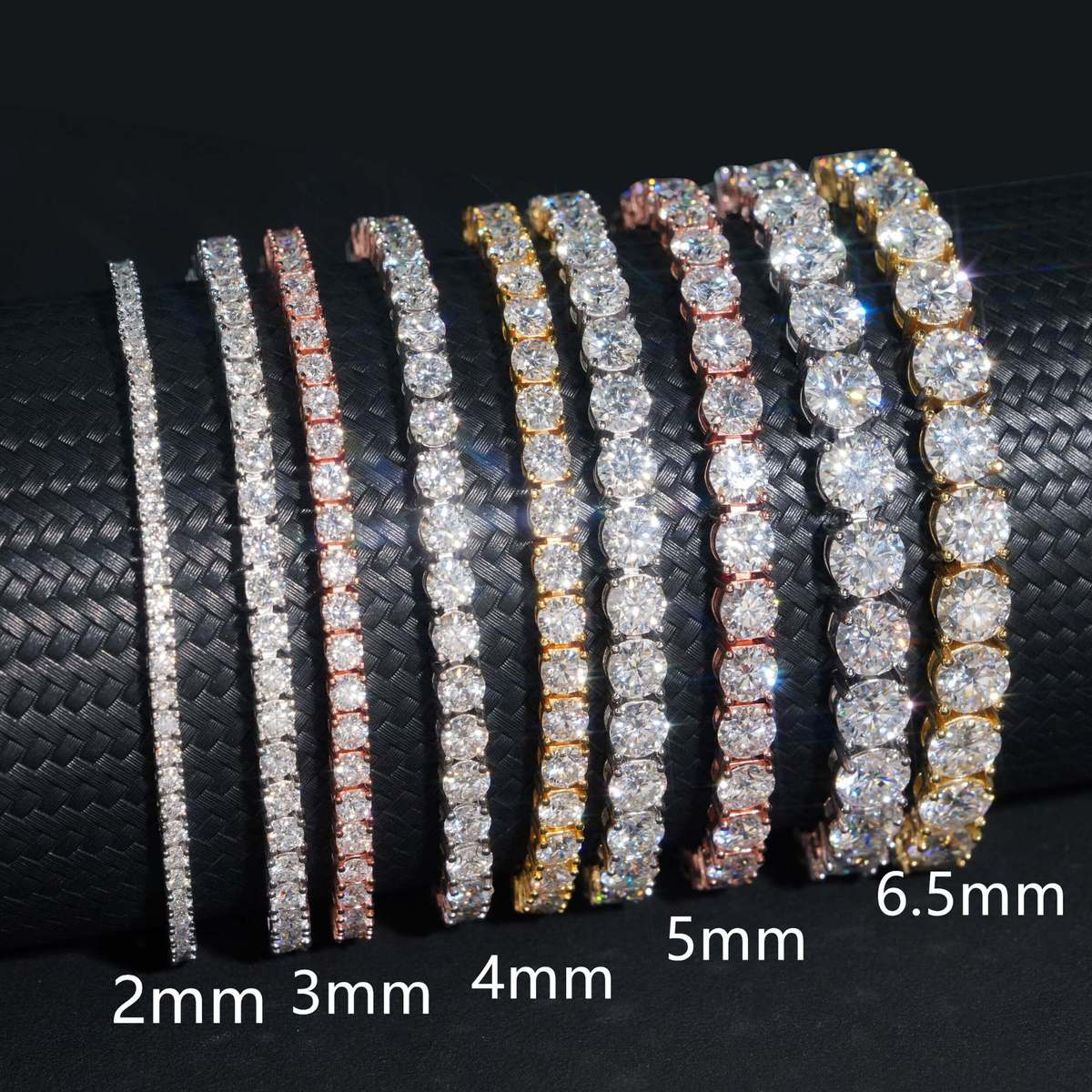
That spread is not quality. The pieces shown on this page are 925 sterling silver with hand-set moissanite in four claws; width, length and stone count are the whole difference. So the question is not how many carats you want — it is which width. Carat and price follow.
A tennis bracelet’s carat weight is a total, not a grade
Carat on a tennis bracelet means total carat weight, CTTW: every stone in the row added together. A 12-carat bracelet is not one 12-carat stone. It is 25 stones of about 0.5 carats, summed, and the number says nothing about whether they are well cut, well matched or well set.
On a moissanite listing the figure is normally diamond equivalent weight, DEW: what a diamond of the same diameter would weigh. Moissanite is silicon carbide and less dense than diamond — about 3.2 specific gravity against 3.5 — so a 3mm stone actually weighs a shade under the 0.10 carat it is sold as. DEW is a size comparison, not a material claim, and it is the convention that makes a 3mm row mean the same thing from any seller.
The carat arithmetic, so you can check us
Stone count is a division, not a guess: finished length, minus 12mm for the clasp, divided by the stone diameter plus about 0.4mm of metal between stones, rounded down. Caratura publishes the method, and on a 7 inch line it gives 69 stones at 2mm (about 2.1 carats) and 48 at 3mm (about 4.8 carats).
Worked, at 3mm: 177.8mm less 12mm leaves about 165mm carrying stones. 165 divided by 3.4mm is 48.5, so 48 stones. At 0.10 carats each, that is about 4.8 carats. The per-stone weights are 0.03 carats for a 2mm round, 0.10 for a 3mm round and 0.50 for a 4×6mm emerald cut.
The honest caveat: we sell by width and length, not by carat, so every figure below is an estimate calculated from stone size. The clasp and each setting take up room, and a real build can land a stone or two either side. Ask and we will count the build you are ordering.
What each width weighs, and what it costs at 7 inches
| Piece | Stone | Stones (est.) | Total carat (est., DEW) | 7 inch price | Price per carat |
|---|---|---|---|---|---|
| 2mm round row | 2mm, 0.03ct each | 69 | about 2.1ct | $99 | about $48 |
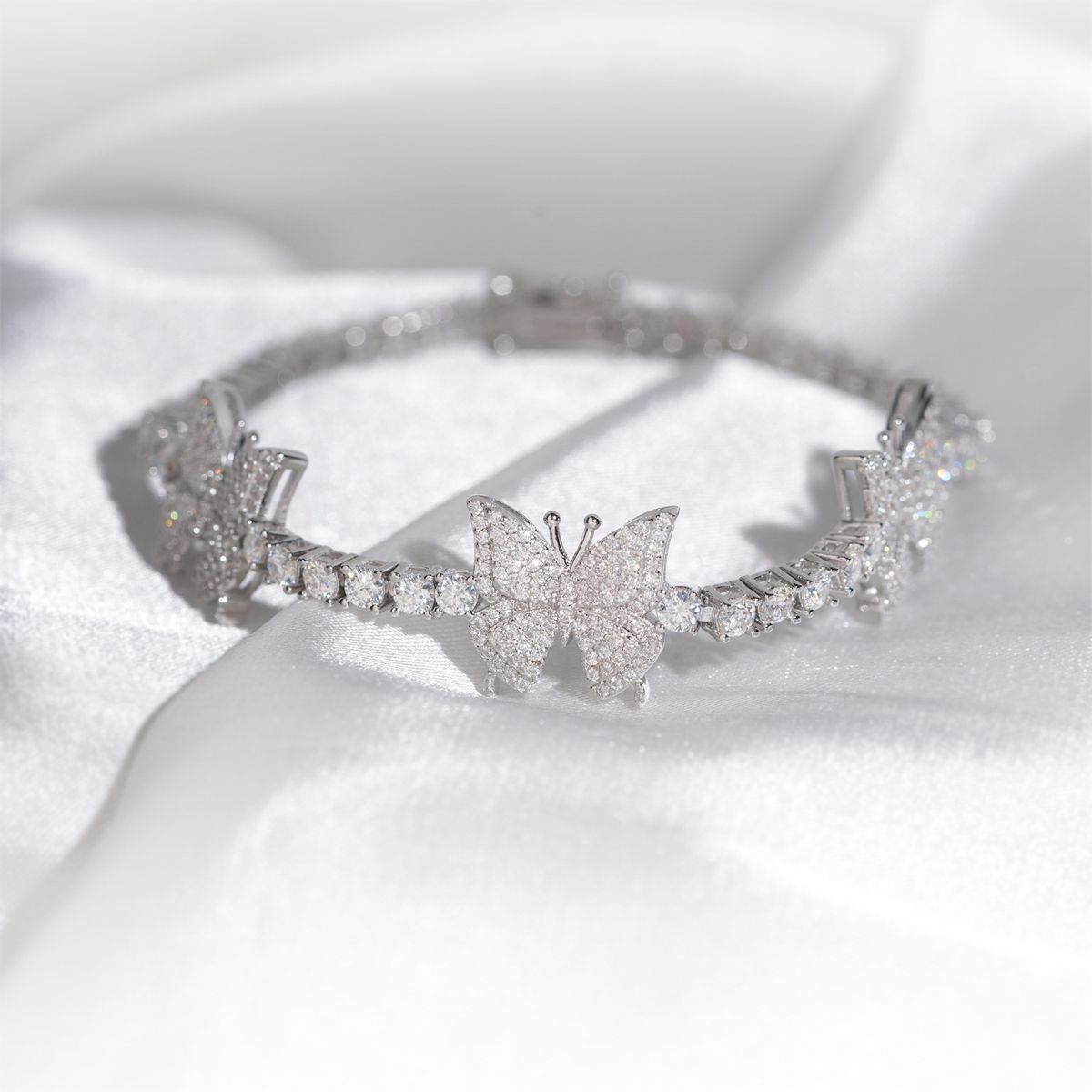
| 3mm round, butterfly centre | 3mm, 0.10ct each | 48 | about 4.8ct | $220 | about $46 |
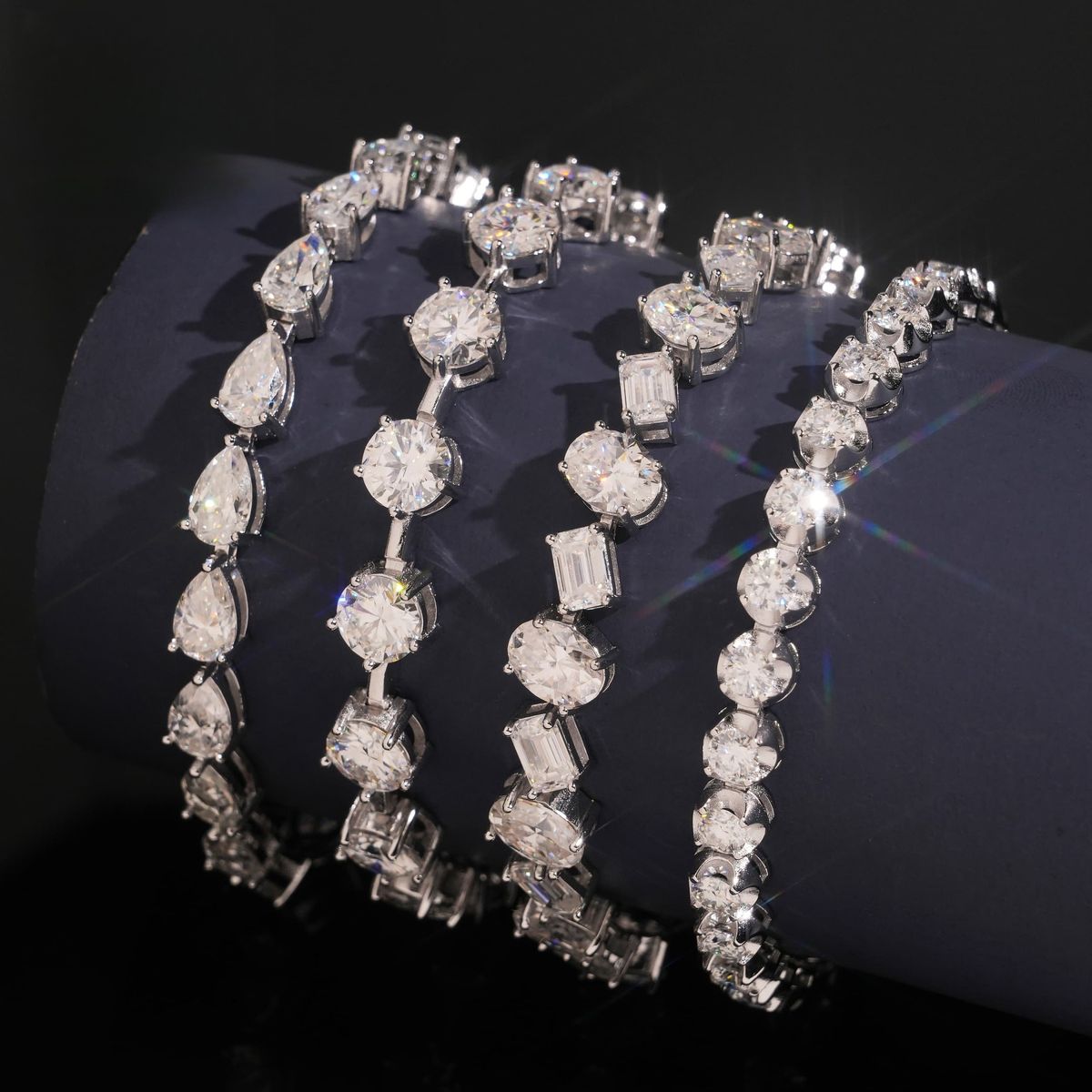
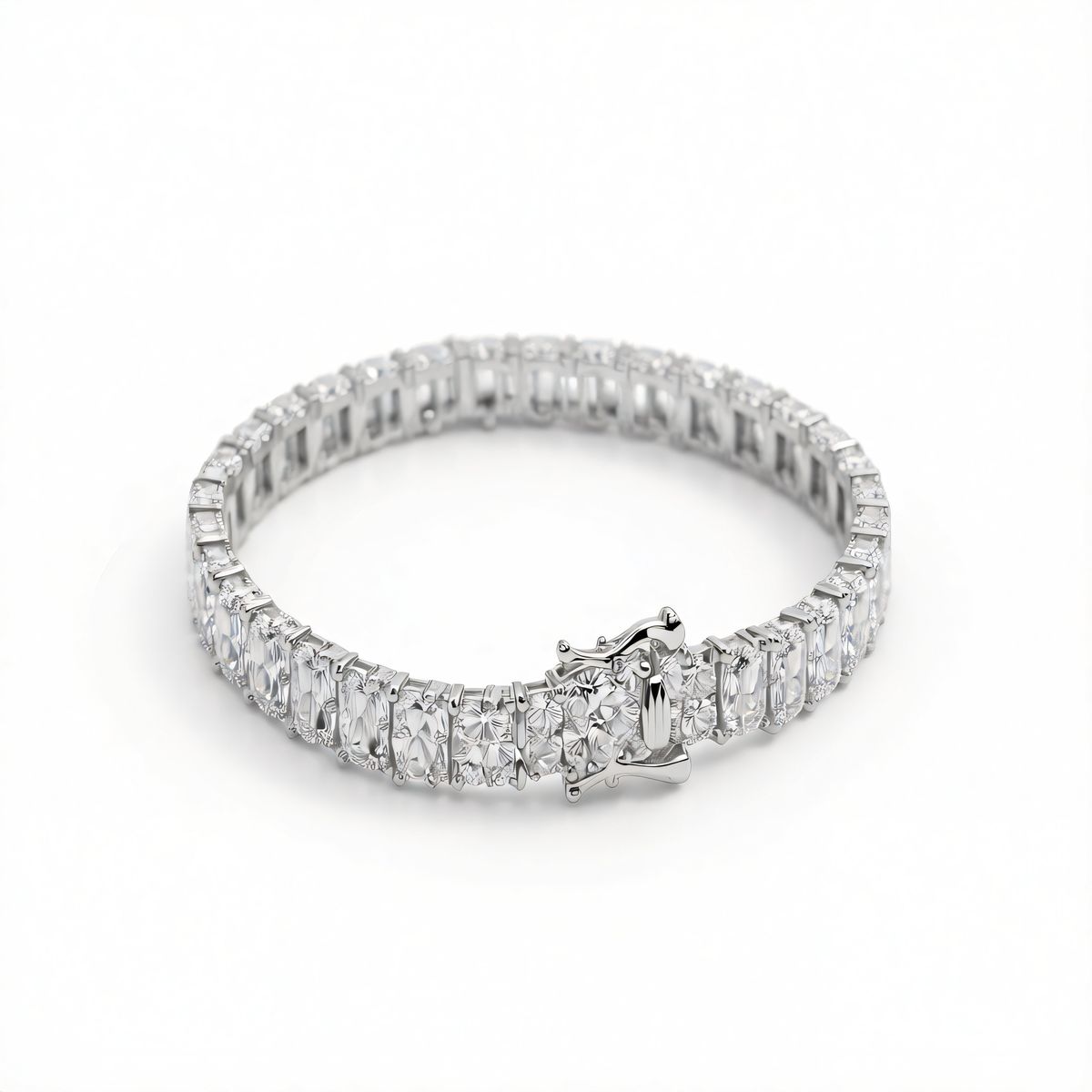
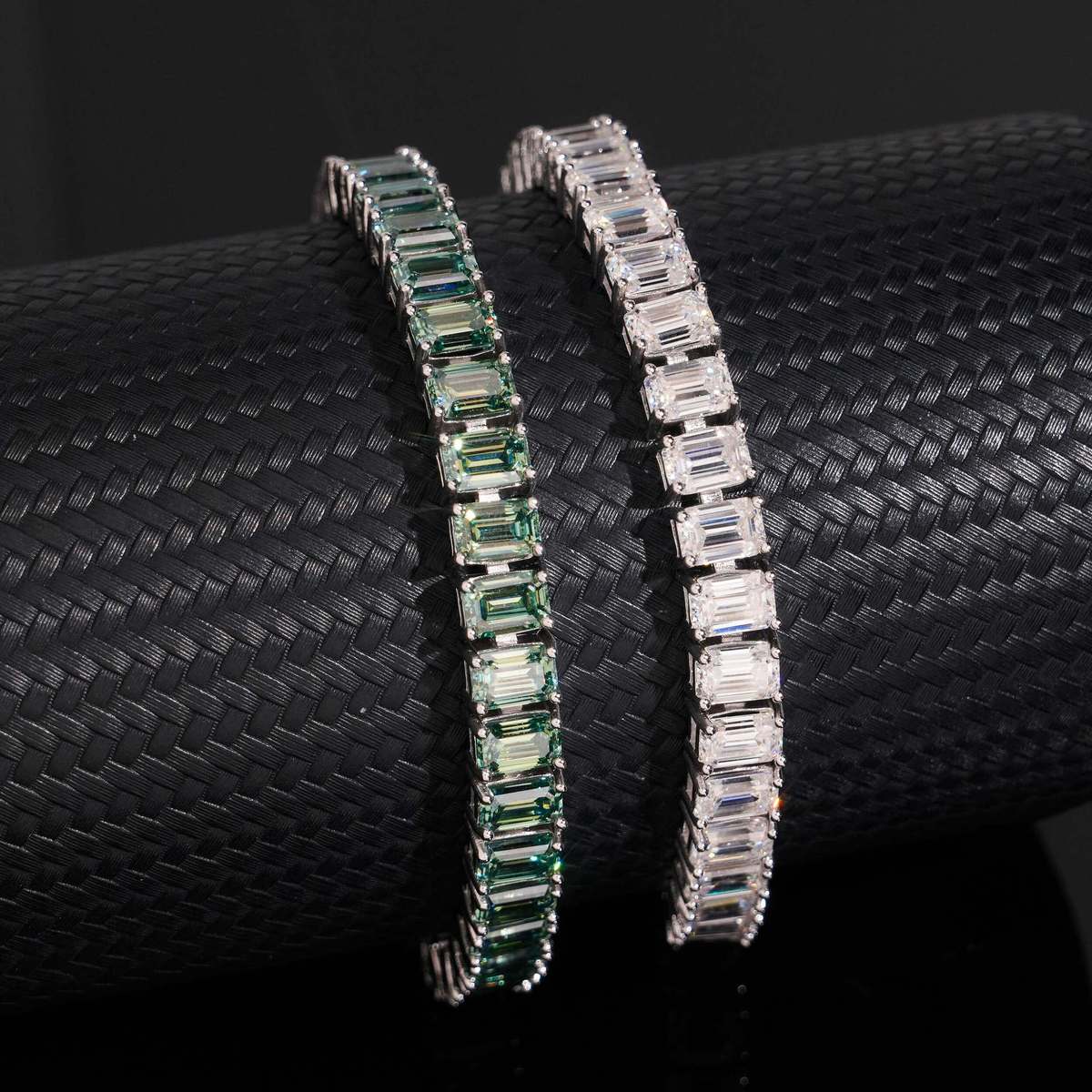
| 4×6mm emerald cut | 4×6mm, 0.50ct each | 25 | about 12.5ct | $354 | about $28 |
Estimated from stone diameter and a 177.8mm length, with a 12mm clasp allowance and 0.4mm between stones; per-stone DEW of 0.03ct at 2mm, 0.10ct at 3mm, 0.50ct at 4×6mm. Estimates, not measured weights. Prices: our own variant prices, 31 October 2026.
Read the last two columns against each other. From the 2mm row to the 4×6mm row the carat total multiplies by about six, 2.1 to 12.5, and the price by 3.6, $99 to $354. Carat gets cheaper as the stone gets bigger, the opposite of what the word makes people expect.
Why the price per carat falls as the stones get bigger
From the 2mm row to the 4×6mm row the carat total goes from about 2.1 to about 12.5 and the price from $99 to $354: six times the carats for 3.6 times the money, or about $48 down to about $28 a carat.
Three costs sit inside a bracelet and only one is stones. Silver and clasp are close to fixed per piece whatever the width. Setting labor runs the wrong way for the thin line: 69 placements with four prongs each, against 25 on the wide one. And stone material at the thin end is the smallest line item, because a 0.03-carat stone is close to a by-product of cutting a bigger one.
So carats grow faster than the cost of producing them, which makes shopping by carat a mistake: the wide row is not expensive because it has 12.5 carats, it has 12.5 carats because it is wide. The same logic runs on a chain, in links: the Cuban chain cost guide.
Every length, in one table
Length is the second lever and the weaker one. Same method, same gap, same per-stone weights.
| Piece | Length | Stones | Total carat (est.) | Price | Price per carat |
|---|---|---|---|---|---|
| 2mm round | 6.5 inch | 63 | about 1.9ct | $99 | about $52 |
| 2mm round | 7 inch | 69 | about 2.1ct | $99 | about $48 |
| 2mm round | 8 inch | 79 | about 2.4ct | $119 | about $50 |
| 3mm round, butterfly | 6 inch | 41 | about 4.1ct | $189 | about $46 |
| 3mm round, butterfly | 8 inch | 56 | about 5.6ct | $252 | about $45 |
| 4×6mm emerald cut | 6.5 inch | 23 | about 11.5ct | $329 | about $29 |
| 4×6mm emerald cut | 8 inch | 29 | about 14.5ct | $405 | about $28 |
Estimates from stone diameter and finished length, 12mm clasp allowance, 0.4mm between stones. Prices: our own variant prices, 31 October 2026. Whole tennis line, silver or plated: $99 to $405.
The 2mm row is $99 at 6.5 inches and $99 at 7, reaching $119 at 8: length is a weak lever. On the butterfly row, 6 to 8 inches adds 15 stones, 1.5 carats and $63 — about $46 down to about $45 a carat. The long one is marginally better value, not cheaper.
The same carat total in another material
The next question is what the same carat total costs as a diamond. These are retail prices for a like-for-like build — 6.5 inch, 14K white gold, round, four-prong, full circle — from Brilliant Earth, prices current to July 2026.
| Total carat | Stones | Lab-grown diamond | Natural diamond | Our nearest, 7 inch |
|---|---|---|---|---|
| 1 CTTW | 93 | $1,895 | $2,495 | 2.1ct, $99 (2mm) |
| 2 CTTW | 76 | $2,295 | $3,395 | 2.1ct, $99 (2mm) |
| 3 CTTW | 64 | $2,950 | $4,495 | 4.8ct, $220 (3mm butterfly) |
| 4 CTTW | — | $3,550 | $5,800 | 4.8ct, $220 (3mm butterfly) |
| 5 CTTW | 51 | $4,150 | $7,500 | 4.8ct, $220 (3mm butterfly) |
Diamond prices: Brilliant Earth, “How Much Is a Tennis Bracelet?”, page updated 24 September 2026, prices current to July 2026. Ours: our own variant prices, 31 October 2026.
Two caveats. A moissanite tennis bracelet is not a diamond one: silicon carbide against carbon, and nothing here makes the two interchangeable. This is a price reference at the same carat total, not an equivalence — 6.5 inches in 14K gold against 7 inches in 925 silver.
What it shows is where the money sits in a diamond bracelet: the material and the metal, not the setting. A diamond row barely moves per carat between 2 and 5 CTTW; ours falls 40% across a comparable step. On a ring it runs differently: the ring cost guide. For the material, What Is Moissanite?
What actually moves the price
Five things, in the order they matter:
- Stone diameter. The biggest lever, working through the count: 69 stones on the 2mm row, 25 on the 4×6mm. Width changes what each stone costs and how many there are.
- Length. More wrist, more stones, more setting — less than you would think: 6.5 to 8 inches moves the 2mm row $20 and the 4×6mm row $76.
- Hand setting. Each stone sits in its own four claws, placed by hand. Labor is the largest cost at thin widths.
- Clasp and articulation. A tennis bracelet fails at the clasp more often than at a stone, and that clasp is 12mm of length carrying nothing.
- Metal and finish. 925 sterling silver base; gold and rose gold are plated finishes on that silver. Plating is a look-and-upkeep question: Does Moissanite Tarnish?
Where the carat number will mislead you
Five traps worth knowing before you compare two totals.
Part of the length is not stones. The 12mm clasp allowance is real: 12mm of a 7 inch bracelet holds nothing.
A sixth of a thin line is metal. The 0.4mm gap is what lets a row flex, and it accumulates: at 2mm, 69 stones put about 27mm of gap into a 166mm run, roughly 17% of the visible line.
A half-set line looks identical from above. Stones across the top half read the same on the wrist at roughly half the carats. Ask whether the row goes all the way around; every piece here is a full row.
Carat is not size. 2.1 carats over 69 stones is a fine continuous line; 2.1 carats in two stones is another object entirely.
Fancy shapes weigh more per stone. A 4×6mm emerald cut is about 0.50 carats, so a 7 inch row is about 25 stones and 12.5 carats at $354, about $28 a carat. Rectangular stones are measured across two dimensions, so the round-stone column does not transfer.
None of that changes the buying order: width first, length second, carat as a check on what arrived.
Sizing, because length changes the carat
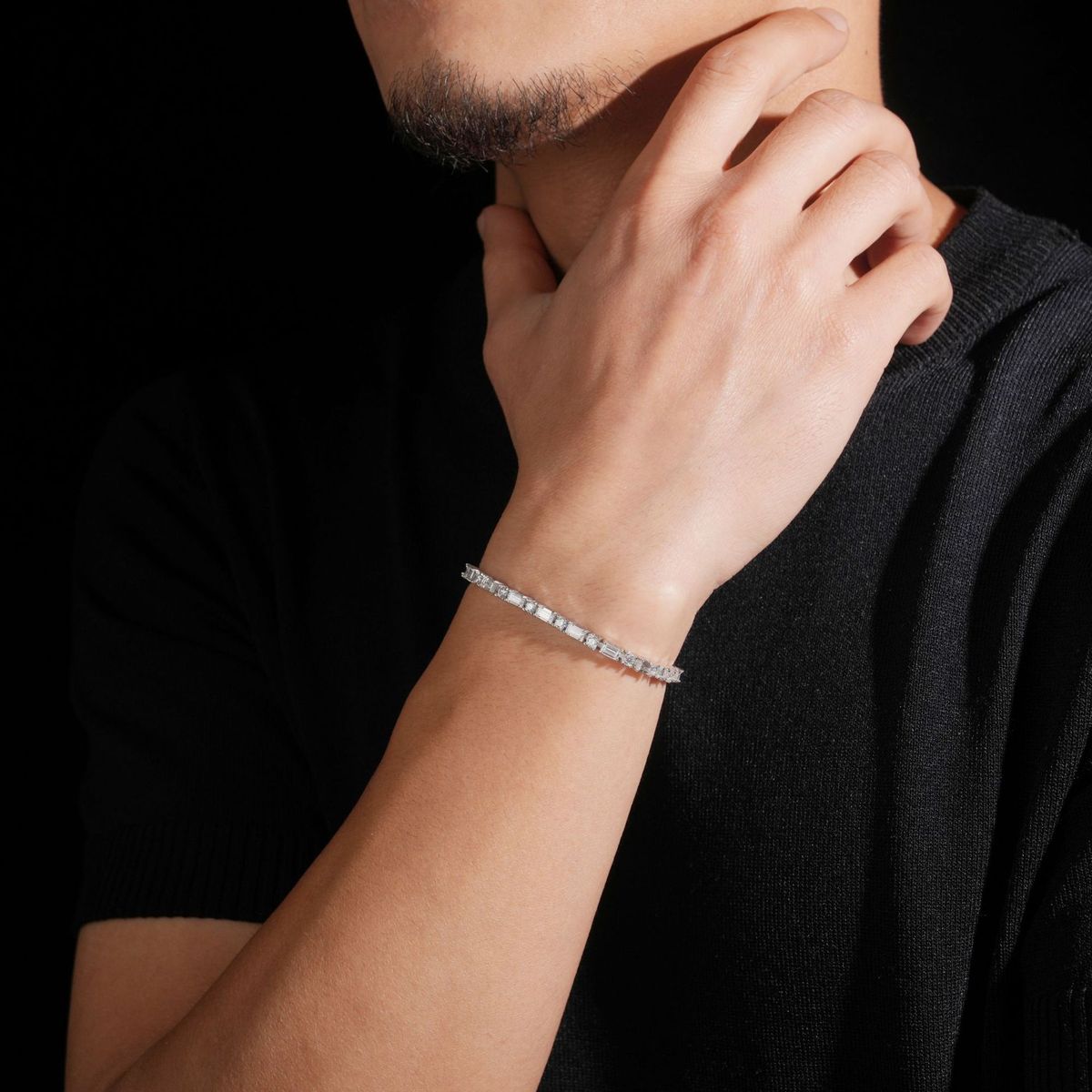
Measure snugly at the wrist bone with a soft tape, then add about half an inch — roughly 1.3cm — for movement and the clasp. Seven inches, about 17.8cm, is the most common adult length and the one every figure here uses. A closed bracelet that slides off over your hand without being opened is too loose; it will rotate rather than lie along the wrist.
And half an inch is stones: at 3mm, 7 to 8 inches adds about eight stones and 0.8 carats, the $220 to $252 step on the butterfly row.
Which width to buy
Width sets carat and price at once, so it is the only decision that really needs making. At 7 inches:
- 2mm round — $99, about 2.1ct, about $48 a carat. Delicate, and the least visible option on a larger wrist. The cheapest way onto the page and the natural choice for stacking two. The 2mm row comes in silver, gold plated and rose gold plated.
- 3mm round, butterfly — $220, about 4.8ct, about $46 a carat. More than twice the carats of the 2mm for $121 more, and the width that reads closest to a traditional diamond line. The butterfly row comes in silver, or a two-tone build with rose-gold butterfly links.
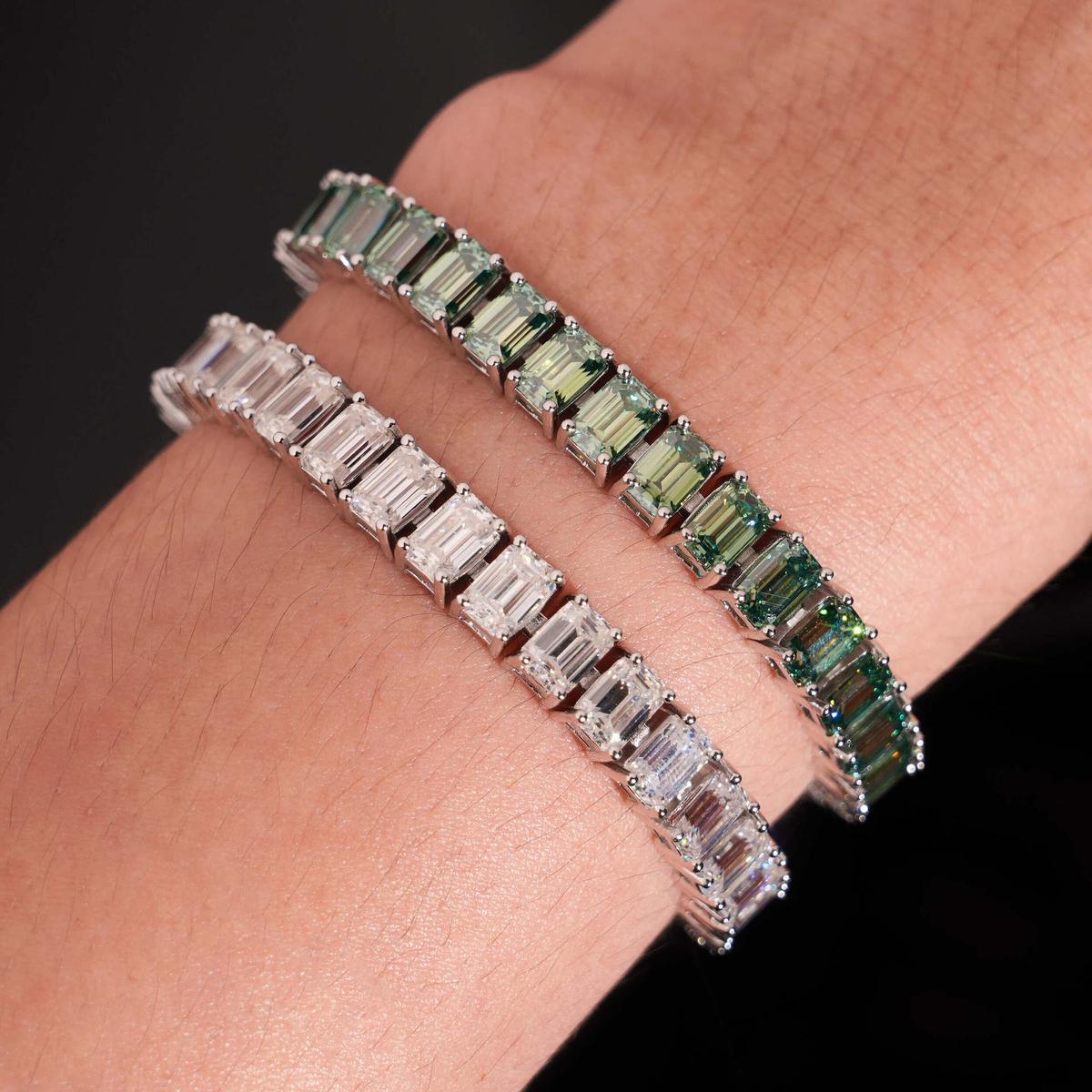
- 4×6mm emerald — $354, about 12.5ct, about $28 a carat. Two and a half times the carats of the 3mm row at the lowest cost per carat in the range. A statement row, not a stacking row: the 4×6mm row, white or blue-green.
If you are unsure between two widths, take the wider one: among the three builds in the table, $99 to $220 is the whole jump from 2mm to 3mm, and the narrow row is the one buyers come back and replace.
Frequently asked questions
How much does a moissanite tennis bracelet cost?
Across our tennis line, $99 to $405 as of 31 October 2026. At 7 inches: $99 for the 2mm round row, $220 for the 3mm round row with a butterfly, $354 for the 4×6mm emerald cut, and $405 for that last one at 8 inches.
How many carats is a tennis bracelet?
It depends on stone diameter more than length. On a 7 inch line with a 12mm clasp allowance: about 2.1 carats at 2mm over roughly 69 stones, about 4.8 at 3mm over 48 stones, and about 12.5 for a 4×6mm emerald cut over about 25 stones. Estimates calculated from stone size, not weights off a scale.
Why does the price per carat fall as the stones get bigger?
Because the carat total is mostly a count and the cost is mostly the work. Going from 2mm to 4×6mm raises the carat total about six times, 2.1 to 12.5, while the price rises 3.6 times, $99 to $354. The stone count falls from 69 to 25, and silver, clasp and handling are close to fixed per bracelet.
Is a 3mm tennis bracelet too thin?
No. A 3mm row at 7 inches carries about 48 stones and 4.8 carats, the proportion most fine tennis bracelets run at. The 2mm is the one to think about twice: 69 stones and 2.1 carats looks deliberate on a small wrist and slight on a larger one.
هل المويسانيت هو نفسه الألماس؟
No. Moissanite is silicon carbide, grown in a laboratory; a diamond is carbon. Different materials, different hardness and density, and moissanite is not a variety of diamond. Carat figures are usually diamond equivalent weight — what a diamond of the same diameter would weigh — which is a size comparison, not a claim about the material. How testers read the two is in هل يجتاز المويسانيت اختبار الألماس؟
Can you give me the exact carat weight of a bracelet?
We sell by width and length, not by carat, so every figure here is calculated from stone diameter and finished length; a real build can land a stone or two either side. Ask with the width and length and we will count that build. Any paperwork we supply is a CoA — a certificate of authenticity stating material and construction, not a grading report. The three home checks cover what you can verify yourself.
Want the Count for Your Wrist?
Send us the width and length you are considering and we will come back with the stone count, the carat estimate for that build, and the price at that exact size — including the lengths that are not on this page.
اسأل على واتسابSources: Brilliant Earth, “How Much Is a Tennis Bracelet?” (6.5 inch, 14K white gold, round four-prong full-circle prices by total carat weight for lab-grown and natural diamonds; page updated 24 September 2026, prices current to July 2026) — brilliantearth.com; Caratura, “Tennis Bracelet & Eternity Band Stone Counts” (stone count = finished length divided by stone diameter plus 0.4mm, with a 12mm clasp allowance, and the worked example of about 48 stones at 3mm on a 7 inch line) — caraturagems.com. Prices are our own catalogue variant prices, read 31 October 2026, in USD. Carat figures throughout are calculated estimates from stone diameter and finished length, not measured weights; we sell by width and length rather than by carat. Moissanite is silicon carbide, not diamond, and every comparison with diamond prices here is a price reference at the same carat total, not an equivalence.
Shop the Pieces in This Guide
Made to order in our Guangzhou atelier — 925 sterling silver, hand-set moissanite in four-prong settings.
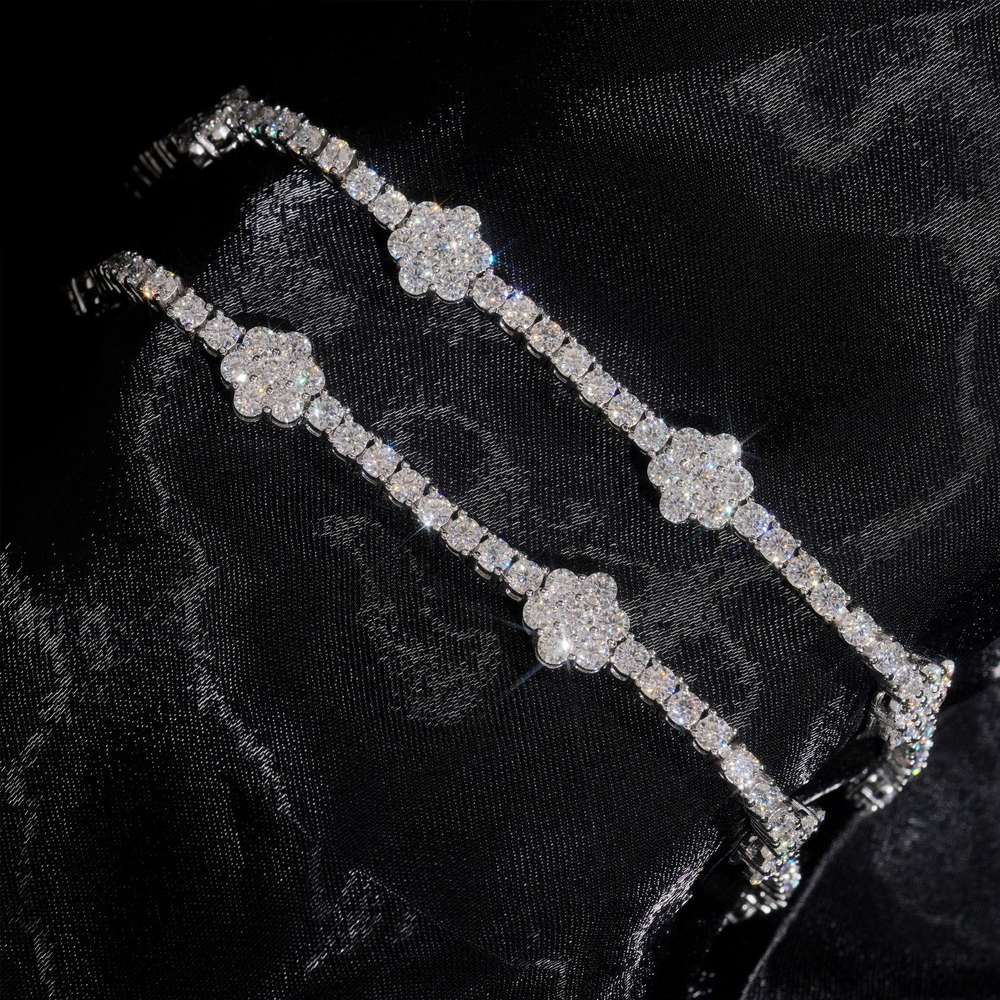
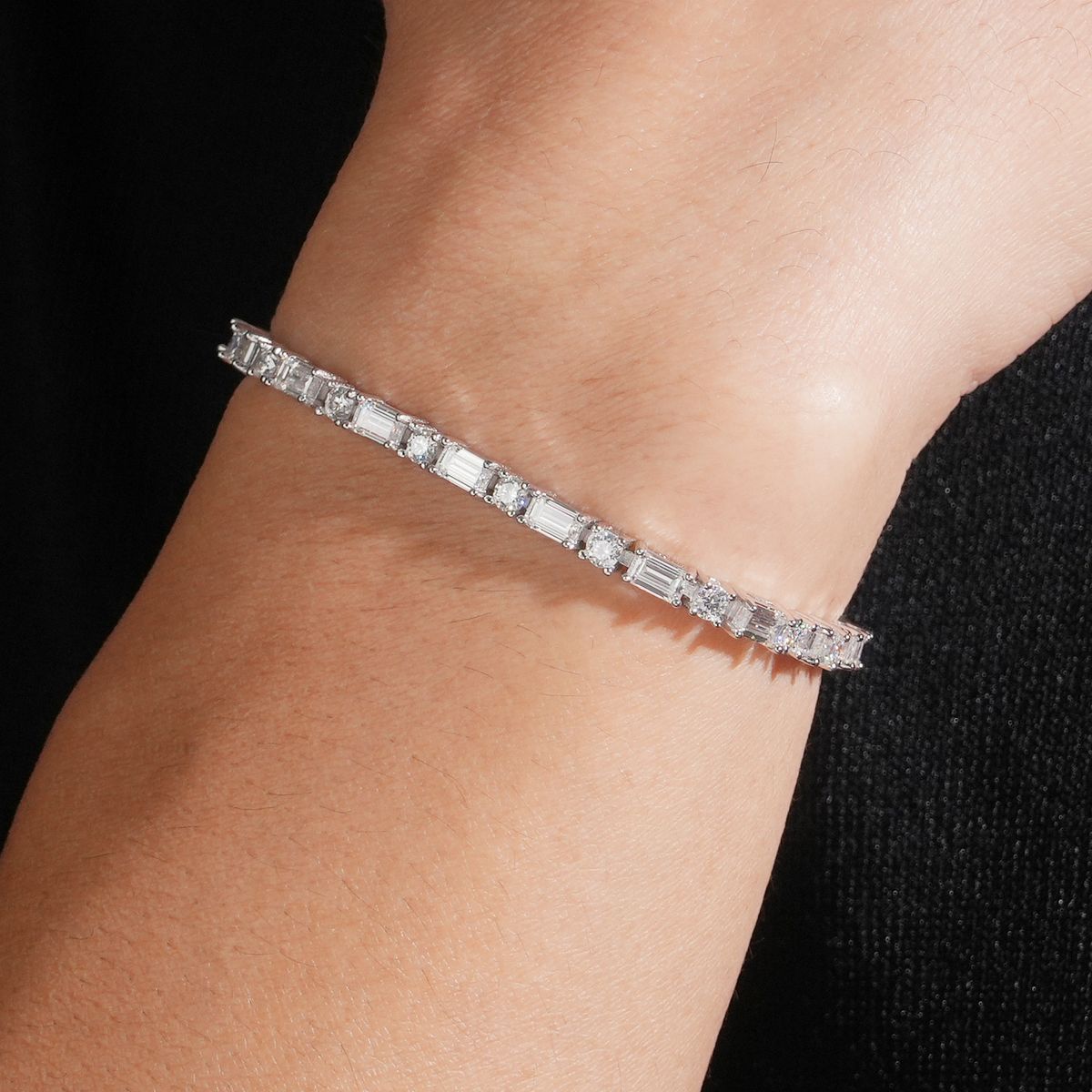
Also in the line: an emerald-cut and round alternating row at $199 in every length; the pear row at $239 and the flower row at $219.
Where these pieces come from
Everything here is made and set on our own bench in Guangzhou — 925 sterling silver and moissanite, with gold-tone plated alloy watch cases where the listing says so. If you are buying for a store, a brand or a reseller, the wholesale pages carry the minimums, lead times and terms:
- Cuban link chains — wholesale
- Moissanite jewelry — wholesale
- Custom iced out watches — wholesale
- Private label & brand manufacturing
Retail pieces in the same workshop: 16mm Cuban link chain · 18mm iced Cuban chain · RAM iced out pendant · Iced out square-case watch