Moissanite Certificate: What It Proves, What It Doesn't (2026)
Short answer: a certificate on a moissanite piece is an identification document. It says the stone is man-made silicon carbide, and gives its weight, shape and a colour description. It is not a grading report. No major laboratory grades moissanite on the diamond clarity scale, so a clarity figure on a moissanite listing is the seller's own sorting standard — and the document never adds a dollar to the price.
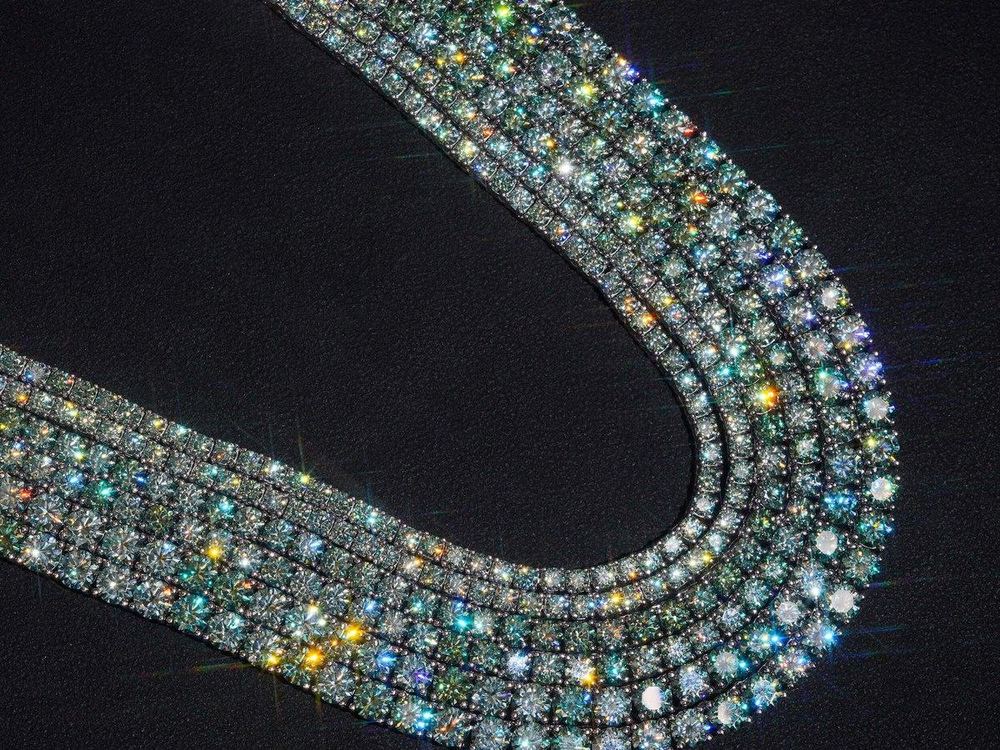
This is not an argument against documents. It is an argument about what they are for, because most of the confusion we answer on WhatsApp starts with a photograph of a card and the question: does this make it worth more?
What a laboratory actually writes on one
In December 2022 the International Gemological Institute began issuing documents for moissanite sold by a Dallas distributor. National Jeweler reported on 21 December 2022 exactly what those documents state: that IGI verified the material as man-made moissanite, together with the stone's carat weight, shape and “colorless characteristics”. The programme covered stones of 0.50 to 5 carats.
The same report notes that IGI had issued gem identification reports on moissanite for years, as had GIA and GCAL. So this is not an unusual document. It is a standard identification report with a short field list.
Read that list again: material, weight, shape, a colour description. Four fields. There is no cut grade, no clarity grade, no polish or symmetry score, and no carat-to-millimetre table promising you a spread. Those fields are missing for a reason, and the reason is the next section.
Why there is no grade in it
US rules define diamond numerically: “a mineral consisting essentially of pure carbon crystallized in the isometric system”, hardness 10, specific gravity approximately 3.52, refractive index 2.42 (16 CFR 23.12(a)). Moissanite is silicon carbide, and National Jeweler puts its refractive index at 2.69 and its Mohs hardness between 9.25 and 9.50.
A grading scale is a set of positions on a defined material. Change the material and the positions stop meaning what they meant. GIA said this in the Fall 2020 issue of Gems & Gemology, describing a moissanite it had examined in its Johannesburg laboratory: “The clarity would have been equivalent to VVS2 (if such clarity grades were assigned to synthetic moissanite).”
That parenthesis is the whole argument. A laboratory will tell you where a moissanite would sit. It will not give it a seat.
The three clarity claims you will meet, and only one is a problem
The GIA sentence above splits every listing you will read into three kinds, and they deserve different reactions.
- “Colour D–F, clarity in the VVS range — our sorting standard.” A supplier's own sorting, stated as sorting. Normal, and you can check the top end of it with a loupe in daylight.
- “D colour, VVS clarity” with no owner on the sentence. Usually diamond vocabulary carried over from wholesale sheets. Common. Ask whose scale, and you will usually get an honest answer.
- “Laboratory graded at VVS”. A grade that does not exist for this material. This is the one to walk away from, because it is a claim about a document that cannot have been issued.
For the record, and because you should hold us to the same standard: on our own listings the sentence reads “our stone standard: D–F colour, VVS range clarity”. That is a statement about how we sort parcels as they arrive from the workshop, not a laboratory finding. We write it that way on purpose. If a page cannot tell you which of the three cases it is in, that is the answer.
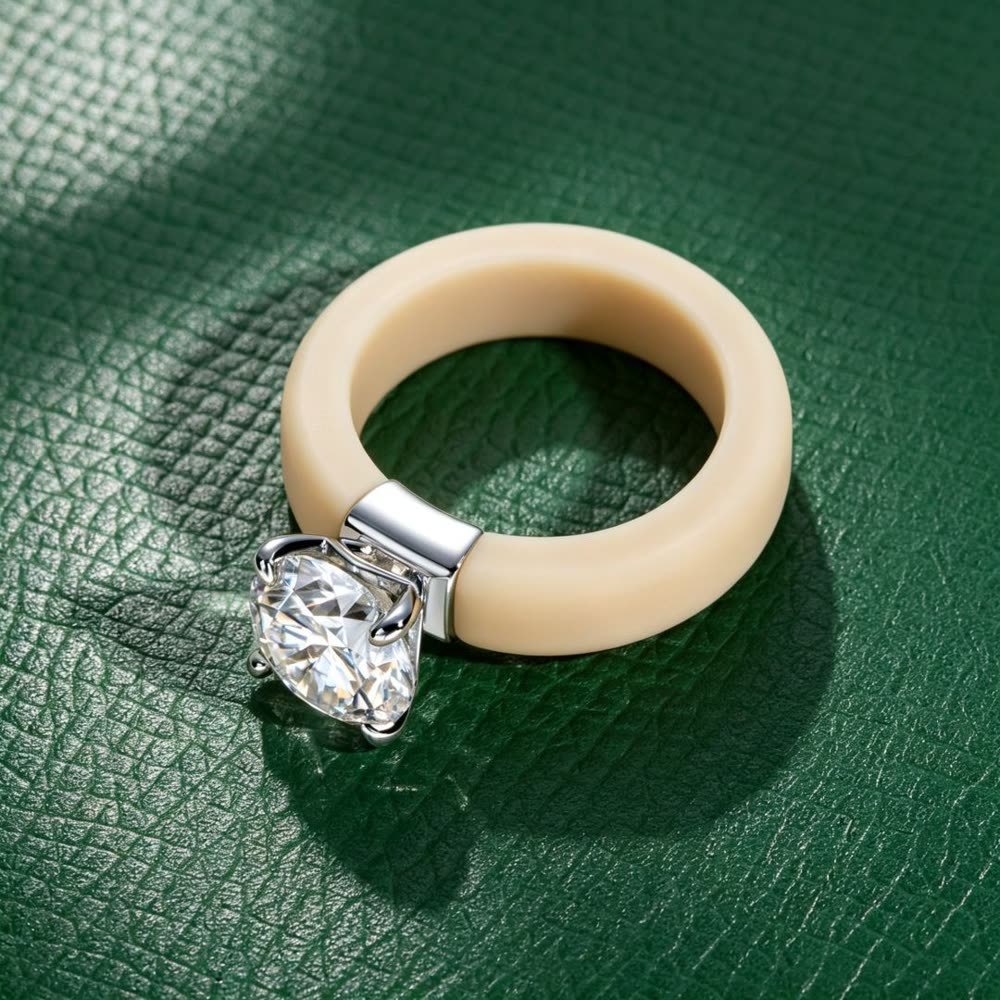
The one field you can check in thirty seconds
In the Fall 2020 lab notes, GIA described a 1.02 ct round brilliant sent to Johannesburg for a diamond report. The girdle carried a GIA inscription. Standard testing showed it was not diamond, and spectroscopy confirmed silicon carbide. The report number on the stone belonged to a diamond graded in 2019 at the same weight — and the inscription font was visibly not GIA's.
The Fall 2022 notes repeat it: a 1.71 ct square modified brilliant arrived in Mumbai with “GIA” and a number matching an existing report on its girdle. Also silicon carbide. That same note describes GIA Match iD, a matching service built on laser inscription imaging that GIA had recently announced — which tells you copies circulate widely enough to need one.
Two conclusions, and they are different. First, an inscription is not the stone. Second, a document is still worth checking, because the copy only works on a buyer who does not check.
So check. If a document carries a report number, type it into the issuing laboratory's own lookup — not the seller's page, which is where the copy was printed. Compare the weight and the measurements on the paper against the piece in front of you. And if the stone is already set, accept the limit: a set stone cannot be taken out and weighed, so the paper describes a loose stone at a moment in the past.
What the metal line has to say
Silver has a legal definition as well. Under 16 CFR 23.5(b), “Sterling Silver”, “Sterling” or “Ster.” may only describe an article that is at least 925/1,000ths pure silver; the bare word “silver” needs an accurate fineness figure immediately in front of it; and a product that is only coated with silver has to say that it is coated.
Which makes “925 Sterling Silver” a claim with a number inside it, and “silver” on its own no claim at all. Check the specification table rather than the headline. If the words are not there, the metal is unspecified, however the page is titled.
“Gold plated” has a floor of 0.175 microns. “Heavy” means 2.5
16 CFR 23.3(c)(3) sets the vocabulary. A gold electroplating may be described as Gold Plate or Gold Electroplate if the alloy is at least 10 karat and the coating reaches a minimum thickness equivalent to 0.175 microns of fine gold. At 2.5 microns — about fourteen times that — the piece may be called Heavy Gold Electroplate.
So “18K gold plated” tells you the karat of the coating and very little about how long it lasts. The rule's durability test is “reasonable durability”, which is a judgement rather than a number you can hold a seller to. The number that matters at year two is microns, and most listings do not print it.
Ours do not either. Our pieces are 925 sterling silver with a rhodium finish, or 18K gold plated in the gold colour. We do not quote a micron figure because we have not had our plating measured to that specification, and a number we cannot measure is a number we will not print. If plating life is the deciding factor for you, ask for microns and see who answers.
What the listing has to call the stone
FTC guidance on this is blunt. A seller describing an imitation or simulated stone must disclose that it is not diamond by describing it as “imitation”, “simulated” or a phrase of like meaning, immediately preceding the word “diamond” and equally conspicuously. Under 16 CFR 23.12(b), using the unqualified word “diamond” for something that does not meet the definition is unfair or deceptive.
A practical test you can run in ten seconds: search the product page for the word “diamond”. If it appears with nothing in front of it and the product is silicon carbide, the page is mislabelled, and the required disclosure has to sit next to the word — not in an FAQ two clicks away.
The word that always works is the material's own name. Our listings say moissanite, and where the chemical name helps, lab-created silicon carbide. Nothing else is needed, and nothing else is safer.
What the document does not do to the price
The same card rides along with the cheapest piece we sell and with the dearest. Price follows stone count, metal and the hours of hand setting between them. Below is our own catalogue, read as variant prices — what you actually pay at a given length or size, not the “from” figure on a category page.
| Category | Cheapest variant | Median variant | Dearest variant |
|---|---|---|---|
| Earrings | $29 | $59 | $339 |
| Pendants | $29 | $169 | $1,959 |
| Rings | $29 | $129 | $585 |
| Bracelets | $99 | $284 | $903 |
| Chains | $29 | $209 | $2,948 |
| Watches | $189 | $558 | $771 |
| Grillz | $55 | $526 | $1,096 |
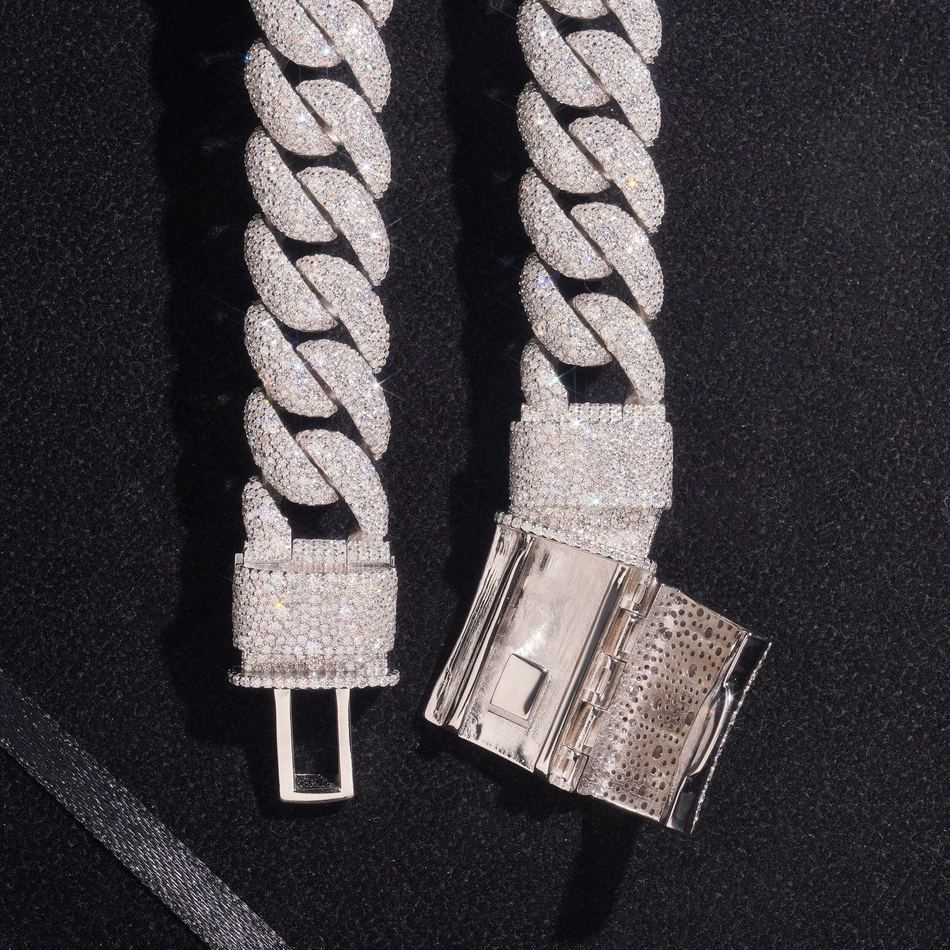
Our catalogue, variant prices in USD, 8 November 2026. The $29 end of Chains is a single-stone pendant necklace; the top is an 18mm four-stone Cuban chain at 24 inches.
A certificate is identical across every row of that table. That is the useful fact: the document is not a quality tier, because it does not change when the quality changes. Anyone charging a premium for the paperwork is charging for paper, and a document does not create a resale market for a lab-created stone either.
Six questions to send before you pay
Copy these. They take two minutes to answer and they close most of the gap between a listing and a piece.
- What is the stone called on the invoice? The invoice is the document that matters after the sale. If it carries a diamond word with no qualifier in front of it, ask why.
- What exactly does your document cover, and which stones? One loose centre stone, or the parcel behind a fully set chain? Those are different promises.
- What is the base metal and the finish? You are looking for 925 sterling silver with rhodium, or 925 with 18K gold plating. Anything vaguer is unspecified.
- If gold: plated, heavy plated, or solid? And if they say heavy, ask for the microns, because that word has a number behind it.
- Which length, in inches, and which clasp? In writing. A chain quoted as “18–24 inches” is three different prices.
- If a stone comes out in the first year, what do you do? The answer tells you whether the setting was sold as workmanship or as a favour.
If you want to check the stone yourself rather than trust a card, the three home checks are ranked in how to test moissanite at home, and the reason a heat pen lights “diamond” on silicon carbide is in does moissanite pass a diamond tester. For what the material actually is, see what moissanite is; for the difference between a simulant and a different stone, moissanite vs cubic zirconia. Pricing by the piece is in the Cuban chain and pendant guides.
Holding a Listing You Are Not Sure About?
Send the link, or a photo of the document and the piece. We will tell you which of the six questions it fails, even when the answer is “it fails ours too”.
Ask on WhatsAppFrequently asked questions
Does moissanite come with a certificate?
Usually yes, and it is an identification document. When IGI began issuing documents for moissanite sold by a Dallas distributor, National Jeweler reported on 21 December 2022 that they state the material was verified as man-made moissanite, plus the stone's carat weight, shape and colorless characteristics. Four fields: material, weight, shape, colour. There is no clarity grade, cut grade or polish score on the document.
Is a moissanite certificate the same as a diamond grading report?
No. A diamond report grades colour and clarity on scales built around carbon: 16 CFR 23.12 defines diamond as pure carbon with hardness 10, specific gravity about 3.52 and refractive index 2.42. Moissanite is silicon carbide, refractive index 2.69 and Mohs hardness 9.25 to 9.50 according to National Jeweler. GIA described one moissanite's clarity as having been equivalent to VVS2, if such clarity grades were assigned to it. That condition is the whole point: the scale exists, the assignment does not.
Can a moissanite certificate be faked?
The inscription can be, and GIA has documented it twice. In its Fall 2020 lab notes a 1.02 ct round brilliant arrived in Johannesburg with a GIA inscription carrying a report number that belonged to a diamond graded in 2019; spectroscopy showed the stone was silicon carbide, and the inscription font was not GIA's. In the Fall 2022 notes a 1.71 ct square modified brilliant in Mumbai carried a GIA inscription and a matching report number, and was also moissanite. Look a report number up at the laboratory that issued it, never at the seller's page.
My listing says D colour, VVS clarity. Is that wrong?
Not necessarily wrong, but it is borrowed vocabulary, because those terms were defined for diamond. There are three cases and they are not equal. If the page says the figure is the seller's own sorting standard, that is a checkable claim about sorting. If it just prints D colour VVS with no owner, ask whose scale. If it says the stone is laboratory graded at that clarity, walk away: no major laboratory assigns moissanite a clarity grade, and GIA phrases the comparison as a hypothetical.
Does a certificate make moissanite worth more?
No. The same document travels with a $29 pair of studs and with the dearest chain we sell at $2,948. Price follows stone count, metal and hand work, not paperwork. Anyone charging a premium for the document is charging for paper, and no document creates a resale market for a lab-created stone.
How do I check the metal claim myself?
Two places. On the piece, look for 925 or S925 stamped on the clasp or a small tag. In the specification table, look for the words 925 Sterling Silver: under 16 CFR 23.5 those words may only be used on an article that is at least 925/1,000ths silver, and the bare word silver needs a fineness figure in front of it. If neither appears, the metal is unspecified whatever the headline says.
Sources: National Jeweler, “IGI Now Issuing Reports for Moissanite From Roseco”, Michelle Graff, 21 December 2022 — nationaljeweler.com; GIA, Gems & Gemology Lab Notes, Fall 2020, Vol. 56 No. 3, “Synthetic Moissanite with Fraudulent GIA Inscription” — gia.edu; GIA, Gems & Gemology Lab Notes, Fall 2022, “Fraudulently Inscribed Synthetic Moissanite” — gia.edu; 16 CFR 23.12, 23.3(c)(3) and 23.5(b), e-CFR via Cornell LII — 23.12, 23.3, 23.5; FTC, “In the Loupe: Advertising Diamond, Gemstones and Pearls” — ftc.gov. Prices: our catalogue variant prices, 8 November 2026, USD, per piece; entry and top figures name the actual variant, medians are the middle value of every variant we currently sell in that category.