Tennis Chain vs Cuban Link: Price, Width, Which to Buy
Short answer: A tennis chain is one row of set stones — the money goes into stone. A Cuban link is metal loops with stone on the flat face — the money goes into metal. At 18 inches ours are $169 and $689.
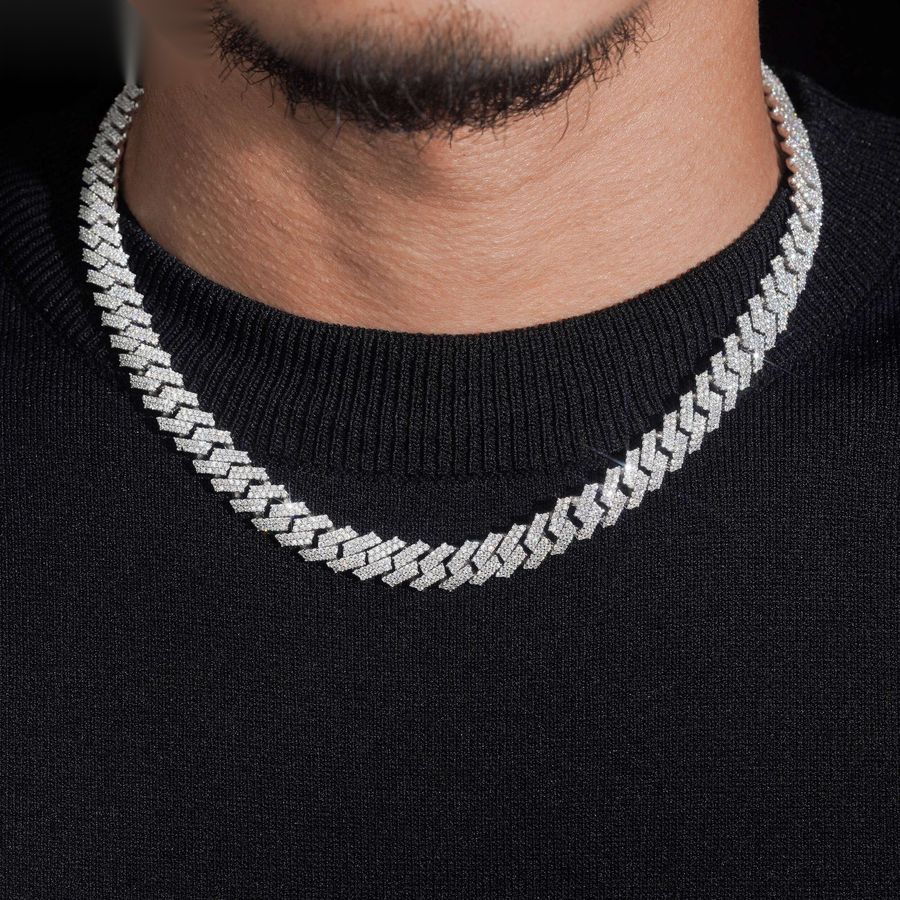
Below: how each is built, what the millimetre numbers mean at 18 to 24 inches, our own variant prices at every length, and four buyer cases.
What each one is built like
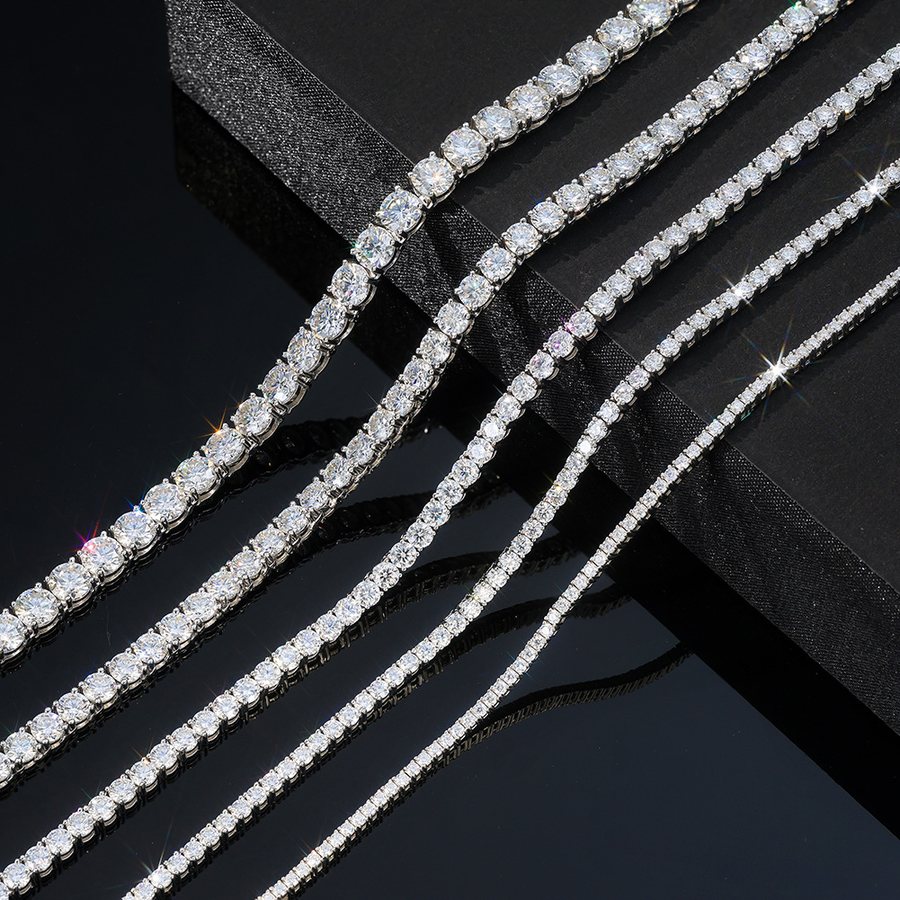
The name is young; the construction is old. GIA puts the name on Chris Evert and the 1987 US Open, where her bracelet came off mid-match, and describes the piece as a line bracelet: a continuous line of individually set stones (GIA 4Cs, “How the Tennis Bracelet Got Its Name”, 6 July 2016). A tennis chain is that object with a clasp at each end — one stone per setting, each setting joined to the next, and nothing in the row but the width of the joint.
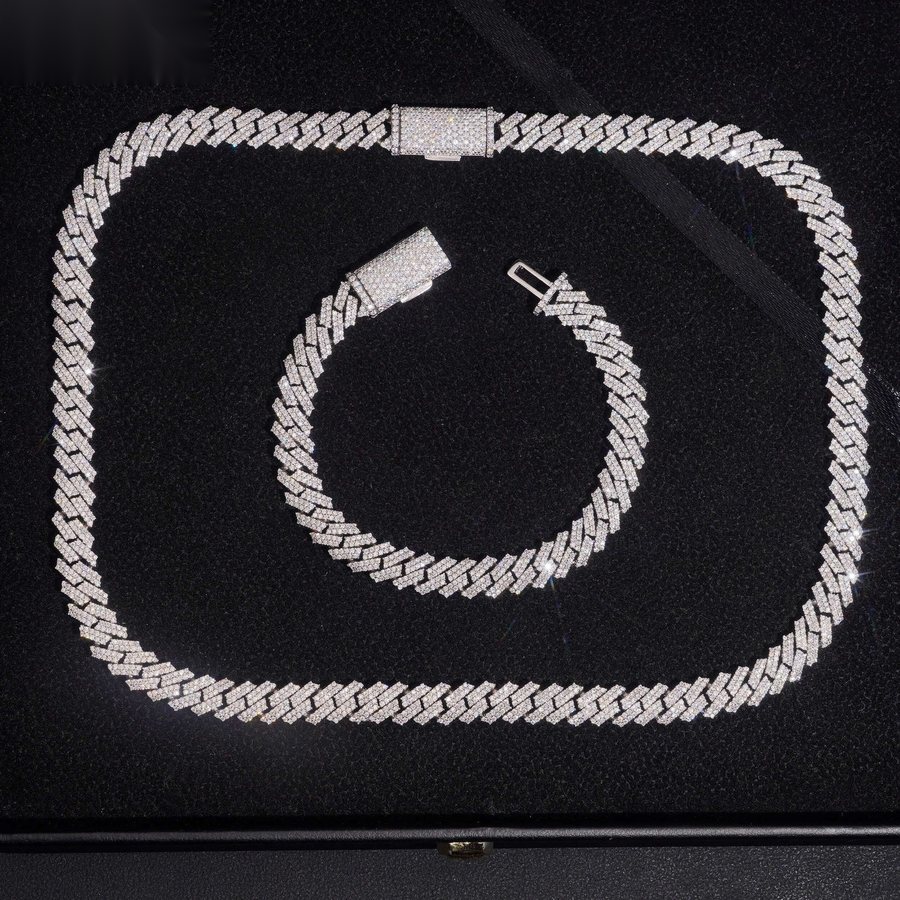
The Cuban link is the other way round. Business Insider is blunt about the history: the origin is hard to pin down and probably did not start in Cuba, but by the late 1970s and 1980s the link was part of hip-hop style, and the costliest examples are still made by hand in a handful of Miami shops (Business Insider, 19 July 2021). What matters for a buyer is the unit: a closed loop, each loop passing through the next. Set stone on that face and the loop is still there — the sides of every link, and the join where two links meet, stay bare metal.
That one difference explains most of what follows. On a tennis chain the metal hides under and between the settings, so the row reads as a single line of stone. On an iced Cuban the link is the frame: the stone sits on the face and the outline stays metal all the way round. Same width, two different silhouettes.
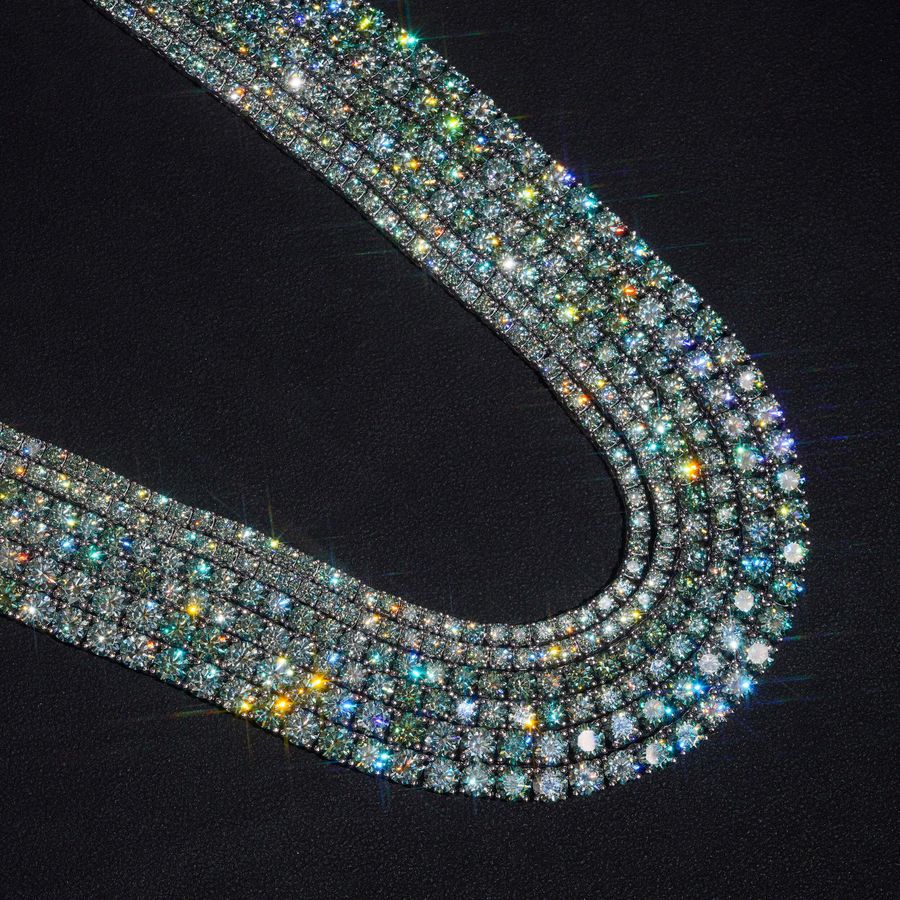
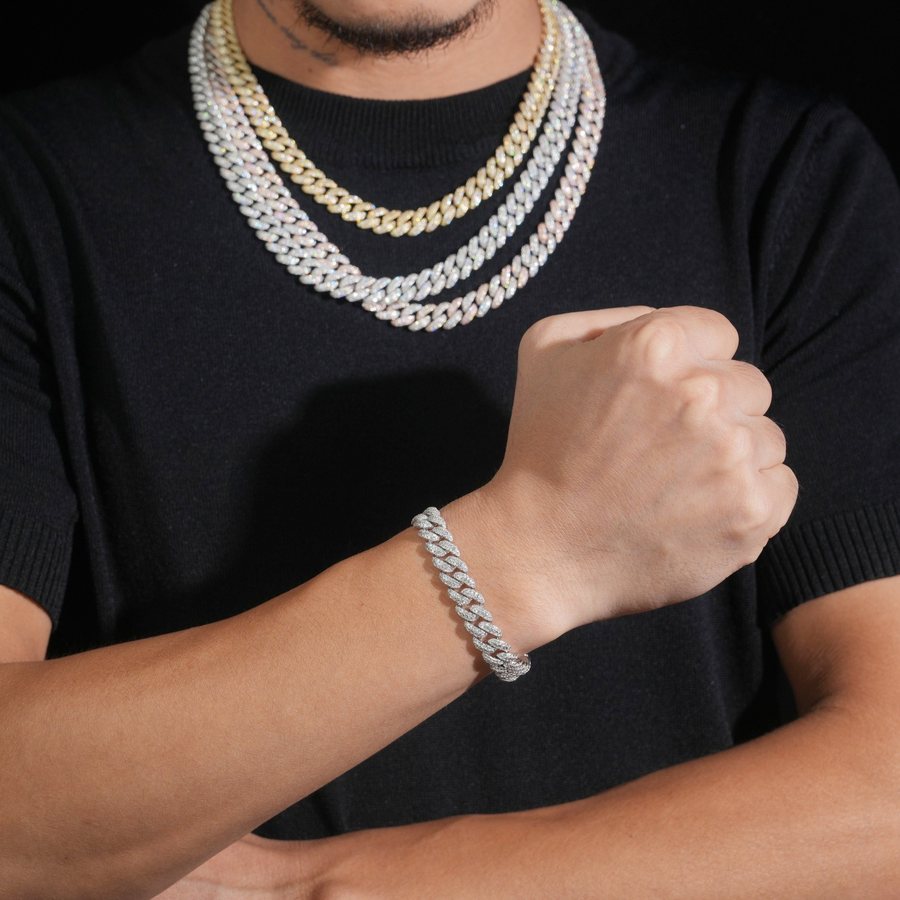
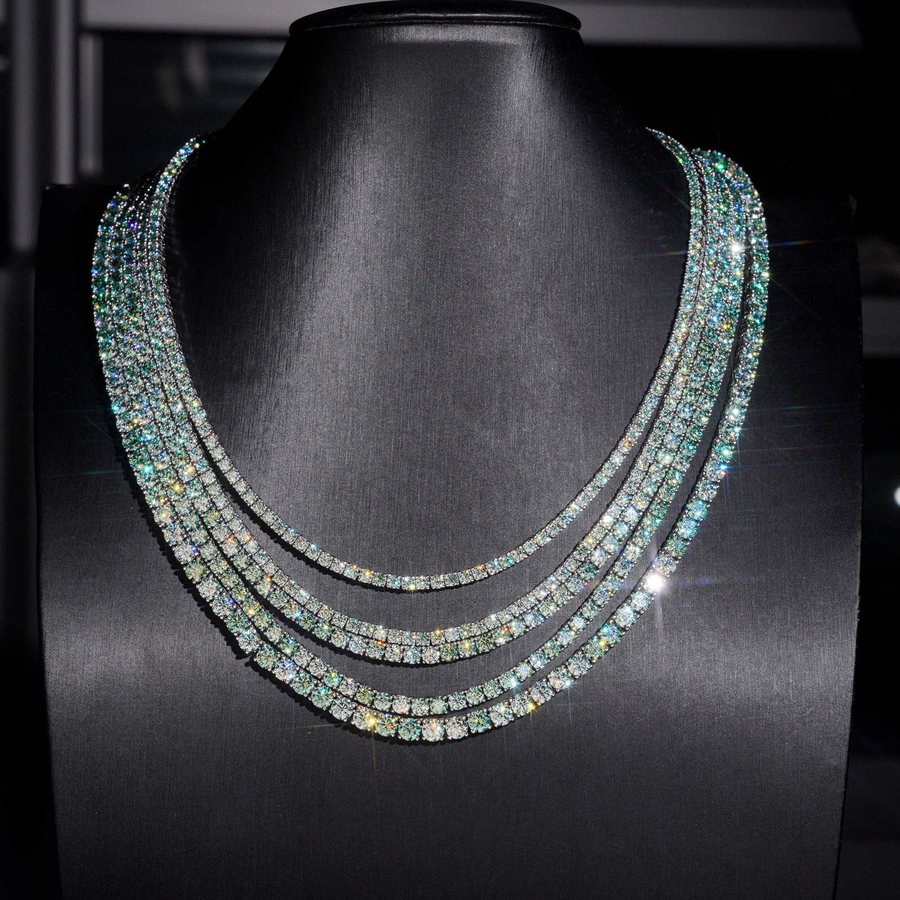
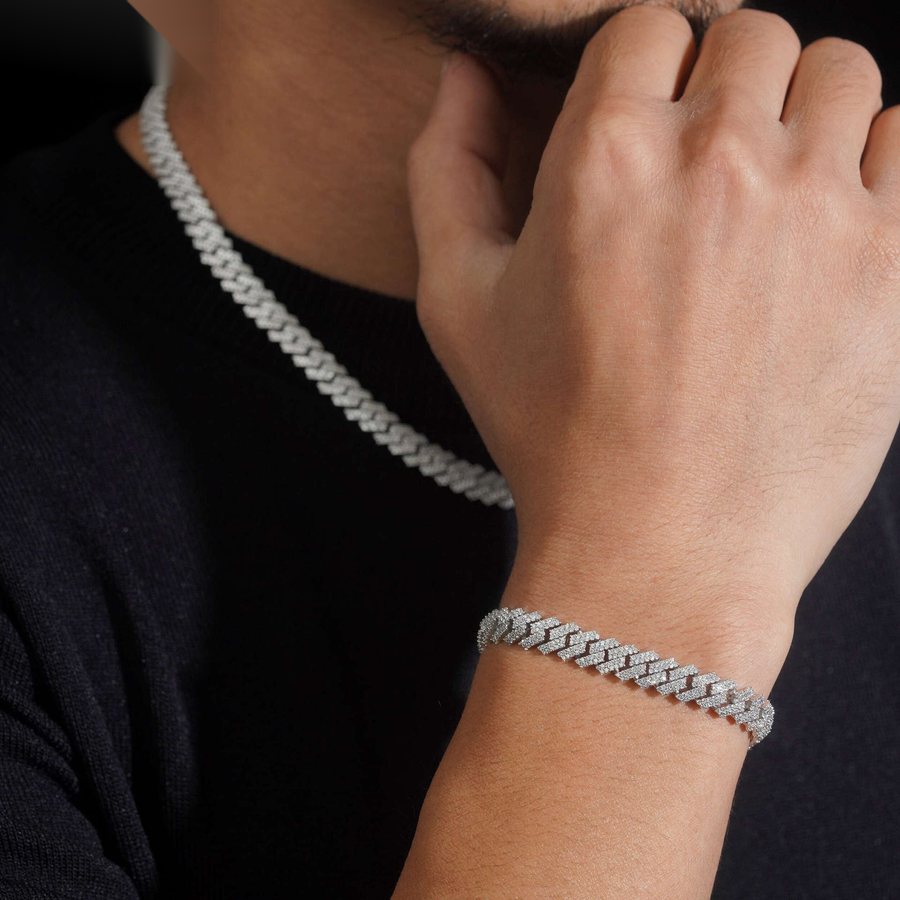
It also decides how each sits on the neck. A tennis chain lies flat and close, brightness even because every stone faces the same way; a Cuban stands off the skin, and the joins throw small shadows between paved faces.
Width and length: what the numbers mean at 18–24 in
Width is the millimetre figure measured across the face, not around the piece. Our tennis chain comes in 2.0, 3, 4, 5 and 6.5 mm. The iced Cuban comes in 8 mm, where the face carries two rows of stone, and in 10 mm.
Length is where it sits. 14 inches is a choker position, above the collarbone; 18 inches lands at the collarbone on most men, which is the length we stock as standard on the tennis chain; 24 inches drops to the chest and reads as a pendant-length chain over a T-shirt. The four positions are photographed side by side in the chain length guide.
Then the part that surprises people: which number moves the price. On our tennis chain, width is free. All five widths are $169 at 18 inches, $120 at 14 inches and $222 at 24 inches — the same money whether the row is 2 mm or 6.5 mm. That is a pricing decision on our side, not a law of jewellery, but it makes the millimetre on a tennis chain a taste question rather than a budget one.
On a Cuban, width is not free. The 8 mm double row runs $619 at 16 inches to $919 at 24; the 10 mm runs $849 to $1,269. Both numbers move, because a wider link is more metal per inch and carries more stone on the face per link, and both of those are work.
We do not print a gram weight: the field in our catalogue is not filled in reliably for these pieces, and a table built on a guess is worse than none. Ask about a style and a length and we weigh that piece.
What each costs in our line
Three pieces, the lengths people actually order, all silver colour on an S925 silver base with moissanite set:
| Piece | Width | Short length | 18 in | 24 in |
|---|---|---|---|---|
| Tennis chain, one row NOV-TN-001 | 2.0–6.5 mm | $120 (14 in) | $169 | $222 |
| Iced Cuban, 8 mm double row NOV-CH-9840 | 8 mm | $619 (16 in) | $689 | $919 |
| Iced Cuban, 10 mm NOV-CH-9836 | 10 mm | $849 (16 in) | $949 | $1,269 |
Variant prices from our own catalogue, read 22 November 2026, in USD, silver colour. Each figure is the variant price for that length, not an average.
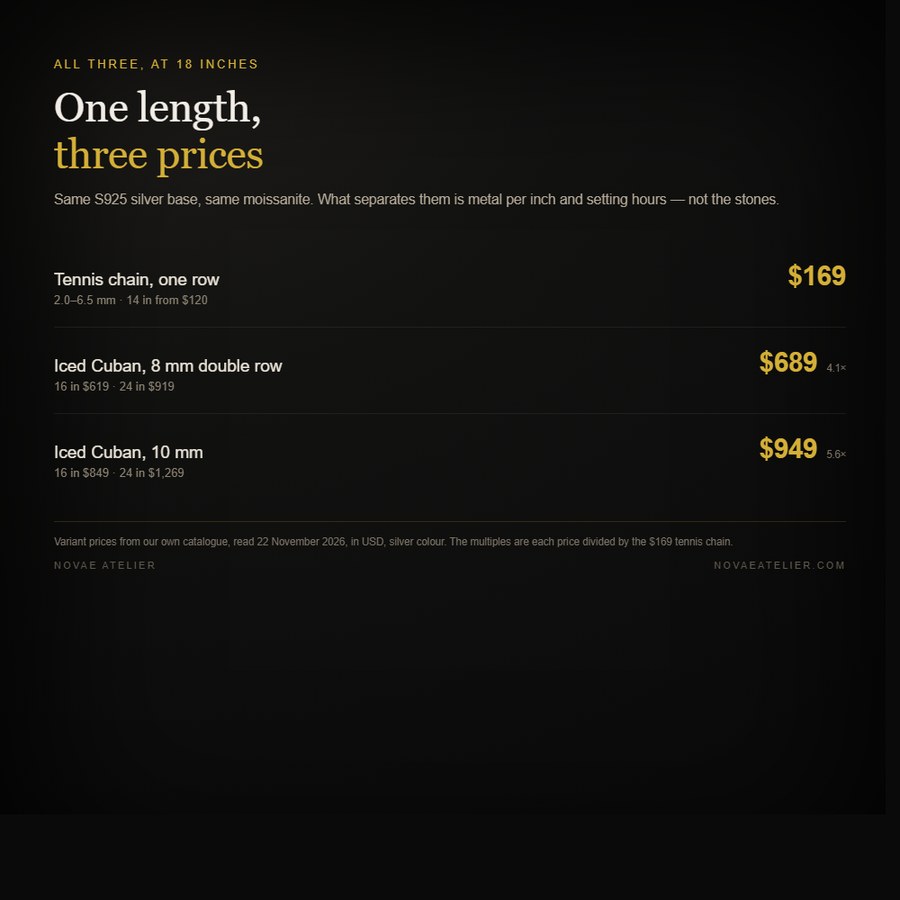
$689 is 4.1 times $169; $949 is 5.6 times. If you want the same metal at the price of a tennis chain, the short end is where to look: both Cubans also come as bracelets, 6.5 to 8.5 inches at $249 to $429 for the 8 mm and 7 to 9 inches at $369 to $479 for the 10 mm.
And if the question is only the lowest price on this page, it is neither of the Cubans: our blue-green tennis chain, NOV-CH-9848, is a single listing at $119.
The arithmetic for wide links is in the Cuban chain cost guide, and the same logic for one row of stone at bracelet lengths is in the tennis bracelet cost guide. What the stone itself is — silicon carbide, 9¼ on the Mohs scale, dispersion 0.104 — is in what is moissanite (GIA, Gems & Gemology, Winter 1997).
Which one to buy for your case
Four cases cover almost every order we take.
| Your case | Buy | Why |
|---|---|---|
| First iced chain, budget under $200 | Tennis chain, 18 in — $169 | The most stone per dollar in the line, and at a given length the width costs nothing extra |
| You wear a pendant on it | Cuban, 10 mm at 16–18 in — $849–$949 | The link holds the weight and the shape of a bail; a row of settings does not |
| You layer several chains | A 2–3 mm tennis at 16 in, an 8 mm double row at 20 in | Flat next to thick reads as two pieces; two thick chains read as one |
| Gift, size unknown | Tennis chain, 18 in — $169 | Width is the same price, and 18 in is the length we stock as standard |
Two rules of thumb are worth more than a table. If you want sparkle that carries across a room, take the tennis chain: the row faces outward, and every stone is a full face of light. If you want mass — the piece that reads in a photo before anyone looks at the stones — take the Cuban, and buy width before you buy length, because an 8 mm at 18 inches will do more for the silhouette than a 6 mm at 24.
On a pendant, the numbers for the piece itself are in the pendant cost guide; on stacking, how to layer chains has the order that keeps them apart. If the finish is your worry rather than the stone, the care side is in what actually tarnishes.
Frequently asked questions
Is a tennis chain or a Cuban link more expensive?
In our line the Cuban link is, by a wide margin. At 18 inches the tennis chain is $169 and the 8 mm double-row iced Cuban is $689; the 10 mm is $949. The difference is metal per inch and the setting hours that come with a paved link face, not a dearer stone.
Which one looks bigger at the same width?
The Cuban. Its unit is a closed loop, so at a given millimetre the piece stands further off the skin and its outline takes more of the frame. A tennis chain is a flat line of settings, and it reads as a line rather than a mass.
Can I wear a tennis chain every day?
Yes, with one habit. It is a row of individual settings, and every setting is a small moving joint, so the wear point is the setting rather than the stone. GIA recommends having the clasp and mountings of tennis jewellery checked periodically and adding a safety catch beside the clasp (GIA 4Cs, “How the Tennis Bracelet Got Its Name”, 6 July 2016). The stone is not the part you are protecting: moissanite measures 9¼ on the Mohs scale.
Is the metal plated?
It depends on the piece, and it is the one line worth reading on the product page before you buy. Both iced Cuban chains in this guide are electroplated over the same S925 silver base. A plating is a surface, so the points that rub lose it first, and what shows through is silver, not a different metal.
What lengths do you make?
Tennis chain: 14, 16, 18, 20, 22 and 24 inches in all five widths. Iced Cuban: 16 to 24 inches, plus bracelet lengths from 6.5 to 9 inches. The listed lengths ship as standard; a custom length is made after the order.
Tell us the length and we will price one piece
Both constructions are made in our own workshop in Guangzhou. Send the style, the width and the length in inches, and you get one number for that piece — not a range.
Ask on WhatsAppNotes on this page
Prices are variant prices read from our own catalogue on 22 November 2026, in USD, silver colour; where a piece is sold by length the figure is for that length. Every piece named here is an S925 silver base set with moissanite, which is silicon carbide and carries no gem-lab clarity grade. Gold colour means an electroplated finish over that silver base, not a solid gold alloy, and not every style is offered in every colour. The construction descriptions are of the two types, not a measurement of any individual piece. The GIA and Business Insider references describe origin and construction; they are not product claims about the pieces here.
Shop the Chains in This Guide
Made to our spec in Guangzhou — S925 silver base, moissanite set in our workshop, finish named per style.
Where these pieces come from
Everything here is made and set on our own bench in Guangzhou — 925 sterling silver and moissanite, with gold-tone plated alloy watch cases where the listing says so. If you are buying for a store, a brand or a reseller, the wholesale pages carry the minimums, lead times and terms:
- Cuban link chains — wholesale
- Moissanite jewelry — wholesale
- Custom iced out watches — wholesale
- Private label & brand manufacturing
Retail pieces in the same workshop: 16mm Cuban link chain · 18mm iced Cuban chain · RAM iced out pendant · Iced out square-case watch