Is Moissanite Worth It? The Honest 2026 Guide (Cost, Wear & Resale)

Nobody who writes to us asks whether moissanite is pretty. They ask whether the money is right. That single question is really three questions wearing one coat — will it look the way I want for years, will it survive being worn the way I actually live, and if I change my mind later, is there anything left to sell? Most pages answer the first, dodge the second and never mention the third. This page does all three, with our own prices and names of the sources behind every claim.
Short answer: for wearing, yes. As of 11 October 2026 our catalogue runs from $29 for a pair of stud earrings to $3,589 for an 18mm fully iced Cuban link chain — 251 pieces, stones set, most of them in 925 sterling silver, made to order in our Guangzhou workshop. The stone does not cloud, fade or discolour, and it is hard enough for everyday wear: GIA's own study of synthetic moissanite rates it about 9¼ on the Mohs scale against diamond's 10 (GIA, Gems & Gemology, Winter 1997), and measures its dispersion — the property that splits light into colour — at 0.104 against diamond's 0.044, which is what people mean when they say it throws more fire (same study). Where moissanite is not worth it is as a place to keep money. There is no organised secondhand market for it, and we are not going to quote you a resale percentage that we cannot source. If part of why you are buying is value you might get back one day, the more honest purchase is a diamond, or nothing. You will rarely hear a seller say that. It is still true.
Three questions, separated
Does it look right. This is a taste question with a measurable half. Moissanite is silicon carbide, a crystal grown in a laboratory, and it bends and splits light more strongly than diamond does. GIA's description of the material is unusually direct: it can be mistaken for diamond because some of its properties approach diamond's, “namely hardness and thermal conductivity”, while other properties are “quite different from diamond, such as a much higher dispersion (leading to more obvious fire) and double refraction” (GIA, Gems & Gemology lab notes, Fall 2020). More fire means more colour coming back at you in a room, more rainbow in daylight, and the doubling effect visible through a loupe. Some people love exactly that. Some people wanted a quieter white. Both are legitimate; only one of them is moissanite.
Does it last. The stone is the easy half: silicon carbide does not tarnish, cloud or fade, and at roughly 9¼ on the Mohs scale it sits just under diamond and above almost everything else used in jewellery (GIA, Winter 1997). The metal is the half that ages, and how fast depends on the finish — silver darkens, a gold or rhodium layer wears where it rubs. On a ring worn against skin every day that is a five-year question; on a pendant worn occasionally it is barely a question at all. The full breakdown is in Does Moissanite Tarnish? 925 Silver & Gold Plating.
Can I get the money back. Almost never, and less than you would like. This is the section we would rather write honestly than write well.
What our pieces cost, category by category
These are our own selling prices — what a customer pays, stones set — read from our catalogue on 11 October 2026, in USD. Every piece is made to order rather than pulled from a shelf.
| Category | Pieces in the line | What you pay (as of 11 Oct 2026) |
|---|---|---|
| Earrings | 78 | $29 – $209 |
| Pendants | 37 | $29 – $1,749 |
| Watches & watch pieces | 37 | $149 – $1,599 |
| Rings | 35 | $49 – $585 |
| Chains | 27 | $79 – $3,589 |
| Bracelets | 19 | $79 – $539 |
| Grillz | 9 | $411 – $1,096 |
| Iced sunglasses | 9 | $219 – $419 |
| Whole catalogue | 251 | $29 – $3,589 |
Read the numbers by line, not by mood. The $149 in the watch line buys a stone-set bezel that mounts on a watch you already own, not a complete watch; the complete iced-out watches start higher. The $29 in earrings is a pair of studs, and $29 is also the lowest price in the entire catalogue.
What a given budget buys
Ranges hide the decisions. Here is the same catalogue as a ladder, so you can see what each step actually is.
| Piece | Code | What you pay |
|---|---|---|
| Moissanite Stud Earrings — 6-Prong Round Solitaire, 925 Silver | NOV-EA-1011 | $29 |
| Moissanite Stacking Ring — 2mm Thin Band, 925 Silver | NOV-RG-1027 | $49 |
| Moissanite Tennis Bracelet — 2mm Thin, Custom to 10mm, 925 Silver | NOV-BR-1006 | $79 |
| Moissanite Tennis Ring — Iced Band, 925 Silver | NOV-TR-001 | $119 |
| Moissanite Pendant — Moon & Star Iced, 925 Sterling Silver | NOV-PD-1025 | $119 |
| Moissanite Engagement Ring — 3ct Emerald Cut, 925 Silver | NOV-RG-1025 | $129 |
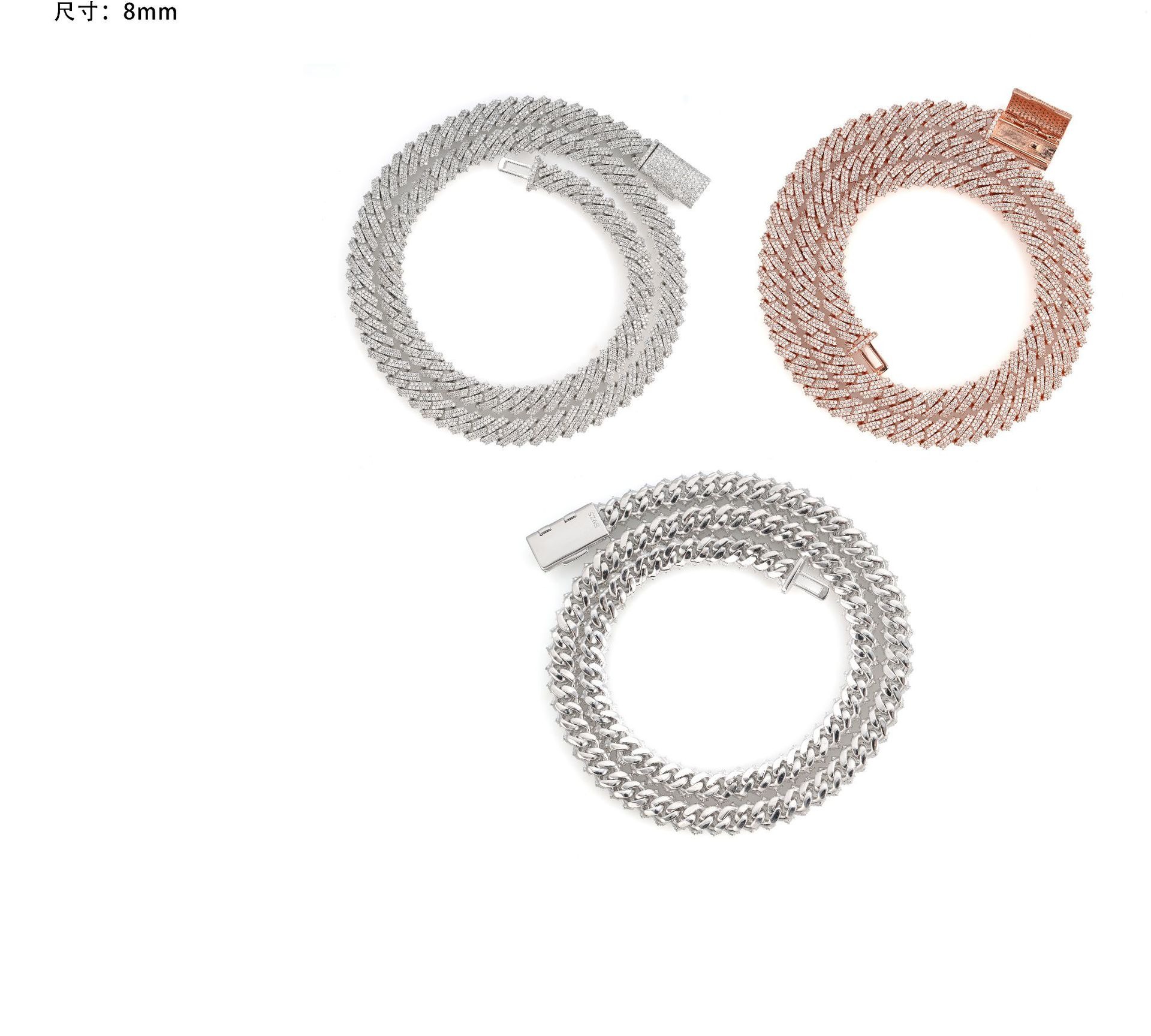
| Moissanite Cuban Link Chain — 8mm Double Row, 925 Silver | NOV-CH-9842 | $189 |
| Iced Out Moissanite Watch — Octagonal, Two-Tone Dial | NOV-WC-014 | $1,599 |
| Moissanite Cuban Link Chain — 18mm Fully Iced, 925 Silver | NOV-CH-9455 | $3,589 |
Codes are our own reference numbers, so you can point at one piece when you message us. Prices as of 11 October 2026, stones set, in 925 sterling silver.
Two things stand out from that table, and both are about arithmetic rather than taste. First, the price of a piece is set by how much setting work and how much stone surface is in it, not by the name of the material — the same silver carries a $29 earring and a $3,589 chain. Second, most of the decisions that matter happen below $200, where the differences are about size and design rather than quality: the $29 studs and the iced-out studs are the same stone and the same metal, and what separates them is diameter, stone count and how much of the ear they cover.

Where moissanite earns its money
Light. Dispersion is the number that decides how much colour a stone throws, and GIA measured 0.104 for synthetic moissanite against 0.044 for diamond (Gems & Gemology, Winter 1997). That is the physical reason a buyer describes the stone as having “blue flashes” in the same sentence as calling it brilliant. It is also why a moissanite piece can read as busier than a diamond in the same light — more fire is not only more, it is different.
Hardness. At about 9¼ on the Mohs scale (same study), silicon carbide sits below diamond and above essentially every other stone used in everyday jewellery. It does not need to be protected from the gym, a handbag or a jacket sleeve. Published figures for moissanite's hardness do vary slightly between sources — some quote 9.5 — but every one of them puts it just under diamond, and none of them puts it in the range where a stone scratches from ordinary wear.
Size for the money. This is the part that is genuinely hard to argue with, and it comes from the same GIA study: because moissanite's specific gravity is lower than diamond's (roughly 3.20–3.24 against 3.52), a stone cut to the same diameter and proportions weighs less. GIA's own example is a 6.5mm round brilliant: about 1.00 carat as a diamond, about 0.91 carat cut as synthetic moissanite. The face you see on the hand is the same either way. That is why comparisons by carat number mislead in both directions, and why we price in millimetres and by design rather than by carat weight.
And one thing it does not do. We do not publish a grading scale, because moissanite does not have one: GIA's lab note gives a stone's clarity as equivalent to a diamond grade only inside brackets, with the caveat that no such grades are assigned to synthetic moissanite (GIA, Fall 2020). Under US federal rules a diamond is defined as pure carbon with a hardness of 10 and a specific gravity of about 3.52 (16 CFR § 23.12(a)), and using the unqualified word “diamond” for anything that does not meet that definition is treated as unfair or deceptive (16 CFR § 23.12(b)). That is why this page names the stone in every sentence rather than reaching for a comparison it is not entitled to make.

Where it does not: the exit
Resale is the honest problem, and it is worth being precise about which part is the problem.
In jewellery, brand holds value, not material. The clearest public evidence comes from the secondhand trade itself: The RealReal's resale data, reported by National Jeweler in January 2021, showed the Van Cleef & Arpels Alhambra line reselling at an average 86 percent of original retail, Cartier's Love collection at 78 percent and Tiffany's T range at 69 percent. A piece that is recognised by name and searched for by name has a floor underneath it. A well-made piece from a small workshop does not — and that is true of it whether the stones in it are moissanite, cubic zirconia or diamond.
A laboratory-grown stone shows what happens to a lab-created one. Wholesale prices for laboratory-grown diamonds have fallen dramatically: the lab-grown wholesale price index published by analyst Edahn Golan declined 13 percent year over year in the Q2 2026 edition and is down 96 percent from July 2018, with 2-carat stones down 20 percent year over year (Edahn Golan, Q2 2026 Lab-Grown Wholesale Price List). That is a stone costing many times what moissanite costs, made in the same kind of facility, losing most of its wholesale value inside a few years.
And moissanite has no organised secondhand market at all. There is no published resale index for it that we are aware of, no trade body quoting it, and no line of buyers whose business is pricing used moissanite. If a seller offers you a resale percentage, ask what market it was measured in — we could not find one to quote, and we are not going to invent a number to make this page look better. Buy it the way you would buy a good jacket: because you will wear it a lot, not because it appreciates.
How it wears over five years
Two materials age at different speeds in the same piece. The stones will look the same in five years as the day they arrived; the metal is on a slower clock set by your habits.
- Stones. No tarnish, no clouding, no colour shift. The failure mode to avoid is mechanical: a knock that loosens a setting, which is why we set stones by hand under a microscope rather than rushing a field of pavé. Loose stones can be re-tightened; the stone itself is not the fragile part.
- 925 sterling silver. The silver can darken over time, especially where it touches skin, because tarnish is a reaction between the metal and sulphur in the air and on hands. It is not a defect and it does not mean the piece was sold wrong — it means it needs a wipe with a silver cloth before it goes back in the box.
- Plated finishes. A gold or rhodium layer wears first where something rubs: the inside of a ring band, the top edge of a chain link, the underside of a clasp. How long that takes depends on friction, not on the calendar. Where a rhodium layer is applied we disclose it, as 16 CFR § 23.7 requires.
- Pendants and earrings survive noticeably better than rings, for a simple reason: rings are worn against skin and against whatever your hands touch all day.
Two habits do most of the work: dry the piece before it goes away, and keep pavé out of a home ultrasonic cleaner, whose vibration can shake small stones loose. Whether the stone reads as diamond to other people is a different question and it is answered in هل يجتاز المويسانيت اختبار الألماس؟ — the short version is that a pocket thermal tester usually reads it as diamond, and that is a quirk of heat conductivity rather than proof of anything.

Against the other two stones
Cubic zirconia. Cheaper again, and softer — around 8.5 on the Mohs scale — and it clouds and dulls as it picks up oils and surface wear. On earrings worn occasionally it is fine. On a ring or a chain worn daily it is the reason people end up disappointed and think all lab-created stones look tired after a year. Moissanite is the differentiator there; the full comparison is in المويسانيت مقابل الزركون مقابل الألماس المخبري.
Laboratory-grown diamond. A category apart, and worth stating plainly so nobody buys the wrong thing: a laboratory-grown diamond is diamond — pure carbon, grown in a lab rather than mined, graded on the same scales as a mined stone. Moissanite is silicon carbide. They are not variations of one material and the difference is not a marketing distinction; the two-stone version of that comparison is in الألماس المخبري مقابل المويسانيت. Laboratory-grown diamond gives you the word diamond, a harder stone, and a much higher price that has been falling at the wholesale level for years.
If you want a third reference point, the difference between a workshop and a shop counter is a separate story, told with the same kind of arithmetic in Custom Jewelry Pricing — Direct Workshop vs Retail Store.
When a diamond is the better buy
We sell moissanite, and there are still situations where we would tell you to buy something else. Four of them:
- You may need the money back. If this purchase is partly financial — an engagement you might postpone, a piece you might sell — diamond has an infrastructure moissanite does not, and is the safer holding. Neither is an investment, but only one has a market.
- The stone has to be diamond to a jeweller, an insurer or a family. A bench jeweller identifying a stone will tell you it is moissanite, because it is; and an heirloom conversation is not a conversation you want to lose. If being diamond is the point of the piece, buy diamond and buy it once.
- You want a quiet stone. Moissanite's fire is its selling point and its loudest feature. If what you like about a diamond is that it is bright rather than colourful, this is the wrong material for you, and no amount of price advantage fixes taste.
- You are buying the smallest possible stone. Below a few millimetres the differences that matter to the eye get very small, and at that point a plain metal piece is often the better value than a stone set small enough to disappear.
Frequently asked questions
Is moissanite worth it?
For wearing, yes. In our own catalogue, a pair of moissanite stud earrings starts at $29 and the heaviest pieces reach $3,589 as of 11 October 2026, with the stones set and most of the line in 925 sterling silver. The material does not cloud or fade, it is hard enough for daily wear at about 9¼ on the Mohs scale against diamond's 10 (GIA, Gems & Gemology, Winter 1997), and it disperses light about 2.4 times as strongly as diamond. What it is not is an asset: there is no organised secondhand market for moissanite, so if getting money back later matters to you, a diamond is the more honest purchase.
Does moissanite hold its value?
No, and no seller should tell you otherwise. Moissanite has no organised resale market and no published secondhand price index that we are aware of, so any resale percentage quoted for it is somebody's estimate rather than a market price. In jewellery, what holds value is a recognised brand rather than a stone: The RealReal's resale data, reported by National Jeweler in January 2021, showed the Van Cleef & Arpels Alhambra line reselling at 86 percent of original retail, Cartier's Love collection at 78 percent and Tiffany's T range at 69 percent. Buy moissanite to wear it.
Does moissanite look cheap in person?
It does not look like glass, and it does not look like a diamond either, because it is its own material. GIA describes synthetic moissanite as a stone that can be mistaken for diamond because some of its properties approach diamond's, namely hardness and thermal conductivity, while others are quite different from diamond, such as a much higher dispersion, leading to more obvious fire, and double refraction (GIA, Gems & Gemology, Fall 2020). In practice that means more rainbow and more blue flashes than a diamond shows in the same light. Whether you like that is taste, not quality.
How long does moissanite last?
The stone lasts indefinitely. Silicon carbide is rated about 9¼ on the Mohs scale by GIA, just below diamond, and it does not cloud, fade or discolour with wear. The metal is what changes: the 925 sterling silver underneath a plated finish can darken over time and a rhodium or gold finish wears where it rubs, so a ring worn against skin daily will show more over five years than a pendant worn twice a month. Rhodium plated surfaces are disclosed on our listings, as 16 CFR 23.7 requires.
Is moissanite worth it compared with a laboratory-grown diamond?
They are different materials, so the comparison is not like for like. A laboratory-grown diamond is diamond, pure carbon grown in a lab instead of mined, and it is graded on the same scales as a mined stone. Moissanite is silicon carbide, an entirely different material with its own optics. Laboratory-grown diamonds cost many times what moissanite costs, and their wholesale prices have fallen hard: the lab-grown wholesale price index tracked by analyst Edahn Golan declined 13 percent year over year and is down 96 percent since July 2018 in the Q2 2026 edition. If you want the word diamond to be true, buy a laboratory-grown diamond. If you want the look and the wear without the price, moissanite is the stronger value.
How much does moissanite jewellery cost in your catalogue?
As of 11 October 2026: 251 pieces from $29 to $3,589. Earrings run $29 to $209 (78 pieces), pendants $29 to $1,749 (37), watches and watch pieces $149 to $1,599 (37), rings $49 to $585 (35), chains $79 to $3,589 (27), bracelets $79 to $539 (19), grillz $411 to $1,096 (9) and iced sunglasses $219 to $419 (9). Every price is the amount a customer pays, with the stones set.
Tell us the piece, the budget and the date
Send us the design you have in mind and what you want to spend, and we will quote it in 925 sterling silver with hand-set moissanite — the stone, the setting and the sizing in one price. If we think a piece is wrong for how you plan to wear it, we will say so before you pay.
اسأل على واتسابSources: US Federal Trade Commission jewelry rules, 16 CFR § 23.12(a) and (b) (definition of diamond; unqualified use of the word) and § 23.7 (disclosure of a rhodium surface layer); FTC, “In the Loupe: Advertising Diamond, Gemstones and Pearls” (thermal diamond testers may not accurately identify moissanite, which may falsely register as a diamond); Gemological Institute of America, “Synthetic Moissanite: A New Diamond Substitute”, Gems & Gemology, Winter 1997 (Mohs hardness about 9¼; dispersion 0.104 against diamond's 0.044; specific gravity roughly 3.20–3.24 against diamond's 3.52; a 6.5mm round brilliant weighing about 1.00 ct as diamond and about 0.91 ct as synthetic moissanite); Gemological Institute of America, Gems & Gemology lab notes, Fall 2020, “Synthetic Moissanite with Fraudulent GIA Inscription” (moissanite can be mistaken for diamond because hardness and thermal conductivity approach diamond's, while dispersion and double refraction are quite different; no clarity grades assigned to synthetic moissanite); Edahn Golan, “After a 96% Decline, What's Next for Lab-Grown Diamond Prices? The Q2 2026 LGD Wholesale Price List” (index down 13 percent year over year and 96 percent since July 2018; 2-carat stones down 20 percent year over year), checked 11 October 2026; National Jeweler, “Find Out Which Jewelry and Watch Brands Boast the Highest Resale Value”, reporting The RealReal's 2021 resale report (data for 2020), published January 2021. Prices in this article are our own catalogue prices as of 11 October 2026 in USD and are the amounts a customer pays, stones set, in 925 sterling silver.
Start With One Piece
Made to order in our Guangzhou atelier — 925 sterling silver, hand-set moissanite, built to the size you ask for.


Where these pieces come from
Everything here is made and set on our own bench in Guangzhou — 925 sterling silver and moissanite, with gold-tone plated alloy watch cases where the listing says so. If you are buying for a store, a brand or a reseller, the wholesale pages carry the minimums, lead times and terms:
- Cuban link chains — wholesale
- Moissanite jewelry — wholesale
- Custom iced out watches — wholesale
- Private label & brand manufacturing
Retail pieces in the same workshop: 16mm Cuban link chain · 18mm iced Cuban chain · RAM iced out pendant · Iced out square-case watch